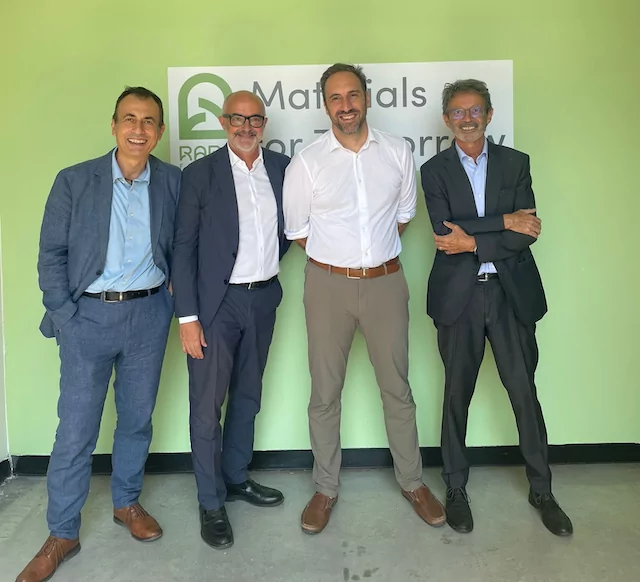
Rara Factory, a deeptech spin-off from Ca’ Foscari University in Venice that accelerates the discovery of new alternative materials to rare earths through physics-driven artificial intelligence, has announced that it has raised €3.2 million in its seed investment round. The operation was supported by Primo Capital, through the Primo Climate fund, CDP Venture Capital through the Accelerators Fund, and a group of business angels led by Alberto Baban, president of Fondazione Nord Est.
The capital injection will enable the expansion of Rara Factory’s high-throughput experimental capabilities through targeted investments in laboratory infrastructure and advanced instrumentation for the synthesis and comprehensive characterisation of new alternative materials for industrial applications in strategic sectors such as energy, mobility and aerospace, removing dependence on rare earths and other critical materials.
Founded in 2024 by four professors from Ca’ Foscari University, this innovative Venice-based company has developed a proprietary platform that integrates artificial intelligence with experimental materials physics. Unlike purely computational approaches, scientists generate real experimental data on a large scale, enabling rapid cycles of iteration and validation. To date, nearly 10,000 new materials have been created and tested, forming the basis for training AI models. In 2024, it was selected as one of five start-ups to participate in the Motor Valley Accelerator in Modena, the CDP Venture Capital National Accelerator Network programme dedicated to start-ups developing solutions for the automotive and mobility sectors, with Plug and Play Tech Centre, UniCredit and Fondazione di Modena as co-investors, confirming its status as one of the most promising companies in the programme.
Rara Factory has already secured its first commercial contract and signed collaboration agreements with leading Italian and international companies. This round of investment will support rapid technological development and business expansion towards strategic partnerships and the commercialisation of solutions.
“We created Rara Factory to innovate and make the process of discovering new materials more systematic and efficient, finally bringing it to real industrial implementation,” says Stefano Bonetti, founder and professor of experimental physics of matter, in a statement (pictured with the team). “By combining physics-driven AI and large-scale experimental validation, we aim to design and optimise new materials in a matter of days rather than years.”
“With over a hundred materials synthesised and characterised every day, measuring all the properties relevant to industrial use, we have provided a scientific answer for a concrete industrial application. Our proprietary dataset will soon be ready to respond to the growing demand for alternatives to rare earths and other critical raw materials in strategic industrial sectors, says Michele Bugliesi, founder, professor of computer science and former rector of Ca’ Foscari University.
The acceleration of the energy and industrial transition is generating unprecedented demand for new materials, often characterised by limited availability, critical extraction processes and complex global supply chains. Innovation in materials has therefore become an urgent strategic imperative for both economic resilience and environmental sustainability.
The lack of high-quality experimental data has been one of the main causes of limited innovation in materials, according to Giusy Cannone, partner at Primo Climate: “Rara Factory’s ability to generate large-scale proprietary datasets based on physics and real experiments is a highly distinctive feature. This innovative solution is a key asset for strengthening Italian and European economic competitiveness and strategic independence.”
“Rara Factory is a shining example of collaboration between research and industry,” adds Stefano Molino, head of CDP Venture Capital’s Accelerator Fund. “The project has the potential to strengthen the national ecosystem of advanced materials and generate long-term industrial impact.”
ALL RIGHTS RESERVED ©