Table of contents
- Generative Bionics on the AMD main stage
- The Italian mission, institutional coordination and territories
- Comparision with Asian delegations
- Italian technologies on display
- Area Science Park and Deep Tech Revolution
- Humanoid robotics, two approaches
- International technologies, neurotech and domestic AI
- Italian automotive presence
- Conclusions
CES 2026 opens with figures that confirm its role as the world’s leading technology showcase: over 4,300 exhibitors, 1,200 start-ups at Eureka Park and 148,000 visitors from every continent. Against this backdrop, national delegations are taking on increasing importance, transforming the fair into an opportunity for ecosystems and industrial strategies to come together.
Italy is represented by 51 start-ups from 13 regions, the largest delegation ever. This presence is alongside that of other structured entities: the 31 Japanese start-ups coordinated by JETRO for the Tokyo Metropolitan Government and the 57 Taiwanese start-ups from the National Science and Technology Council, which consolidate Taiwan’s role as ‘AI Island’.
South Korea is on a different level, with over 450 start-ups focused on robotics and consumer electronics, reflecting an industrial strategy based on scale and integration with large national technology conglomerates.
Generative Bionics on the AMD main stage
AMD’s opening keynote featured Daniele Pucci, CEO of Generative Bionics, who presented GENE.01 alongside Lisa Su. The humanoid robot, developed using technologies from the Italian Institute of Technology, represents the Physical AI approach: intelligence distributed throughout the body via full-body tactile skin with force and contact sensors integrated across the entire surface.
Generative Bionics closed a €70 million funding round in December led by CDP Venture Capital, with participation from AMD Ventures, Duferco, Eni Next, RoboIT and Tether. AMD provides CPUs, GPUs and FPGA-based embedded platforms for real-time computing on board the robot. The roadmap calls for launch in the second half of 2026, with a focus on complex industrial environments.
The Italian mission, institutional coordination and territories
The Italian pavilion is coordinated by ICE, the Italian Trade Agency, with the slogan “Inspired by legacy, designed by vision”. Italy’s presence at CES 2026 sets a new record: 51 start-ups from 13 regions.
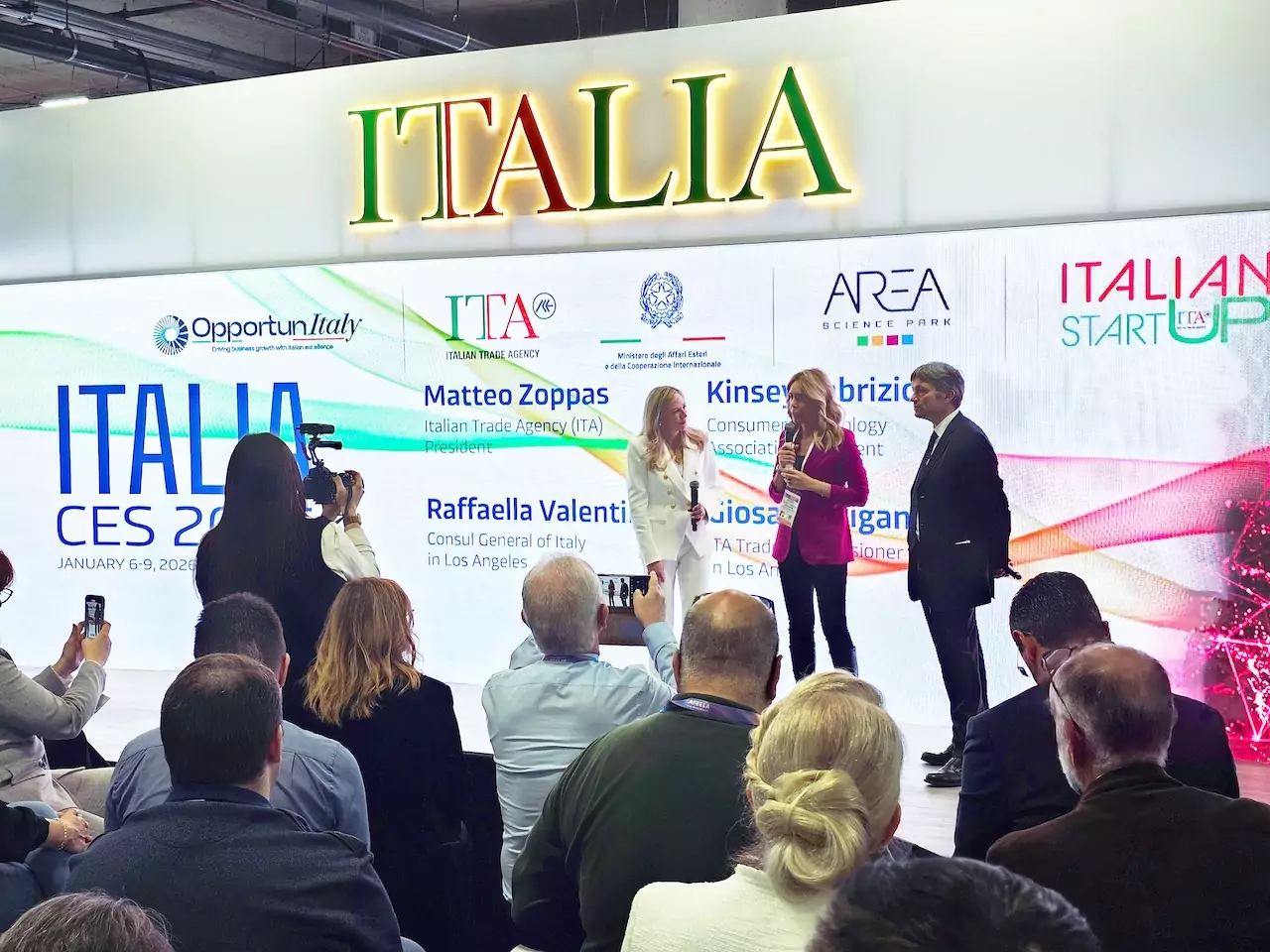
During the opening ceremony, ICE Agency President Matteo Zoppas emphasised the value of innovation as a competitive lever. “Research and development means increasing our ability to win competitively,” he said, thanking “Italian companies, entrepreneurs and start-ups” present in Las Vegas. Zoppas linked the competitiveness of Italian-made products to the ability to innovate: “Italian-made products are growing because we are chosen every day over other products. Because we innovate, because we have innovative DNA.”
The Italian Consul General in Los Angeles, Raffaella Valentini, also spoke, emphasising the qualitative growth of the Italian delegation: “This is my third time here at CES, and every year I am increasingly impressed by the quality and vision of the start-ups, and this year the quality is even higher.” Valentini also referred to the European context: “We are proud to be part of the European Union as a founding country. The European Union is a leading player in technology and innovation.”
The ceremony was attended by Kinsey Fabrizio, president of the Consumer Technology Association, and Giosafat Riganò, Trade Commissioner of the ICE Office in Los Angeles.
The largest delegations come from Lazio and Lombardy, with a strong presence from Veneto and Puglia. The Friuli-Venezia Giulia region, classified as a ‘Strong Innovator’ by the European Commission, is also participating. The Italian presence includes collaboration with Innovit (Italian Innovation and Culture Hub in San Francisco) and WMF (WeMakeFuture).
Comparision with Asian delegations
Japan brings 31 start-ups focused on Urban AI and sustainability, with daily pitches in the JETRO pavilion. Taiwan has 57 start-ups focused on edge computing and AI hardware, leveraging its position in the semiconductor value chain. South Korea has over 450 start-ups working on personal robotics and consumer electronics, bolstered by the presence of Samsung and LG.
“CES 2026 showed how quickly physical AI is moving from research to real-world applications,” noted Yoshimura Keiichi, Director General of Startup Policy at the Tokyo Metropolitan Government, emphasising how countries and cities must leverage their unique characteristics and focus on strategic partnerships to accelerate innovation.
Tokyo participated for the first time with a booth dedicated to SusHi Tech, using CES as a global platform to promote a vision of sustainable urban innovation, accompanied by a side event on the entertainment industry.
In comparison with Italy, Yoshimura highlighted the growing role of the Italian delegation: “The Italian Pavilion stood out for its size and energy,” he said, adding that “meeting again at CES after previous meetings in Helsinki and Tokyo demonstrates the value of ongoing collaboration between ecosystems.”
The strategies reflect different development models: while some delegations focus on scale and industrial diffusion, others, such as Italy, concentrate on highly complex technological verticals, where competitiveness depends on advanced engineering, certification and reliability in critical contexts.
Italian technologies on display
D-Air Lab presents Aether, an ultra-lightweight, intelligent airbag system. The device opens and inflates in the event of a fall, using three proprietary technologies: Wing (safer gas cartridge), Ribs (lightweight, ventilated protection) and Brain (intelligent control module connected to the D-Alert app for emergency alerts).
SunCubes brings an on-demand laser charging system for wireless sensors: a ground-based platform designed to wirelessly power sensor networks in urban and industrial environments, compatible with CCTV cameras, air quality monitors and environmental sensors, eliminating manual battery replacements.
Tinental presents Caleno, a solution that optimises fluid mechanical machines such as pumps and fans through AI and IoT. With a zero-Capex model, it has demonstrated up to 60% energy and CO2 savings while maintaining the same production output.
MLR brings the WuvDay platform for digital content certification: every photo and video recorded via the app is instantly certified, guaranteeing authenticity and proof of origin in the context of disinformation and deepfakes.
WhoTeach presents an AI-based B2B digital learning platform The key strength is WhoSlides, an AI generative module that supports the creation of accurate educational content using multi-agent AI workflows and reliable sources, producing presentations that can be exported to PowerPoint and Google Slides.
Icarus develops an AI voice assistant that handles incoming phone calls for healthcare providers, answering every call, understanding patient requests and automatically creating structured tickets on a cloud platform.
Other participants included: IntelligEarth with ProteGO (an AI platform for infrastructure inspections with 70% cost reduction), Beadroots (superabsorbent polymers from algae with up to 80% water savings in agriculture), Agade (semi-active AI exoskeleton for heavy lifting), Oraigo (neurotechnology to prevent driver fatigue), Koale (ecosystem for decentralised energy communities), Myndoor (AI for mental wellbeing, undergoing MDR Class IIa certification).
Area Science Park and Deep Tech Revolution
For the ninth consecutive year, Area Science Park is working alongside the Italian Trade Agency (ICE) to organise the pavilion. Many start-ups have a marked deep tech footprint, with highly scientific solutions ranging from life sciences to new materials, energy technologies and advanced digital technologies.
During CES week, the first phase of “Deep Tech Revolution” will be completed, a €1 million programme for innovative high-tech projects. The five winners, to be announced in January, will receive funding and direct access to the organisation’s technological platforms, ranging from genomics to advanced microscopy.
Humanoid robotics, two approaches
While Generative Bionics presented the GENE.01 concept on the AMD main stage, Oversonic Robotics gave live demonstrations of RoBee, described as the only humanoid robot certified for industrial and medical use. The demonstrations were held at the Intel pavilion (Venetian Resort) and at the STMicroelectronics exhibition.
RoBee comes in two versions: the R series for industrial use (height up to 200 cm, load capacity up to 180 kg) and the M series for healthcare environments (175 cm, 80 kg). Unlike GENE.01, RoBee is already operational in Italian companies and integrated into hospital trials. Two different approaches: immediate operational maturity versus a long-term vision of distributed physical AI.
International technologies, neurotech and domestic AI
In the French pavilion, Abeye presents Lexilens Screen, the first “neurovisual wellbeing” screen for consumers. The technology integrates neurovisual filters into a full HD monitor to reduce “neurovisual crowding”, interference in the processing of visual signals that causes fatigue. The system modulates visual input in real time. Users of Lexilens Smart Glasses (over 6,000 in 44 countries) report a satisfaction rate of 92%.
Dassault Systèmes presents Step Inside Alzheimer’s: an immersive experience that shows how 3D Univ+Rses combines AI, virtual patient twins and real-time sensors. Visitors navigate between city, home, person and virtual brain from three perspectives (patient, carer, researcher), observing how bodily signals, smart home data and research connect in dynamic feedback loops.
LG Electronics presents the LG CLOiD domestic robot, designed for household chores and based on the vision of zero labour at home, making quality time. Two motorised articulated arms with five fingers for precise motor control, processor with artificial intelligence for natural communication.
Samsung held its Tech Forum at Wynn Las Vegas with four panels: open ecosystems and AI with Yoonho Choi, security and privacy with Shin Baik, the future of FAST streaming with Salek Brodsky, and the human side of technology with Mauro Porcini (chief design officer, DX division).
Italian automotive presence
In the West Hall, the ICE Office in Chicago is coordinating a space with ANFIA, Politecnico di Milano, Stellantis and Eldor. The star attraction is a self-driving Fiat 500e with a robo-driver from the Politecnico di Milano (AIDA project). Eldor is exhibiting automotive products: ECU control units, ignition coils, high-power charging sockets for electric vehicles and CO2 reduction solutions.
Conclusions
CES 2026 confirms dominant trends: multimodal AI agents, personal and industrial robotics, neuro-interfaces, digital certification systems. National delegations show differentiated strategies: South Korea and Japan focus on consumer electronics and urban tech, Taiwan on hardware and semiconductors, Italy on high-barrier technology verticals such as industrial physical AI, content authentication, and energy optimisation.
The Italian presence highlights coordination between institutions, territories and start-ups, with strategic partnerships (AMD, Intel, STMicroelectronics) and significant funding (70 million round for Generative Bionics). The growth of the delegation (51 start-ups compared to around 46 last year) and geographical diversification (13 regions) signal the maturation of the ecosystem.
Discussions with other delegations suggest possible collaborations on urban tech with Tokyo, hardware with Taiwan, and European programmes such as the European Chips Act for technological sovereignty in semiconductors.
ALL RIGHTS RESERVED ©