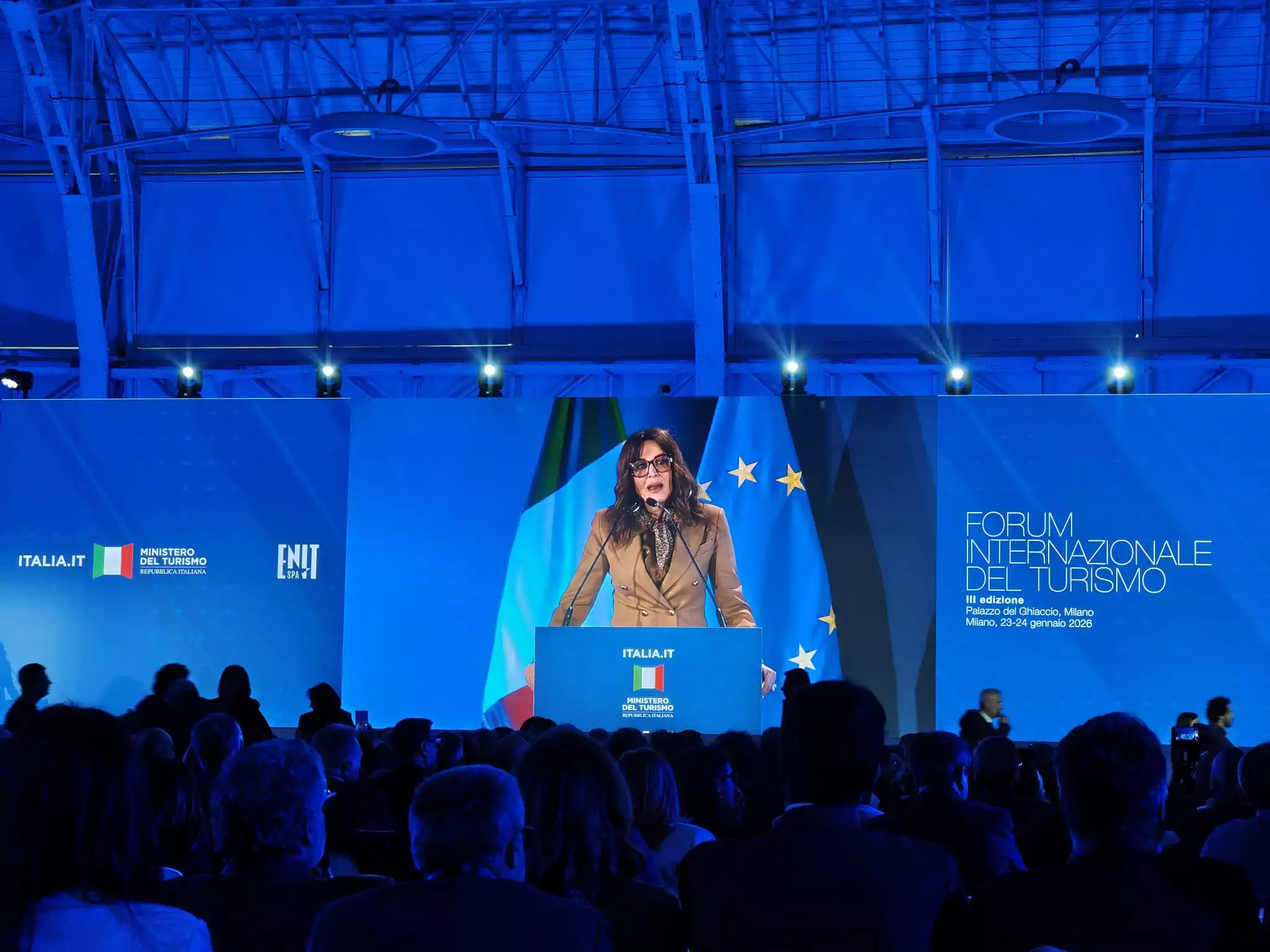
The third edition of the International Tourism Forum was held at the Palazzo del Ghiaccio in Milan. This choice was motivated by many factors, not least the imminent start of the Winter Olympics, but also by the awareness that the sector needs to take on an increasingly industrial character. Tourism Minister Daniela Garnero Santanchè emphasised that 2026 must be the year of the ‘Italian model’, an approach based on the results of 2025: 480 million visitors, €237.4 billion in value generated with expenditure of €185 billion, with an increase even in small municipalities of 6.85% in terms of visitors and 7.86% in terms of arrivals.
The model for 2026 is based on three strands, says the minister: the fight against small-scale operations, a series of tools to facilitate aggregation between businesses, especially hotels, for the next 24 months, with incentives for the facilitated revaluation of assets. Transformation of the tourism sector into a fully-fledged industry: tourism cannot be considered a service but is an industrial sector in its own right and, as such, must be considered when conducting market analyses, taking into account turnover rather than visitor numbers or arrivals (for example, in situations such as the Jubilee, there are many arrivals but pilgrims are low-spending, so the turnover they generate is limited compared to the high number of people) and it must also be considered in regional, national and European policies, which still provide very few structural funds to support tourism precisely because it is seen as a service and not as an industrial sector. A 10% reduction in taxation with the obligation that this money be used for employees in the form of incentives, bonuses and welfare, because we need to move away from the logic of precarious and seasonal employment without additional support. The dignity of those working in the sector must be protected in the same way as that of workers in other industrial sectors.
In this regard, the minister points out that measures have already been implemented, such as the tax exemption on tips, which has resulted in an average increase in pay of around €1,000 per year, and reduced social security contributions for work on public holidays and at night. which is also a sign of awareness of the specific nature of the tourism sector, which has unique dynamics compared to other areas, and the creation of accommodation for workers in the sector, especially in those locations where costs are high but which cannot be passed on to workers who would otherwise have no interest, convenience or real opportunity to take advantage of certain opportunities. In 2022, tourism employed 2.7 million people in Italy, rising to 3.2 million in 2025 and, according to the Ministry’s forecasts based on those of the WTTC Report, reaching 3.7 million in 2035.
The strategy also includes actions aimed at limiting the effects of seasonality and broadening opportunities throughout the year, including a reorganisation of the school calendar in order to break away from the pattern of a very strong summer period and a weaker rest of the year. It also includes actions to significantly extend the territorial scope of tourism, given that today 75% of tourists arriving in Italy stay in 4% of the country, meaning they are extremely concentrated in a few destinations. For example, the top 10 Italian municipalities alone account for 25% of total tourist arrivals, and the city of Rome alone accounts for 8% of the total. It is therefore planned to invest €34 million for the benefit of small municipalities with a tourist vocation, an investment that the ministry estimates could have an economic impact of over €100 million. This approach, called ‘undertourism’ to differentiate it from the concept of overtourism, also includes investments of €75 million for creative cities and UNESCO sites, interventions on smaller islands and inland areas for €6 million, and a promotional campaign in the territory, as well as €60 million of national cohesion resources dedicated to projects to improve the quality of tourist destinations. The focus is therefore on the so-called ‘minor’ Italy, with villages to discover and explore, opportunities to create jobs for young people, the promotion of cuisine and the experience of the Olympics, the first decentralised or widespread games in history, which represent a model for those who will come after, a model that the French have already adopted for the next Winter Games to be held in the French Alps. During the Games, 2 million visitors are expected in the five provinces involved in the competitions: Milan, Sondrio, Trento, Bolzano and Belluno, with long-term benefits in terms of substantial growth in visitor numbers and turnover of up to €1 billion by 2030, with 9 million visitors expected between 2027 and 2030. Finally, it should be noted that today’s tourists are also looking for wellness, shopping, food and wine, events, history, outdoor activities, walking trails, museums and culture, all areas in which the country certainly has a lot to offer.
“We also need to work on administrative efficiency and bureaucratic processes,” says Santanchè. “My ministry also needs to improve. We still spend too much time paying, for example. We need to ensure that the public sector works at the same speed as the market and the private sector.” The Olympics are an opportunity: “I continue to hear many detractors, but the Games are an opportunity for the country. Billions of people will be watching us, and we must be able to demonstrate that Italy’s know-how is active and produces results. These events also serve as accelerators for the development and construction of infrastructure that will remain and bring value in the long term.”
Then there is the concept of the supply chain to consider. The tourism industry has repercussions in other areas. Take mountain tourism, for example, which has an impact on those who produce clothing, equipment, facilities, services and insurance. Mountains are so fundamental to strategies that the International Mountain Tourism Forum will be held in October 2026.
Research presented by Numbers shows that in 2025, €185 billion was spent on tourism, of which over €60 billion came from foreign tourists. Bari, Bergamo, Como, Lecce, and Trieste are the five cities where tourism has grown the most in the last 10 years, while Rimini, Venice, Bolzano, Livorno, and Naples are the provinces with the highest rates of tourist overcrowding. Curiously, Milan ranks sixth, with over 11,000 tourists per square metre, compared to 8,800 in Rome. The research also highlights how the media phenomenon has direct effects, citing TV series that have increased the popularity of places such as Taormina and actions carried out through social media that have led to uncontrolled phenomena, as happened with Roccaraso. Overtourism must be controlled, and there are already examples of this, such as the use of quotas in Pompeii or entrance fees in Venice, but it also brings benefits such as support for the local economy, promotion of places, a drive to improve places and build infrastructure, increased control measures in the area with a consequent reduction in crime, care for historic centres, and an increase in the number of cultural events. Undertourism, on the other hand, is something that should be encouraged by developing systems that provide information on routes and connections to reach destinations, developing accommodation facilities that are often lacking, and adjusting costs and logistical flexibility so that the difference with more famous centres is not too great and is within everyone’s reach.
In such a broad and changing context, there is no shortage of opportunities for start-ups, especially those in the traveltech sector, which are often able to anticipate certain emerging needs and provide technological tools to make transport, experiences, accommodation, and access to local culture and cuisine more easily accessible. At the International Tourism Forum, the presence of start-ups was not very visible. The various panels that animated the two-day event saw many mayors of small towns and representatives of companies such as Italianway and EasyJet, as well as local institutions such as the mayor of Milan and the president of the Lombardy Region, in addition to organisations involved in the organisation of the Milan Cortina 2026 Winter Olympic and Paralympic Games. However, there were few start-ups. Technological innovation and business models require greater attention and support because they are key to the future of the tourism industry in Italy, which is one of the pillars of the country’s economy and social development.
ALL RIGHTS RESERVED ©