VivaTech, the European event held in Paris (from 17 to 20 June 2026) dedicated to start-ups and technology, presents the second edition of the ‘Top 100 Emerging European Start-ups’ ranking, which highlights the 100 most promising start-ups in the European technology ecosystem, active in various sectors. Coming from 12 countries, they stand out for their potential impact on their respective sectors and their rapid growth.
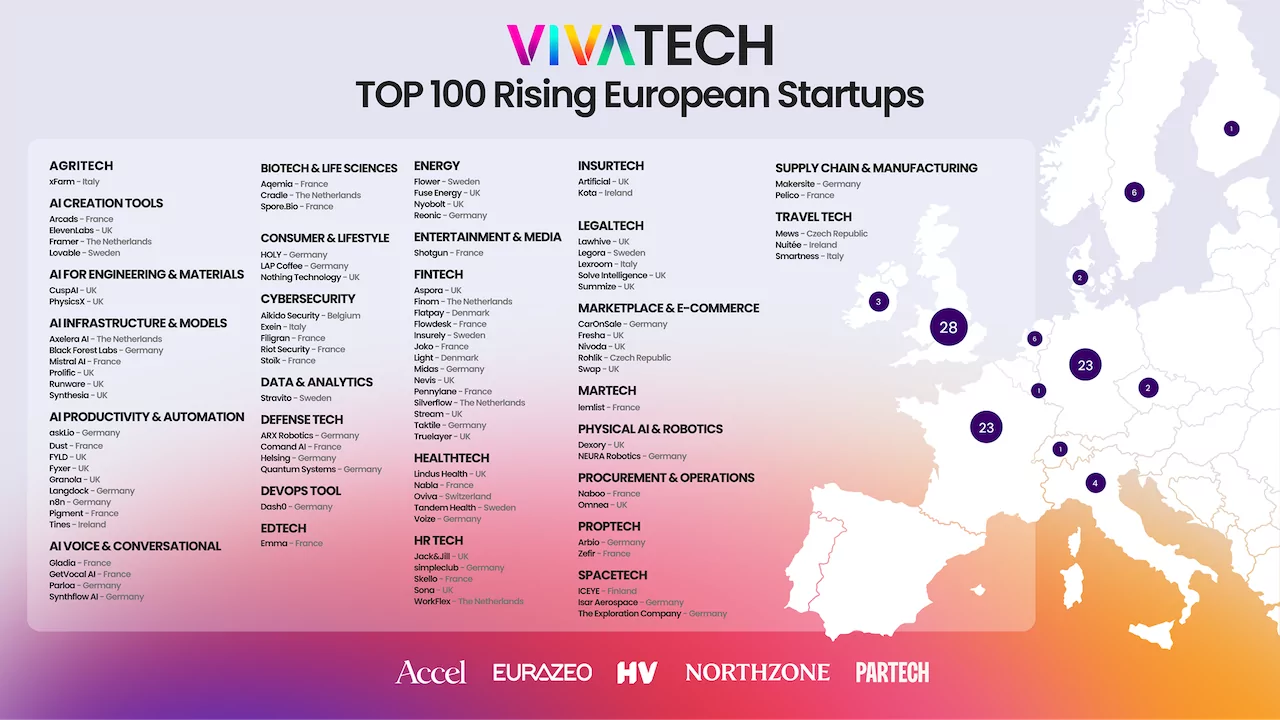
In 2026, the European start-up ecosystem continues to become increasingly diverse and specialised. The ranking of the “Top 100 Emerging European Start-ups” spans 28 sectors and has undergone a major overhaul, with 70 new entries and 30 start-ups that were already present last year. The ranking also reveals a geographical leadership: the UK-France-Germany trio accounts for 74% of the startups on the list: 28 in the UK, 23 in France and 23 in Germany. The Nordic countries (Sweden, Finland, Denmark) lead in the AI and climatetech sectors, while Italy stands out in legaltech and agritech.
According to a statement by François Bitouzet, managing director of VivaTech, “This year, technological sovereignty is the common thread running through the Top 100, and it is particularly evident in the cybersecurity and technological defence sectors. The rise of Mistral AI against the American giants is one of the most obvious examples of this phenomenon. This dynamic marks a strategic turning point, with Europe investing significant resources to gain leadership and sovereignty in key technologies.”
Key trends in 2026
- The era of “generic AI” is over, paving the way for integration and specialisation by area of use.
Artificial intelligence is becoming more vertical, and European start-ups are specialising in specific use cases: content creation (four start-ups in the ranking, including ElevenLabs and Lovable), voice and conversational (four start-ups, including Parloa and GetVocal AI) and productivity and automation (nine start-ups, including Dust, Langdock and n8n). This dynamic is based on solid European technological foundations (Mistral AI, Axelera AI, Synthesia) and confirms a paradigm shift: the European ecosystem no longer develops AI for its own sake, but innovates in applications, integration and specialisation for specific use cases.
- The great comeback of hardware
After a decade dominated by software, hardware and the physical industry are returning to Europe. Physical AI (Neura, Dexory) demonstrates the convergence between artificial intelligence and autonomous robotics. The space industry is also becoming more industrialised thanks to new players (The Exploration Company, ICEYE, Isar Aerospace), while defence tech is emerging as a strategic sector (Helsing, ARX, Quantum Systems, Comand AI). Driven by these dynamics, Europe is embarking on a technological reindustrialisation linked to issues of sovereignty and industrial competitiveness.

- The European fintech sector reaches maturity
The fintech sector continues to be a pillar of European innovation. Today, the sector goes beyond the world of neobanks, focusing on ‘invisible’ and specialised infrastructures. Financial rails (Truelayer, Silverflow), embedded finance (Taktile, Flatpay) and open finance (Insurely) are gaining ground, with models shifting from B2C to B2B2C. This evolution is accompanied by a Europeanisation of payment infrastructures in the face of American and Chinese giants: European fintech is now building the financial backend/back office of the future.
- Regulated sectors are moving towards AI
The boom in legaltech (five start-ups, including Lawhive, Summize and Solve Intelligence); the transformation of healthtech through clinical AI (Nabla, Voize and Tandem); and the modernisation of HRtech (Skello, Sona and Jack&Jill) are accelerating the opening up of the most regulated sectors to intelligent automation. Insurtech (Kota, Artificial) and edtech (Emma) are also integrating this new technology. In 2026, innovation is no longer confined to tech-native companies: AI is making inroads into areas where compliance, regulation and the human factor were previously considered obstacles.
- Cybersecurity, an essential lever for protecting businesses, local authorities and individuals
In a context where the acceleration of artificial intelligence and the emergence of quantum computing pose new challenges for security, five start-ups contributing to European sovereignty feature in the ranking: Aikido Security (Belgium), Stoïk (France), Riot Security (France), Filigran (France) and Exein (Italy).

Selection criteria
The selection of the 100 start-ups was carried out with the help and in collaboration with five of the world’s largest investment funds: Accel, Eurazeo, HV Capital, Northzone and Partech. Each startup in the ranking meets the following criteria: based in Europe; demonstration of innovation capable of transforming its sector; annual recurring revenue (ARR) of at least €5 million in 2025; annual growth of at least 40% over the last three years.
ALL RIGHTS RESERVED ©