Table of contents
In 2026, it is anachronistic to talk about technological transformation in industry solely in terms of chips and sensors. As a designer, I know that the real challenge is not to make a technology work, but to make it transparent. Today, users no longer want to learn how to use a product; they expect the product to speak their language, to adapt to their context, and for the interaction to be as fluid and natural as an everyday gesture.
The failure of the ‘works on paper’ approach
A few weeks ago, an HSE manager at a major industrial firm confided in me about his frustration with a new safety device: technically flawless, but completely ignored by the operators.
The reason? Cognitive friction. A device that requires extra steps or disrupts the workflow isn’t a solution; it’s an obstacle. In my career, I have seen too many projects fail not because of engineering limitations, but because they failed to incorporate the actual user experience. We have worked with companies that had vast amounts of unused data: the technology was there, but the relational ‘bridge’ between the information and those who have to make decisions in a fraction of a second was missing.
The era of physical AI, complex systems, simple interactions
The paradigm is changing radically. Thanks to physical AI, technology is stepping out from behind screens and entering the physical world in an intelligent way. We are no longer talking merely about graphical user interfaces (GUIs), but about systems capable of sensing, reasoning and acting alongside us.
- Support agents: imagine complex industrial settings where the operator no longer needs to query a database, but is supported by intelligent agents that anticipate their needs.
- Naturalness: through voice, gesture or augmented vision, interaction becomes multimodal.
- Value automation: repetitive tasks such as reporting are handled by the system, freeing up staff time for high-value-added activities.
“Today, industrial users have the same expectations as consumers: if the user experience isn’t intuitive, the system is rejected. The real competitive advantage isn’t the functionality, but the friction (or rather, the lack of it).”
Designing with intention, not just function
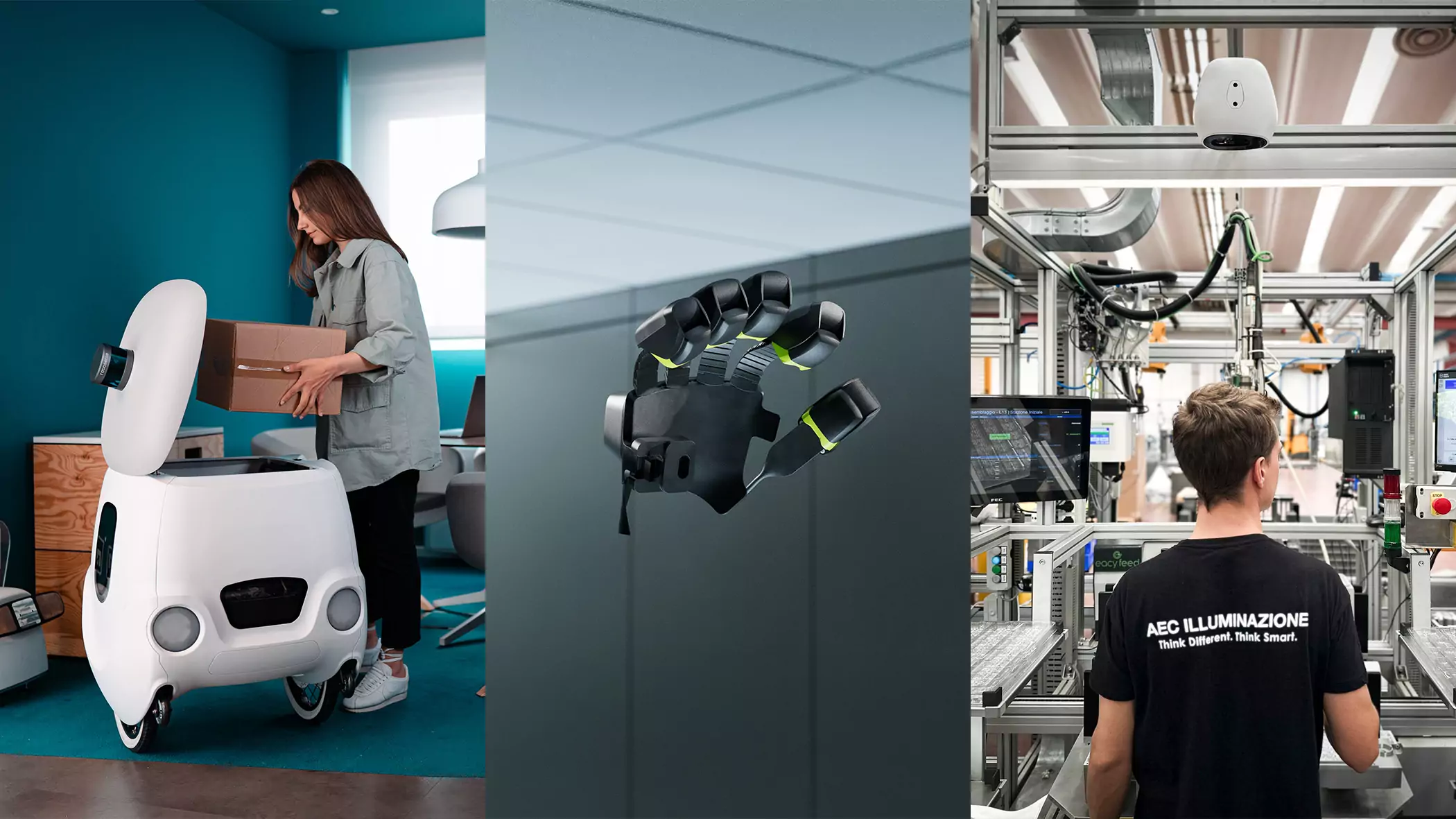
Industry 5.0 puts people at the heart of the process, but it is design that brings this commitment to life. At e-Novia, we have been applying this principle for over ten years. We do not design machines, but ecosystems in which technology is embedded within human behaviour.
It is this approach that has given rise to companies such as Weart, Smart Robots and YAPE, and which guides our collaborations with partners such as Mutti and Brembo. With Brembo, the challenge was not to provide motorcyclists with more telemetry data; they already had too much of it. The challenge lay in the delivery of the information: how could we make that data useful and accessible whilst riding? From this analysis of real-world behaviour came TrackTribe, a product that adds value, not noise.
Transformation is an act of design
SMEs and large companies often hesitate to innovate because they fear the uncertainty surrounding the return on investment. But the greatest risk is investing in tools that nobody will use.
Technological transformation is not achieved by adopting the latest AI trend, but by designing products that people want to use because they make their work easier, safer and more natural. The future of industry is not about tools, but about seamless interactions between humans and intelligent systems.
Note to the reader: the author is Head of Product Design at e-Novia
ALL RIGHTS RESERVED ©