Try saying “Amazon” out loud.
What are you thinking about?
Almost certainly not the forest. Not the river. Not the 10 out of 100 species that still have no name and live there.
Think about parcels. Think about 24-hour delivery. Think about your shopping basket.
That is the problem. And also the challenge.
In 1541, Francisco de Orellana crossed the great South American river for the first time. During his journey, he spoke of warrior women among the local tribes. He likened them to the Amazons of Greek mythology. It was from this account—not from the geography—that the name ‘Amazon River’ originated.
The name doesn’t come from the map. It comes from the imagination.
Then, in 1994, Jeff Bezos set up an online marketplace and called it Amazon. He chose the name because he wanted it to evoke grandeur, abundance and vastness.
The result? Today, if you search for “Amazon” on Google, you won’t find the forest.
The market has appropriated a symbol. It has stripped it of its meaning. It has filled it with something else.
It’s not a legal issue. It’s a matter of the collective imagination. Of mental geographies.
One statistic that is more striking than any analysis: 65% of Brazilians have never seen the Amazon.
We are talking about a country that is home to around 60% of the world’s largest rainforest. You literally fly right over it — on your way elsewhere, often to the US — without stopping.
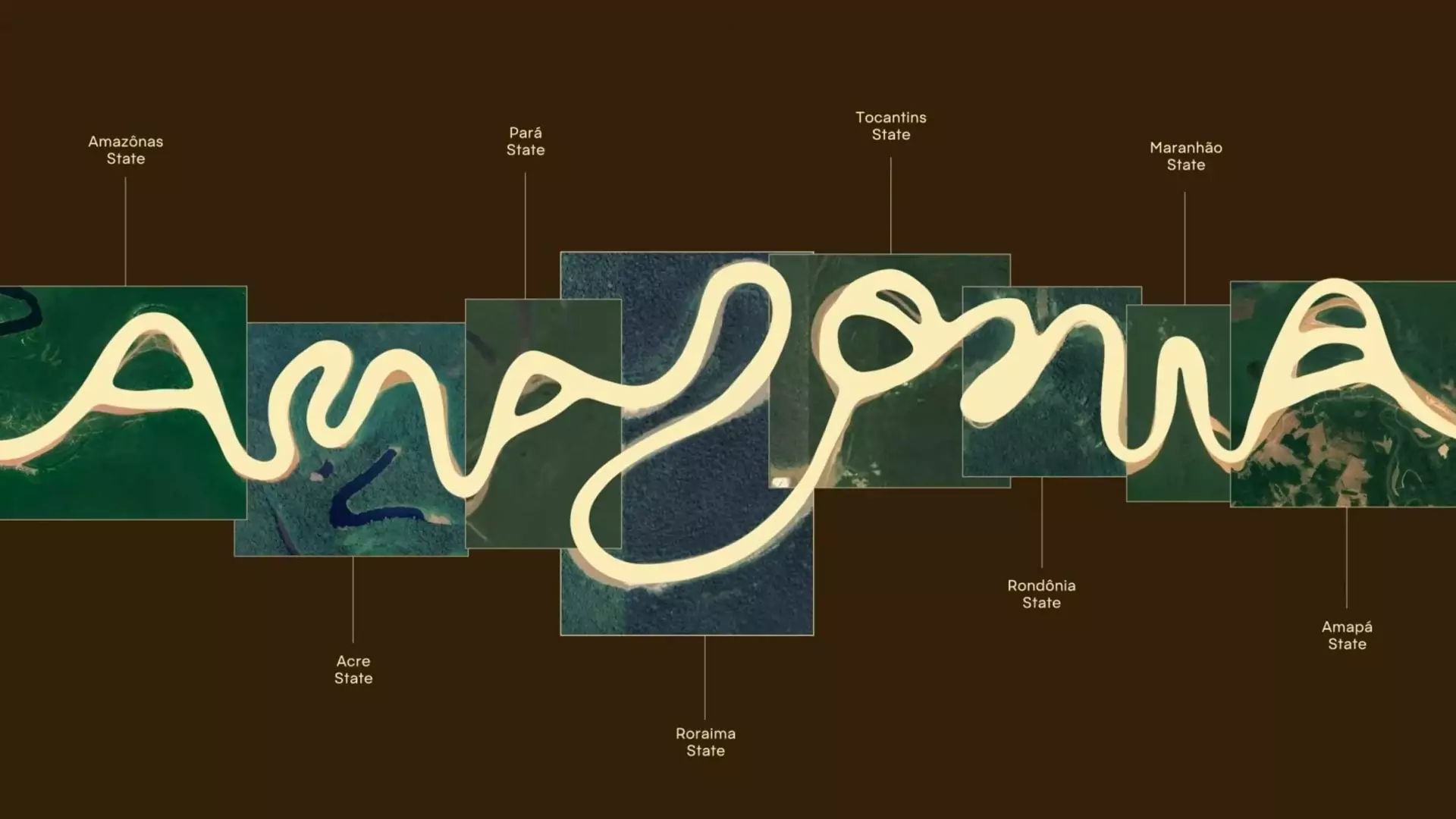
The Amazon is divided across nine of Brazil’s twenty-seven states, each with its own distinct culture and a strong sense of identity, yet with little connection between them. For years, it has spoken to the world in a sporadic, disjointed manner. As if it were unaware that it is the most extraordinary place on the planet.
The problem isn’t the substance. It’s the narrative.
This is where Embratur, the Brazilian tourism board, comes in, with a project called RAI — Rotas Amazônicas Integradas.
It represents the first structured attempt at a regional brand, built not on the basis of a specific location, but in collaboration with the people who live there.
The logic is turned on its head.
Rivers become graphic symbols. Visual coordinates. Typographic structure. Nature is not the subject to be depicted: it becomes the code that generates the design.
When the local area sets the rules, the brand ceases to be a superstructure and becomes part of the infrastructure.
Local communities are not merely the subject of the tourist narrative. They are its creators, guardians and filters.
Tourism, the local economy, cultural identity and environmental conservation are no longer treated as separate entities. They are parts of a single narrative and operational system. A brand ecosystem, in fact.
It’s not just a matter of destination branding.
It’s a change in approach. One I’m very familiar with, because it’s the same approach I used when I developed the NAStartUp brand through co-design: starting with the community, not the logo. Building shared meaning right from the development stage, rather than adding it later.
When meaning is co-created, it does not need to be explained. It is simply recognised.
It’s not a question of choosing between Amazon and the Amazon rainforest.
It is a question of determining who can create a meaning that is stronger, more recognisable and more deeply rooted.
In un panorama di destination branding dominato da estetiche standardizzate e storytelling prevedibili, l’Amazzonia propone qualcosa di diverso: meno promozione, più connessione. Meno immagine, più struttura.
If it works, it won’t just be a tourist success story.
It will be a new – and perhaps necessary – way of thinking about, planning and describing local areas.
A paradigm shift.
And the fact that it’s setting off from one of the most extraordinary places on the planet, and is even reclaiming its own name, makes it all the more interesting.
ALL RIGHTS RESERVED ©