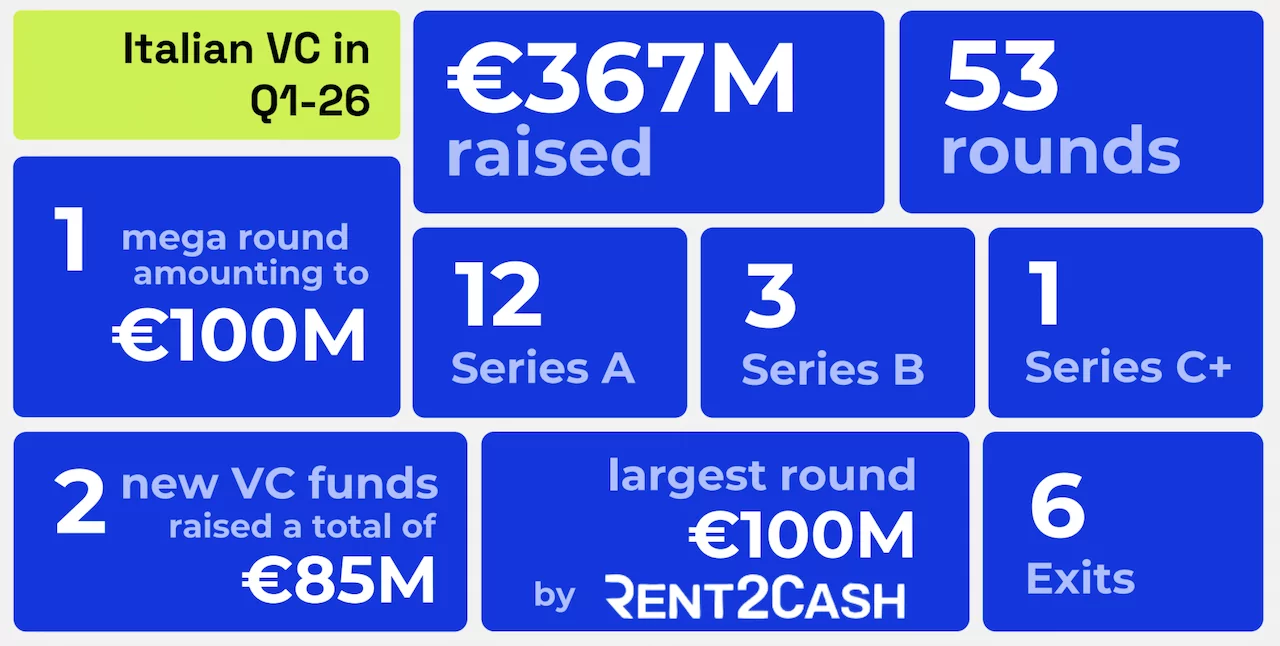
In the first quarter of 2026, Italian venture capital activity was modest in terms of the number of deals – with just 53 rounds closed – but in line with previous quarters in terms of capital invested, at €367 million. During the quarter, there were 12 Series A rounds, 3 Series B rounds, 1 Series C+ round and 6 exits.
Interest is growing in start-ups specialising in AI solutions, which are attracting an increasing number of deals; however, no major deals have been recorded in this sector in Italy. In addition to equity capital, funding rounds at advanced stages are increasingly involving debt financing or secondary transactions. Software remains the most dynamic sector in terms of the number of funding rounds, whilst Fintech leads in terms of capital raised. The largest round by value was Rent2Cash’s €100 million round. In terms of fundraising, the quarter also saw the launch of two new VC funds, with a total of €85 million announced. During the event, attended by some of Europe’s leading players, there was a focus on venture debt, a form of strategic financing that is gaining ground in Europe, although it remains rare in Italy.
The data is taken from the Quarterly Observatory on Venture Capital Investment in Italy, produced by Growth Capital in collaboration with the Italian Tech Alliance.
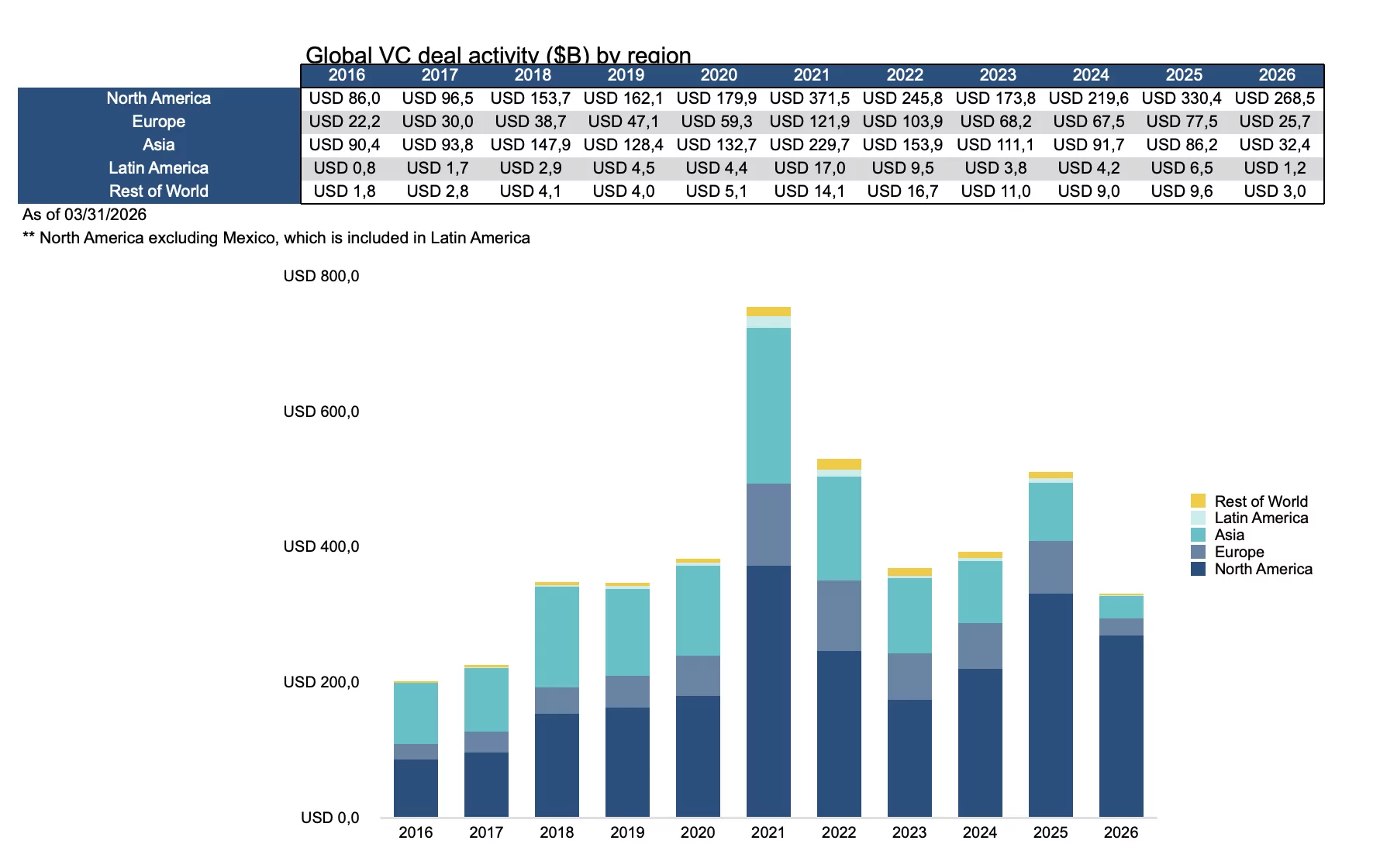
In the first quarter of 2026, the European venture capital market showed signs of stability in terms of deal volume and renewed strength in investment activity. With 2,805 rounds closed, the market remains in line with the last two years, whilst capital raised reached €22 billion, marking the best result since the second quarter of 2022. This performance is driven primarily by mega-rounds, concentrated in the AI and natural language processing sectors, which are driving investment growth despite an overall stable market environment.
2026 in Italy began with just 53 funding rounds: the lowest quarterly figure in the last five years. However, the total amount invested (€367 million) remains broadly in line with the quarterly average of the last three years, whether mega rounds are included or excluded. The distribution by stage reflects a pattern typical of a more mature market: early-stage deals (pre-seed and seed) account for 58% of rounds but absorb only 8% of capital, whilst Series A and B+ deals account for around a third of transactions and almost 90% of investment. In line with recent trends, the number of Series A and B rounds remains stable; however, in terms of volume, there are signs of greater dynamism for Series A, supported by a number of significant deals, whilst Series B continues to show more modest figures.
In the first quarter of 2026, software emerged as the most dynamic sector in terms of the number of deals, driven primarily by investment in AI, machine learning and cybersecurity. Smart cities and life sciences follow. In terms of capital raised, fintech, smart cities and software together account for 72% of investments, driven in particular by larger funding rounds, such as those of Rent2Cash and NewCleo, whilst the strength of the software sector remains linked to the high number of deals rather than their average size.
Looking at the top five deals of Q1 2026, Rent2Cash leads the way (€100 million, Series A), followed by Newcleo (€75 million, Series A), D-orbit (€45 million, Series D), Subbyx (€30 million, Series A) and Dronus (€15 million, Series A).
During the event, which was attended by some of Europe’s leading players, there was a focus on venture debt – a form of debt financing aimed at high-growth start-ups backed by venture capital or private equity firms, typically in growth or later stages. Although still rare in Italy and with significant room for growth, this type of financing allows companies to raise capital whilst limiting dilution, extending their runway and bridging the gap between equity rounds, in a context where valuations remain modest. In recent years, venture debt transactions exceeding €25 million have become increasingly common in Europe, accounting for 18% of transactions and 90% of their total value. Venture debt activity in Europe and the United States has followed very similar trajectories in recent years. When comparing the two ecosystems over the period 2023–2025, the value of venture debt in the United States is 2.2 times higher than in Europe, whilst the gap in venture capital is even more pronounced, with investment in the United States being 3.4 times higher than in Europe.
“2026 is off to a positive start for European ecosystems, driven by mega-rounds. The Italian VC market remains in line with historical averages for total capital invested, despite the lower number of rounds.” “We expect venture debt, which is frequently used in advanced venture capital ecosystems, to gradually take on a more significant role in Italy too,” said Fabio Mondini de Focatiis, founding partner of Growth Capital, in a statement.
“The Italian innovation ecosystem remains robust and capable of delivering high-level expertise and project development. However, the leap in quality we have long been awaiting requires a change of pace on the part of Italian and European institutions. We have seen many announcements and growing attention on the issue, but these have not yet been followed by fully effective structural measures. In Italy, for example, the issue of extending the 30% tax incentive for investments in start-ups remains unresolved, a crucial factor for the competitiveness and attractiveness of our ecosystem. Similarly, the final and fundamental interpretative details are still lacking to enable the important incentive measures contained in the Competition Law to take off. At European level, however, initiatives such as EU Inc, whilst heading in the right direction, are still too limited compared to the ambitions set out in the 28th framework. If we truly wish to compete globally, we must move from the phase of announcements to that of concrete decisions, creating a regulatory and fiscal environment capable of supporting the growth of innovative businesses and attracting investment in a stable and credible manner,” says Davide Turco, president of the Italian Tech Alliance
ALL RIGHTS RESERVED ©