Table of contents
76% have experienced gender stereotypes or comments from investors, clients or partners. 46% were not immediately recognised as the owners of their own businesses. These are the findings of a survey conducted in April 2026 by GammaDonna and Wamo among 223 Italian female business owners. The most interesting finding is not just the frequency of discrimination. It is the way in which this affects the day-to-day running of the business. 46% of those surveyed felt, at least once, that they were treated less favourably than men in their dealings with banks and investors. 38% avoided applying for tenders or funding for fear of not being up to the task, despite 79% stating they were very or fairly confident in financial management. The skills are there. But the environment in which they are exercised continues to breed hesitation, self-censorship and a distancing from the tools available.
The daily burden of running a business
The most frequently cited obstacle to a business’s survival is the difficulty of managing the business, chosen by 46% of the sample, followed by red tape at 40%. Finding and retaining the right staff is the main obstacle to growth: this is according to 59% of the female entrepreneurs interviewed. Then there is the personal cost. When asked what prompted them to consider closing their business, 45% cited the difficulty of balancing work and family life, whilst 38% cited personal wellbeing issues. Among the most pressing desires, ‘having more time for myself’ comes top at 26%, ahead of finding a partner, securing funding and gaining market recognition. Work-life balance is not a nice-to-have; it is a concrete measure of the sustainability of running a business. Technology can solve a great deal in this regard, as Antonio Mazza, Wamo’s Country Manager for Italy, points out. He frames the challenges faced by female founders “not only in terms of access to capital or growth, but above all in terms of the day-to-day sustainability of business management”—an area in which Wamo is working by introducing AI agents into business accounts to automate all those micro-tasks that take up so much time and energy, thereby affecting well-being.
When the company is a start-up, the gap is more noticeable
The picture becomes more stark when the focus shifts to female start-up founders and digital and innovative female entrepreneurs. Here, the perception of bias is almost double the average, as the same research highlights. 52% say they often face stereotyping from venture capitalists or stakeholders simply because they are women, compared with 36% of the general sample. 37% often feel judged differently from men in their dealings with investors, compared to 22% of the others.
The issue of motherhood also has a different impact. Among female start-up founders, 44% say they do not have children, almost double the sample average. Among female entrepreneurs who are mothers, 41% scaled back their business activities after the birth of a child: 24% did so temporarily, whilst 8% saw a significant drop in turnover. Innovative start-ups with a predominantly female workforce remain a minority in Italy. In the first quarter of 2025, they accounted for 13.84% of the total, just over 1,600 companies. This figure reflects a still fragile presence within the most closely observed sector of the innovation landscape. In fact, it is ‘the figure’, because there is little else in the various reports detailing the state of health of the Italian start-up/venture capital ecosystem: CDP Venture Capital Italy VC Monitor; Aifi’s Italian private equity and venture capital market report; P101’s State of Italian VC; the Venture Capital Report by Growth Capital and ITA; various periodic observatories do not seem interested in collecting data on access to capital, average investment amounts, the composition of founding teams, follow-on funding and exits. At best, we have this isolated figure on how many start-ups have female founders, cited for example by the EY Venture Barometer, but this data alone is of little use; it is merely a superficial observation.
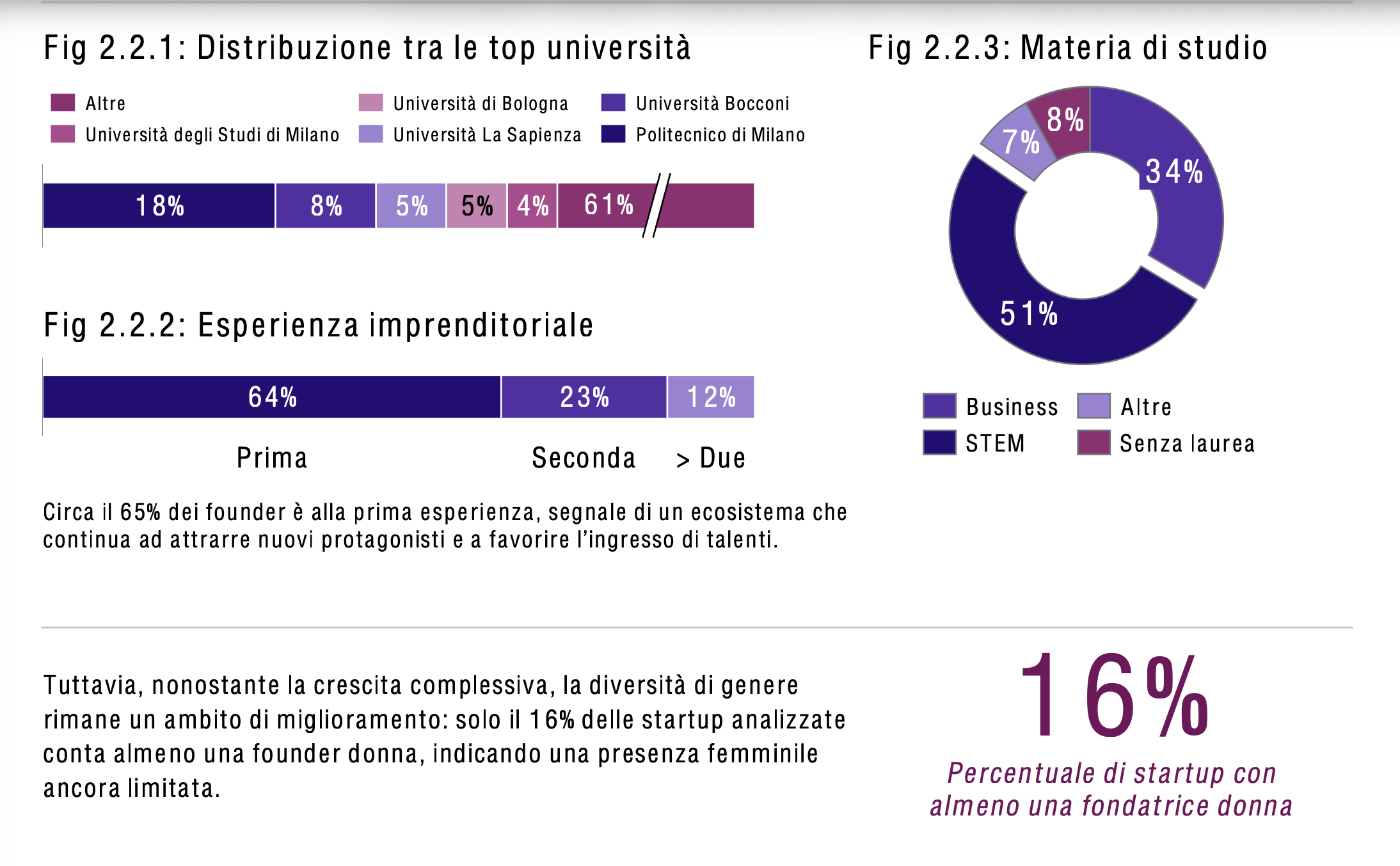
Perhaps the most in-depth study to date is the 2022 report ‘Pow(H)er Generation – How to make a difference’ by Cariplo Factory.
The missing data confirms the problem
Consequently, the main annual reports on the Italian venture capital ecosystem cover funding rounds, sectors, exits, fundraising, universities, corporate venture capital, industrial sectors and systemic impact. The issue of gender diversity occasionally appears in the table of contents, but there is no real in-depth structural analysis. Simple questions are either missing or remain the exception: how many start-ups founded by women receive funding? At what stages? With what average investment amounts? From which investors? How likely are they to access subsequent rounds? What is the difference compared to male or mixed-gender teams? We need this data to better understand the capital and innovation market as a whole, its dynamics, and whether this world is open to harnessing the contribution women can make. And above all, to understand whether we are making progress towards true gender equality. What is not measured does not become a priority, does not guide investment, and does not change behaviour. And in the long run, it risks rendering part of the ecosystem invisible precisely in those places where we believe ourselves to be ‘ahead’ and where decisions are made about what matters.
Even a prize counts
Against this backdrop, it is clear that an award such as GammaDonna (for which applications for the new edition remain open until 9 June 2026) continues to play a vital role, even after 22 years. Over the years, the award has succeeded in giving visibility and support to dozens of female entrepreneurs, founders, co-founders or active partners in managerial roles within the world of innovation who might otherwise have remained in the shadows, and who are now role models. It is therefore not merely an accolade, but a concrete step towards bridging the gender gap in the field of innovation. “Competent and innovative female entrepreneurs continue to operate in an ecosystem that all too often tests their credibility more than their talent,” says Valentina Parenti, president of GammaDonna. “Founders are not asking for preferential treatment, but for fair conditions to compete, grow and make an impact.”
Come on, then – let’s see if any analysts take up the challenge.
(photo by CoWomen on Unsplash)
ALL RIGHTS RESERVED ©
