Table of contents
In Yerevan, a coffee can lead to three meetings. A chat with a founder leads to an investor, then to an accelerator, and finally to a dinner where someone suggests the person you should have met right from the start.
This is one of the characteristics of a small ecosystem, where universities, institutions, accelerator programmes, business angels and diaspora networks tend to overlap. Physical distances are short, and the bonds between people are often even closer. (We wrote about the Armenian ecosystem last October.)
I spent four days in the Armenian capital, three of which were almost entirely taken up with work. The rest took place after working hours: interviews, walks, phone calls and conversations that went on late into the night. In a major tech hub, it can take weeks to figure out who does what. In Yerevan, if you ask the right questions, the ecosystem soon starts to reveal itself.
However, this accessibility should not be confused with maturity. Armenia does not yet possess the financial depth, managerial expertise or critical mass of the major European hubs, and its appeal stems from a combination of technical talent, a limited domestic market, international networks and a public sector that is seeking to play an active role.
According to figures cited by the Armenian Ministry of High-Tech Industry, in 2024 the IT sector generated a turnover of approximately 915 billion drams (just under 2.2 billion euros). The government estimates that the technology sector now accounts for between 7% and 8% of gross domestic product. These are official figures, which should also be seen as part of the country’s narrative, but they point in a clear direction: technology is no longer considered a peripheral sector of the Armenian economy.
Thinking globally out of necessity
The first thing to understand is that Armenian start-ups cannot rely on a large domestic market. For many of them, international expansion does not come after local validation: it is a prerequisite.
This creates an interesting dynamic. The company’s small size limits the number of customers, the availability of capital and opportunities for domestic growth. At the same time, it forces the most ambitious founders to engage early on with foreign markets, international investors and products that must function beyond national borders.
Ruben Osipyan, one of the most prominent figures in the Armenian early-stage capital scene and a member of STAN (Science and Technology Angel Network), describes an ecosystem connected to the world’s major hubs through the diaspora.
In his view, the country’s competitive advantage does not lie in the local market. It lies in the Armenian network spread across the globe.
For a start-up, the diaspora means access to mentors, capital, technical expertise, customers and introductions to markets such as the United States and Europe. It is not merely a question of identity or cultural belonging. In Armenia, the diaspora functions, at least in part, as an informal economic infrastructure.
The government itself is trying to make more deliberate use of it. The Neruzh programme, for example, is aimed at tech start-ups from the diaspora that are interested in relocating or developing their businesses in the country.
But the diaspora does not automatically solve a start-up’s problems. It can open doors, but it cannot build the product. It can facilitate introductions, but it is no substitute for sales, governance, leadership and the ability to execute.
Osipyan also highlights a cultural limitation. Armenia has deep-rooted technical expertise, but it still needs to foster greater tolerance for mistakes and business failure. Social capital is an asset; however, transforming it into global companies requires an equally robust business culture.
The state is not standing idly by
The Armenian government does not appear willing to leave it to the market alone to build the ecosystem. It is working on incentives, accelerator programmes, research tools and links with international operators.
Heghine Muradyan, from the Ministry of High-Tech Industry, sums up the nation’s ambition in a simple phrase: ‘Armenia is a small country but with great potential — and with great talent’ (Armenia is a small country with great potential and great talent, ed.).
The strategy focuses on artificial intelligence, cybersecurity, semiconductors, engineering, biotechnology and edtech. The government is developing tax incentives, grants, research programmes and tools to facilitate access to technological infrastructure in these sectors.
The partnership with Plug and Play (where the author serves as a mentor, ed.) should be viewed in this context. The international accelerator entered the country through a state-funded programme, offering incubation, pre-acceleration and acceleration programmes.
Gohar Hovhannisyan, from the local team, insists, however, on an aspect that goes beyond technology and the market: the calibre of the founders. The most promising candidates are those who can take on board feedback, accept criticism and adapt quickly. “We look for people who are eager and flexible to learn,” he says. Not just people who are willing to listen, but founders who can turn what they hear into decisions.
In the first two cohorts, Plug and Play Armenia worked with 39 start-ups. The programme also involves the direct participation of international mentors in Yerevan. In some cases, relationships formed during the programme have subsequently led to angel investments.
Their public presence is therefore evident. It remains to be seen to what extent these tools will succeed in creating scalable businesses, attracting private capital and delivering lasting results. Announcing programmes is easier than ensuring they work effectively over time.
Talent comes before the pitch deck
The most interesting aspect of the Armenian strategy may not be what you see at demo days. It may lie years earlier, when the talent doesn’t yet have a CV, a start-up or a pitch deck.
Tumo is the best-known example of this approach. The centre offers teenagers a free educational programme based on self-directed learning, workshops and projects. It was not set up as an accelerator, but it helps to foster familiarity with technology, creativity and experimentation from a very early age.
Tumo Labs represents the next step. It is aimed at young adults and professionals and focuses on bringing together applied learning, engineering, academia and industry.
Bella Vasilyan describes the difference effectively: Tumo is a space where teenagers can learn outside of formal settings; Tumo Labs is a place to create and build relationships.
His analysis becomes even more interesting when he discusses what is missing. Many young technical teams have yet to develop a CEO mindset, clear roles, sales skills, discipline in fundraising and an openness to feedback.
It is probably one of the main bottlenecks in the ecosystem. Knowing how to build a technology does not automatically mean knowing how to build a business.
Universities are also getting involved. Epic, the American University of Armenia’s incubator, works with early-stage start-ups on validation, customer discovery and market access. Since 2017, according to figures published by the programme, it has supported more than 130 start-ups and over 320 entrepreneurs.
The value of these initiatives lies not only in the businesses they help to create. It lies in the development of a common language between education, research and entrepreneurship.
An ecosystem that is still incomplete
To portray Armenia solely through the prism of talent, public programmes and ambition would paint an overly polished picture.
Early-stage funding remains limited. Technical skills are often more developed than commercial ones. Some teams struggle to define leadership roles and responsibilities. The culture surrounding failure is less forgiving than in ecosystems where shutting down a start-up is seen as part of a career path.
There is also the risk of becoming overly reliant on external networks. The diaspora is an asset when it amplifies what already exists within the country. It becomes a weakness when it has to constantly compensate for a lack of capital, management expertise or independent access to markets.
The local venture capital sector is also still in its infancy. The launch of Formula VC II, with a stated target of $30 million to be invested in 35–40 start-ups, is a sign of things to come. But that is not enough to describe it as a mature financial market.
Armenia remains an ecosystem in which education, institutions, start-up acceleration and capital are developing at different rates. It is precisely this, however, that makes it so interesting: in a mature market, it is mainly the results that are visible; in a young market, it is possible to see the mechanisms being built.
Why should Italy care?
To an Italian reader, Armenia may seem far removed from the usual spheres of European innovation. Economic ties between the two countries are, however, less marginal than one might imagine.
In 2024, trade between the two countries reached €415 million, whilst the stock of Italian direct investment in Armenia stood at €194 million. The report focuses primarily on machinery, textiles, agri-food, chemicals and other manufacturing sectors, rather than on start-ups and venture capital.
Since 2025, there has also been an ICE desk at the Italian Embassy in Yerevan. Technology has also made its way onto the bilateral agenda: during a business forum held in Naples in 2023, the Armenian government presented its high-tech ecosystem and the opportunities for collaboration with Italy.
For the time being, however, there is still no established link between the two ecosystems in the form of dedicated funds, joint accelerators or a steady flow of start-ups.
The most tangible link could come from research. Armenia has been associated with Horizon Europe since 2022, a status that allows Armenian universities, businesses and research centres to participate in projects alongside partners from Member States. By mid-2025, Armenian organisations had secured around €8 million through the programme.
For Italy, therefore, the interest does not lie in the size of the Armenian market. It lies in the potential synergy between the technical expertise developed in Yerevan and Italy’s industrial, manufacturing and scientific sectors.
The innovation corridor has not yet been established. However, there are economic links, institutional channels and European instruments that can serve as a starting point.
Small, but not on the outskirts
The country’s strength lies in its efforts to harness technical expertise, education, the diaspora and international connections to overcome the limitations of a small domestic market.
There is still a great deal to be done. We need more capital, greater business acumen, a higher tolerance for risk, and more companies capable of growing without constantly relying on personal connections or public support.
Yerevan, however, shows that innovation does not always take the form of large campuses, perfectly branded neighbourhoods or abundant capital. Sometimes it takes shape in a close-knit network of universities, educational programmes, diaspora investors, accelerators and institutions that are still learning to work together.
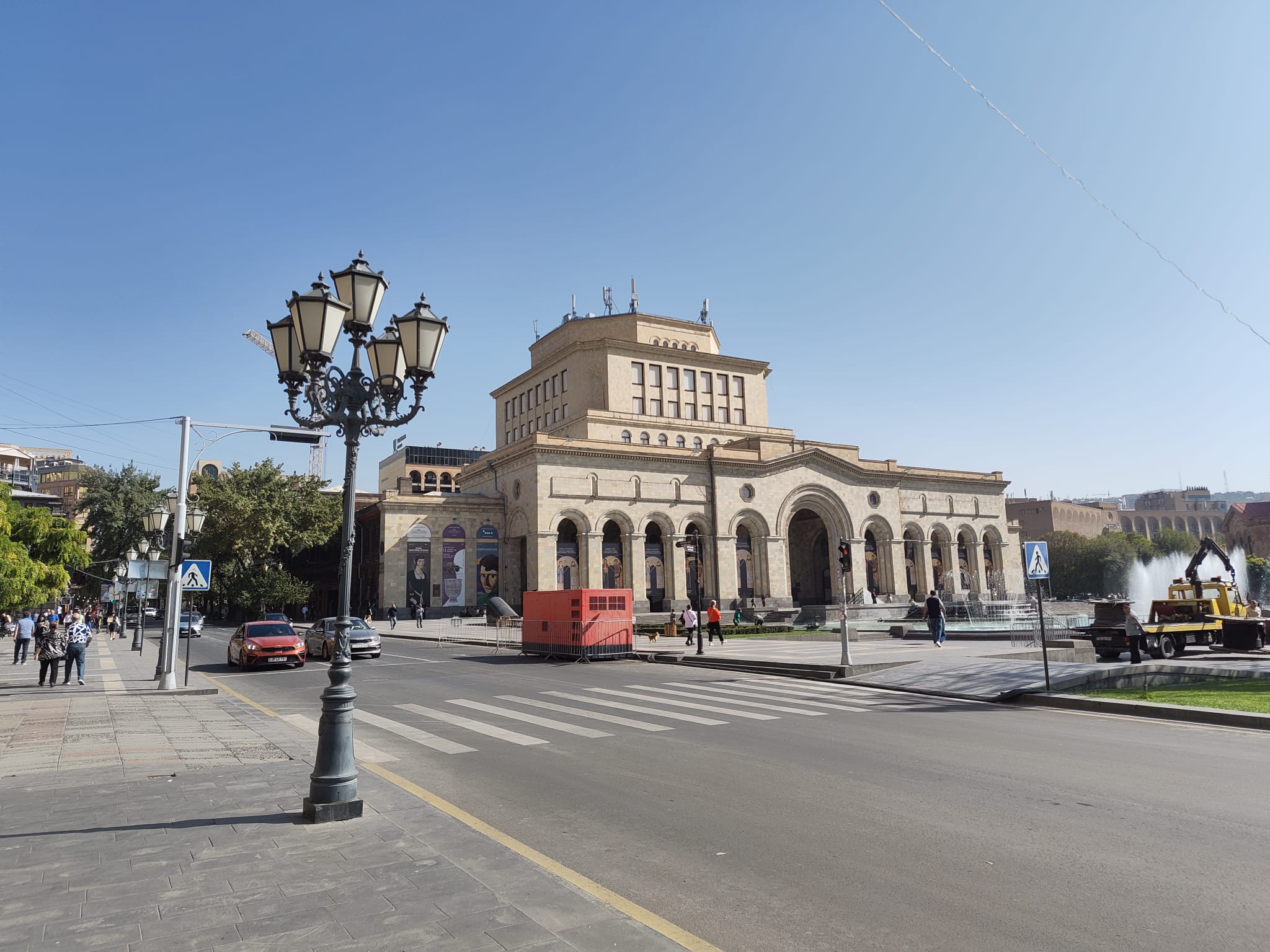
For Italy, looking at Armenia today does not mean chasing the next trendy market. It means beginning to understand an ecosystem which, whilst starting on a local scale, is compelled to think globally. (The photo by Startupbusiness shows a view of Republic Square in Yerevan)
ALL RIGHTS RESERVED ©