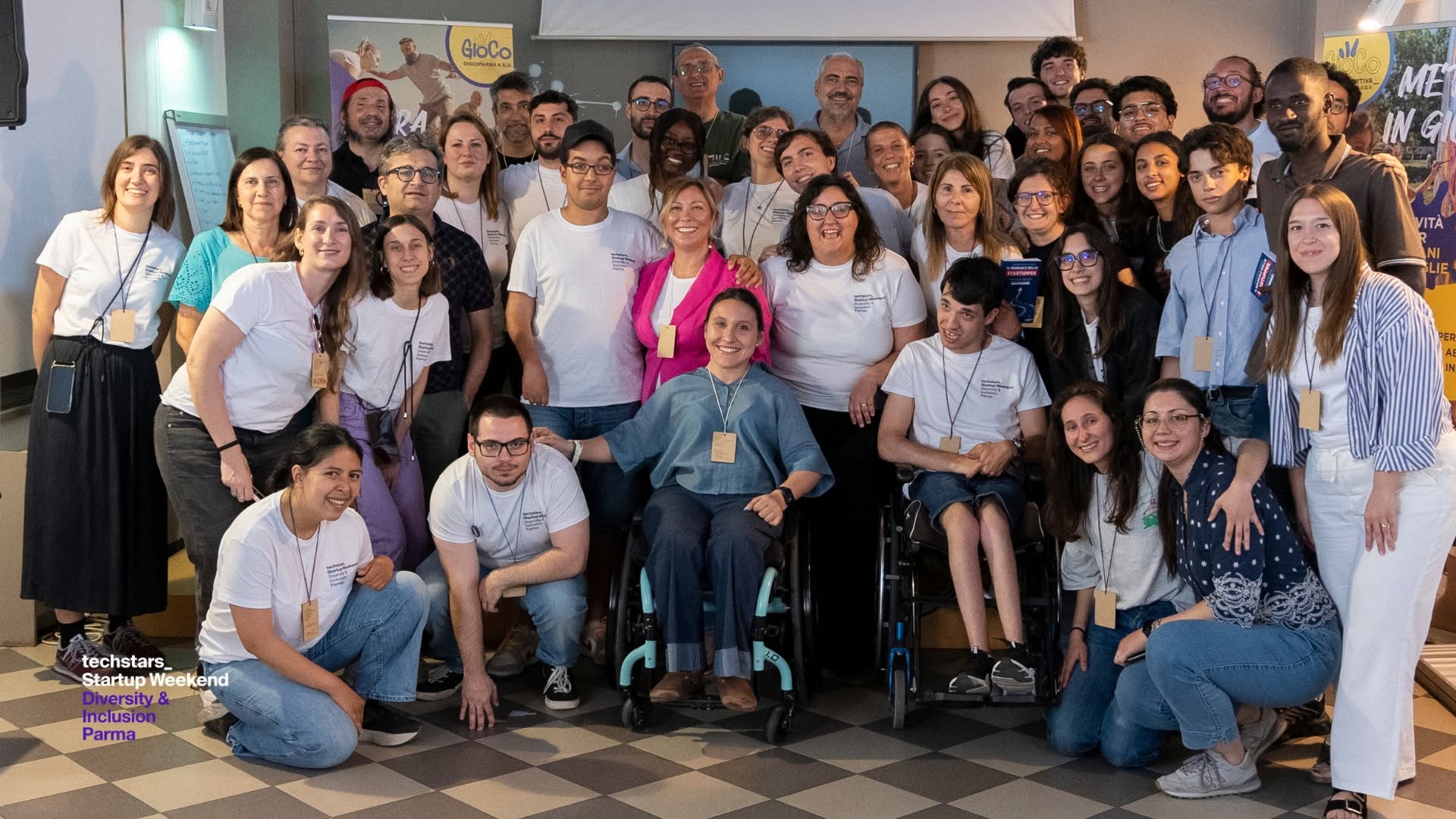
This was my fourth Startup Weekend and, of all of them, it was the most different. At the other events I’ve attended, the atmosphere was often one of searching for the big idea, the start-up to scale up quickly, the project capable of attracting the market, investment and attention. In Parma, however, the starting point was different: not the biggest idea, but the most genuine need.
The theme was diversity and inclusion, with a focus on disability and accessibility. The event was organised by the Startup Weekend Parma 2026 team, comprising Veronica Pinetti as coordinator, Rossella Lombardozzi in charge of partnership development, Elfi Amisani responsible for event communications, and Linda Pittelli coordinating the D.O.P. project for Polisportiva Gioco Parma.
In reality, however, it was not just an event about disability. It was a different way of using the Startup Weekend format, bringing to the fore real issues, actual experiences and the barriers that many people face every day.
For three days, the teams set to work, starting with very specific needs. Not with abstract hypotheses, not with ready-made solutions, and not with slides designed to impress the jury. They began with what is missing, what isn’t working, and what is often left out of innovation processes because it isn’t given enough attention.
This has made me revisit a question I’ve been pondering for years. In the start-up world, there’s constant talk of innovation, whereas when you enter the world of disability, the talk is almost always of inclusion. The point, however, is to understand what we really mean by inclusion.
Inclusion does not simply mean allowing someone to take part. It means creating a more level playing field. Today, in Italy, a person with a disability does not start from the same point as a person without a disability, particularly when it comes to work, business, access to opportunities and the chance to turn an idea into a project.
Startup Weekend Parma 2026 incorporated this challenge into a format designed to develop, validate and present ideas in a short space of time. This is precisely why it was a more complex event than other Startup Weekends, but also a more interesting one.
From an organisational point of view, the outcome was very positive. The team reported that the event exceeded expectations, particularly because it enabled them to redefine the concept of value. Putting people at the centre does not exclude business; rather, it makes it more closely aligned with real needs and therefore more robust.
This is one of the key points. All too often, the social sphere and the business world are treated as two separate spheres: social impact on the one hand, and the market on the other. In Parma, these two worlds have tried to work together, without hiding their differences.
The organisers spoke of the ‘hybridisation of languages’. The start-up world uses terms such as scalability, ROI, MVP and validation. The world of disability requires listening, respect for people’s pace, personalisation and attention to real needs. The challenge was not to let one language take precedence over the other, but to bring them together.
From this point of view, the format has worked because it doesn’t leave much room for theory. You have to put together a team, choose a problem, validate it, talk to potential users, develop a proposal and present it to mentors and a panel of judges. Raising awareness alone isn’t enough, because at some point you need a method, figures, skills and sustainability.
Over the weekend, each team worked on a problem relating to a disability, a difference, a barrier or a specific need. Everyone tried to build something that would be useful to someone else, and that’s not something to be taken for granted in a start-up format.
In such contexts, people often look for the most marketable idea. Here, however, we started with the most practical problem.
This was the event’s greatest strength, but it also revealed a clear limitation. Social, educational and planning skills, as well as practical experience, were very much in evidence, whilst there were fewer people with backgrounds in business, economics and technology.
I don’t see this as a shortcoming of the event. I see it as a sign of the system. If we truly want to build inclusive entrepreneurship, it is not enough simply to involve those who are experiencing need. We also need to bring together, alongside those people, those who know how to transform that need into a product, service, business model, technology and organisation.
Disability brings real challenges, but it also brings real skills. Those who face barriers on a daily basis develop the ability to adapt, read the situation, solve problems and make the most of their resources. These skills must not be confined to personal accounts. They must be incorporated into design processes.
That is why the role of the mentors and the judging panel was so important. The organisers explained that they carried out a ‘reality check’, helping the teams to look beyond projects that were merely attractive or emotionally compelling but difficult to implement. The questions were direct: who is paying for it? How will it be produced? How will it be sustained over time? What is the development plan?
These are tough questions, but necessary ones. When it comes to inclusion, there is a risk of being overly protective of an idea simply because it stems from a genuine need. In fact, precisely because that need is genuine, the idea deserves to be treated with entrepreneurial seriousness.
The thing that struck me most, having been there for all three days and helping out at the tables, was the atmosphere. Despite our different backgrounds, skills and ways of thinking, a very close-knit atmosphere developed. It wasn’t perfect, nor was it always orderly, but it was genuine.
On Saturday evening, it looked as though some teams might not make it to the end. Their ideas were still a bit muddled; they had pitches to put together, models to review and problems to narrow down. By Sunday morning, however, many groups had found a clearer direction. Not everything was ready, not everything was solid, but everyone was further along than when they started.
According to the organisers, one of the most important aspects was the absence of paternalism. There was a risk that some people without disabilities might approach the issue with a ‘rescue’ mentality. This did not happen. A more horizontal relationship was established, in which accessibility was not treated as a constraint, but as an opportunity for design.
This is a practical lesson. Disability does not call for pity. It calls for solutions, tools, independence, work, enterprise and opportunities. It calls for people to listen, but also for it to be recognised as a strength.
Organising an event of this kind, however, is not simply a matter of choosing a theme and putting it on a poster. Complexity permeates every detail: accessibility of venues, digital materials, work rhythms, language, managing expectations and safeguarding personal stories. This is where the difference lies between talking about inclusion and designing for inclusion.
There is also one point that needs to be acknowledged in all honesty. The local response could have been stronger. The organisers reported that around half of the participants came from other Italian cities. This confirms that the issue has national significance, but it also shows that local communities still need to learn to view disability as a business opportunity, not just as a social issue.
The final figures, however, paint a picture of a vibrant event: 38 entrants, 35 actual participants, an average age of 32, 12 ideas presented, 6 teams formed, 18 mentors, 7 judges, 3 winning teams, 3 teams receiving special mentions and 13 awards presented.
The final survey also yielded positive results. The average rating for the event was 4.17 out of 5; 95.8 per cent of respondents felt that the format was effective and innovative, whilst 79.2 per cent said that Startup Weekend had helped them to develop new ideas and foster greater entrepreneurial creativity.
The numbers matter, but what happens next matters even more. The risk with major events is always the same: the final pitch, the applause, the photos, the awards – and then everyone goes their separate ways.
What is needed here is continuity, because there are still teams to support, ideas to test, relationships to nurture and skills to develop. There is also a question for the start-up ecosystem: how much space are we giving to people with disabilities as founders, designers, professionals and innovators?
Startup Weekend Parma did not resolve the issue of inclusive entrepreneurship, and it would be wrong to present it that way. However, it did achieve something useful: it showed that disability is not just a topic to be discussed, but a starting point for design.
When people with different backgrounds work on real-world problems, inclusion ceases to be just a nice-sounding word and becomes a method.
Perhaps this is where we need to start again – not with the grandest idea, but with the most genuine need.
Note to the reader: the author is President of the Free Association of Disabled Entrepreneurs
ALL RIGHTS RESERVED ©