Table of contents
From ‘bad’ chemistry to ‘good’ chemistry: the bioeconomy and start-ups are now playing a part in the revival of Porto Torres, a Sardinian town shaped by a cycle of industrialisation that began in the 1960s and subsequently faced difficult times.
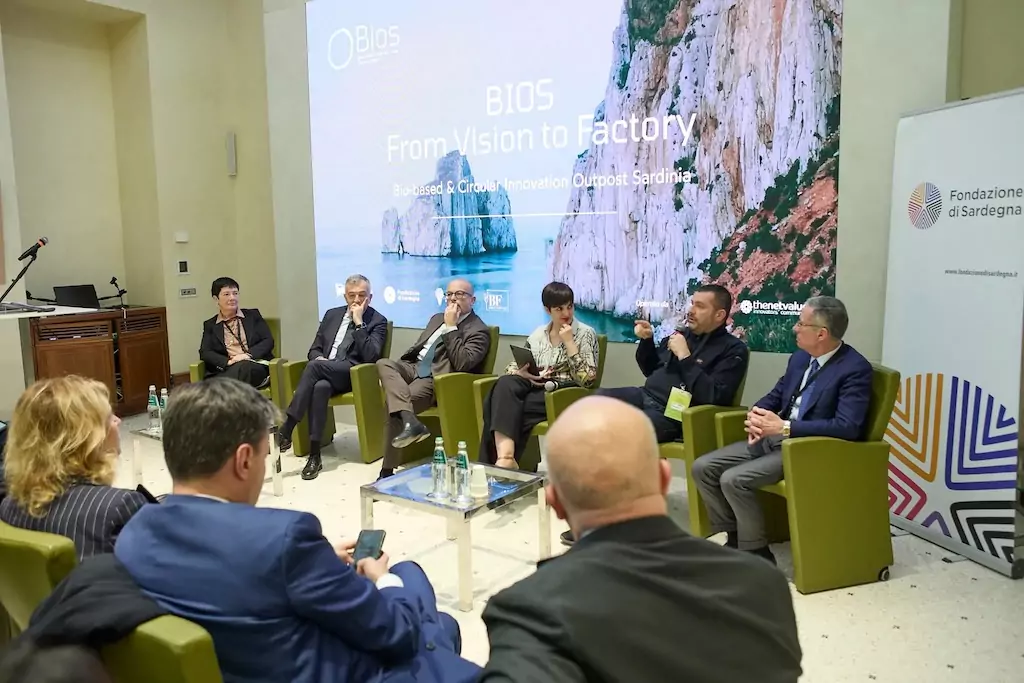
It is precisely this location, in fact, that has been chosen – and not by chance – for the Bios (Bio-based Innovation Outpost in Sardinia) Factory, a hub promoted by Fondazione di Sardegna, Joule (Eni) and BF Educational, and operated by Zest and The Net Value, which was officially launched on 17 March 2026 with the event “From vision to factory”. The initiative aims to accelerate the industrialisation and market uptake of high-impact sustainable solutions, strengthening bio-based and circular supply chains in Sardinia and creating a tangible link between innovation, industry and the local area.
Bios Factory was established to bring together start-ups, businesses, universities and institutions in the development of technologies based on the bioeconomy and the circular economy, with a deliberately hands-on approach: not just networking, but projects to be taken to production. The programme promotes collaborations between start-ups and local companies with the aim of facilitating proof-of-concept trials and concrete industrial integration, bypassing the often endless phase of fruitless experimentation.
A new model, a kind of industrial catalyst or regional open innovation initiative – that is, one that operates at a regional level rather than within a single company.
“For Zest, contributing to the launch of Bios Factory means being able to support and enhance Sardinia’s innovation ecosystem, providing expertise and networks to foster collaboration between businesses, SMEs, universities, start-ups and institutions, thereby accelerating the testing and industrialisation of technological solutions within the circular economy,” says Antonella Zullo, CEO of Zest Innovation “We are now ready to launch the next phases of the project: from matching start-ups with local businesses to defining use cases and developing proofs of concept.”
The focus, therefore, is on solutions that have already been validated and have the potential for scalability. The selected start-ups are working on real-world use cases and will develop a proof of concept in Sardinia, benefiting from technical, financial, logistical and operational support to foster industrial synergies and accelerate industrialisation processes within a circular economy framework. At the heart of this is the valorisation of waste and by-products, a key element for circular models that transform the residues of one production process into the raw material for another.
Four technology sectors
The programme focuses on four key technological areas. The first is waste management and agritech, with a focus on the recovery of agricultural waste and the optimisation of harvesting and processing methods. The second is biofuels, namely the production of fuels from biomass as an alternative to fossil fuels. The third is green chemistry, involving the development of sustainable processes and molecules derived from biological resources. The fourth is biomaterials, involving the creation of new materials from biological resources or industrial waste to replace plastics and conventional materials.
Sixteen start-ups have been selected for this first edition, hailing from across Italy, with technologies already at an advanced stage of development; their applications were assessed on the basis of technological maturity and potential for industrial integration. Among them are companies that transform coffee grounds into thermoplastics, wool waste into biomaterials for the biomedical sector, industrial waste into biogas, and liquorice waste into antimicrobial additives for food packaging. A diverse ecosystem covering the entire value chain of the bioeconomy, from waste collection to the production of materials and molecules, right through to distribution.
The selected startups
| Name | What they do | Website | Sector |
| Agreenet | Bio-based and biodegradable biomaterials for active packaging of fresh food, to extend its shelf life | agreenet.it | waste agritech |
| Alkelux | Natural antimicrobial bio-additives derived from liquorice waste for active food packaging | alkelux.com | biomaterial |
| Antares Electrolysis | AEM electrolyser stacks for the sustainable production of green hydrogen and renewable chemical molecules | antares-electrolysis.com | biofuels |
| Asteasier | Bio-based ingredients with high nutritional value derived from microalgae for the nutraceutical, food and feed sectors | asteasier.com | green chemistry |
| BeNewtral | Alternative mineral binders to cement made from industrial by-products to reduce emissions in the construction sector | benewtral.com | biomaterial |
| CDC Studio | Technologies for transforming textile and leather waste into new sustainable materials and polymers | cdc-studio.it | biomaterial |
| Coffeefrom | Bio-based thermoplastics made from coffee grounds, as an alternative to traditional plastic | coffeefrom.it | biomaterial |
| ECS Cleantech | Cleantech technologies for the remediation of contaminated soil and water and the conversion of industrial wastewater and sludge into biogas | ecs-cleantech.com | biofuel |
| Geomatrix | Sustainable polymeric materials made from recycled plastic and wood waste as circular alternatives to plastic | geomatriximpact.com | biomaterial |
| iotilize.me | IoT solutions and data-driven software to monitor the filling of waste containers and optimise logistics | iotilize.me | waste agritech |
| Kerline | Keratin-based materials derived from wool waste for biomedical, cosmetic and advanced materials applications | kerlinesrl.com | green chemistry |
| Lebiu Design | Bio-based biomaterials made from cork waste for the fashion, design, interior and packaging sectors | lebiudesign.com | biomaterial |
| Relicta | Water-soluble and biodegradable bioplastics made from fish industry waste for sustainable packaging solutions | relictabioplastics.com | biomaterial |
| SIEve | Advanced filtration systems for the treatment of industrial wastewater containing metallurgical waste materials | sie-ve.it | green chemistry |
| Spray Logics | Sensor-based precision spraying systems to reduce pesticide use in agricultural treatments | spraylogics.com | waste agritech |
| VisionIng | Technologies for the treatment and reuse of agro-industrial wastewater with nutrient recovery | visioningtech.com | waste agritech |
The industrial challenge
For the organisers, the key challenge is above all to successfully translate research into industrial applications, without stopping at the pilot phase. “With BIOS, we aim to connect innovative start-ups with large companies and SMEs in order to test advanced bio-based technological solutions and support them on their journey to market,” says Mattia Voltaggio, head of Joule, Eni’s programme dedicated to sustainable entrepreneurship.
“Through this project, we aim to contribute to the development and testing of practical solutions, with the aim of optimising the use of resources and reducing our environmental impact. Porto Torres and Sardinia have the potential to become a leading hub for agritech innovation in the Mediterranean,” says Andrea Novarese, CEO of BF Educational.
The challenge is clear: to use existing infrastructure and expertise to build a new industrial supply chain. Porto Torres, with its chemical hub and history of large-scale plants, represents in this sense a prime example – and in some respects an ideal one – for testing the transition from an extractive model to a circular one. Technical expertise, logistical infrastructure and the presence of established industrial operators are resources that Bios Factory intends to harness.
“The Bios Factory project stems from the belief that sustainable development depends on the ability to bring together innovation, industry and the local area. Sardinia has the scientific expertise, businesses and young talent needed to help build more sustainable production chains focused on resource regeneration,” says Giacomo Spissu, president of the Fondazione di Sardegna. “In this endeavour, collaboration between different stakeholders is crucial.”
The critical stage, as is often the case in industrial innovation, lies not in launching projects but in their ability to move beyond the pilot phase and scale up successfully. This is where the real challenge lies: not in proving that a technology works in the laboratory, but that it can be integrated into a real production process, with industrial-scale costs, timescales and volumes. Bios Factory aims to support this leap, putting start-ups in direct contact with local companies and laying the groundwork for commercial agreements and subsequent investment.
ALL RIGHTS RESERVED ©