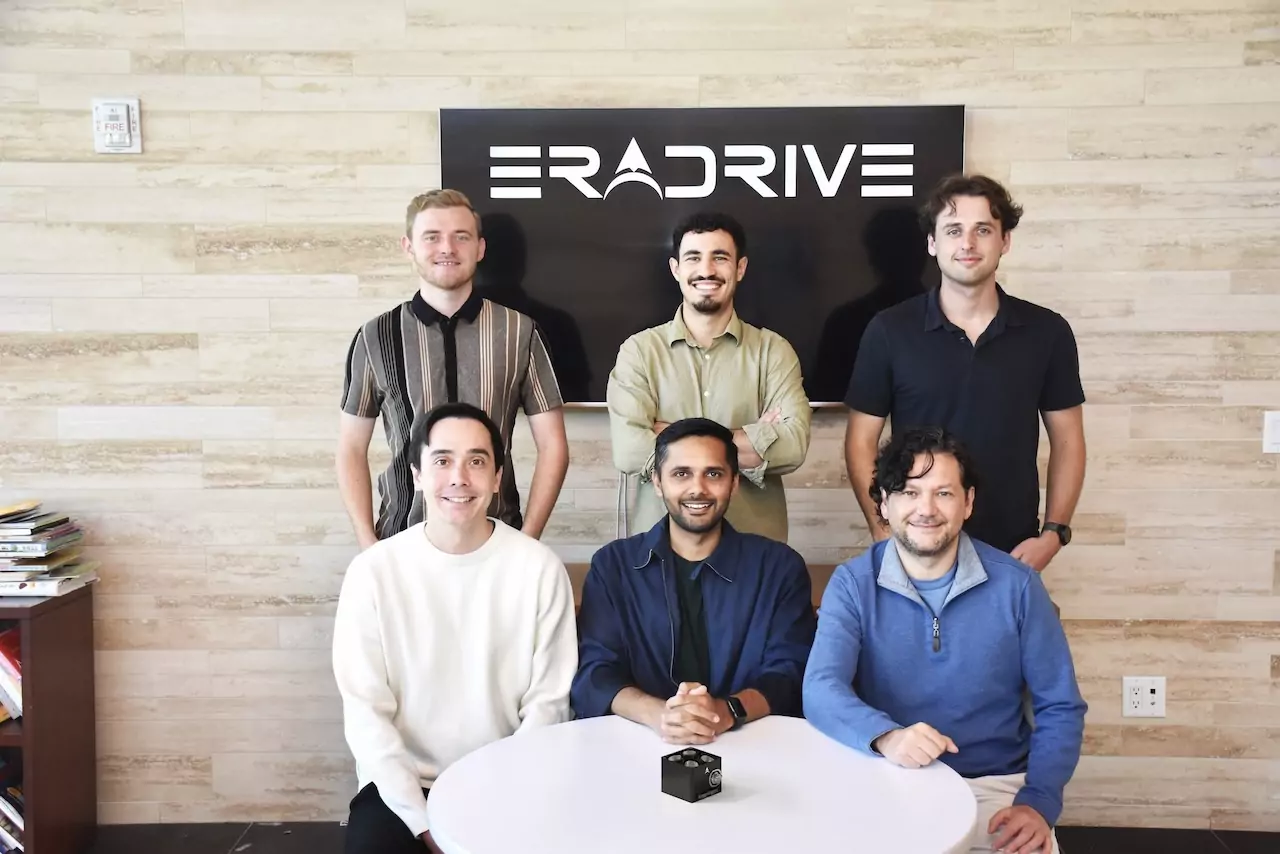
EraDrive Inc., Stanford’s first start-up specialising in autonomous space technology, announces that it has closed an initial funding round of $5.3 million with the aim of revolutionising space operations.
The round, led by Haystack Ventures with participation from Point Nine, Harpoon Ventures, Brave Capital, 2100 Ventures, and Entropy Industrial Capital, will accelerate the deployment of EraDrive’s flight-ready modules that enable spacecraft to operate autonomously. Building on more than a decade of research at Stanford University’s Space Rendezvous Laboratory, co-founders Sumant Sharma, Justin Kruger, and Stanford professor Simone D’Amico are accelerating the production and deployment of EraDrive’s first flight-ready autonomous modules, which combine cutting-edge optical vision and artificial intelligence-based hardware and software.
EraDrive is redefining spaceflight by equipping spacecraft with autonomous on-board intelligence and real-time environmental awareness powered by optical vision and artificial intelligence. Today’s satellites suffer from limited awareness of their surroundings and limited ability to react in real time. They largely reproduce manoeuvre scripts calculated on the ground and uploaded by human operators. Satellites equipped with EraDrive modules, on the other hand, are autonomous and environmentally aware: they detect nearby objects, understand the local orbital context, and execute high-level objectives such as maintaining a safe distance, avoiding collisions, performing rendezvous and proximity operations, conducting orbit maintenance, pointing towards targets, and maintaining position with minimal supervision from the ground.
EraDrive modules combine on-board cameras, data processing, synchronisation, communications and flight software in a compact payload that can be integrated with new or existing space platforms. The modules use vision-based navigation and cutting-edge artificial intelligence to support collision avoidance, cooperative and non-cooperative rendezvous and proximity operations, persistent surveillance, space domain awareness, precise orbit control and positioning, and alternative navigation and timing (APNT) in environments with degraded or denied GNSS. For customers with existing compatible hardware, all of these capabilities can also be provided in a software-only configuration.
“As orbits become more crowded and contested, pushing autonomy to the forefront is no longer optional,” said Sumant Sharma, co-founder and CEO of EraDrive (pictured with the team), in a statement. “Most satellites today are effectively blind and micromanaged from the ground. With EraDrive modules, we are giving spacecraft the ability to see, decide and act autonomously, so that operators can safely scale from dozens of assets to hundreds and ultimately thousands.”
EraDrive is tackling a space environment that is becoming increasingly crowded, commercialised and contested. The United States is pursuing unprecedented scale and resilience in space: the £175 billion Golden Dome missile defence shield has already begun awarding contracts for space interceptors, while the Space Force’s Vector 2025 strategy and PWSA (Proliferated Warfighter Space Architecture) framework call for proliferated, software-defined constellations built with commercial technology. At the same time, commercial operators are deploying ever-larger fleets that must fly closer together, react more quickly and operate with lean ground teams.
“Space is moving from a handful of bespoke missions to a dense, software-defined environment where safety, resilience and responsiveness are paramount,” says Semil Shah, general partner at Haystack . “EraDrive is one of the first teams we’ve seen treat autonomy in orbit the way the best companies treat autonomy on the ground: real perception, real cutting-edge decision-making, and a clear data flow that accumulates over time. We believe they can become a fundamental layer for satellite operations in the next decade.”
Each EraDrive module continuously collects and processes visual data relating to the satellite’s surroundings and orbit. This data is securely shared between the modules in orbit and with the ground base to power a space traffic intelligence system designed to outperform traditional, purely ground-based tracking networks in terms of coverage, revisit time, latency and accuracy. Over time, with the proliferation of modules in low Earth orbit (LEO), geostationary orbit (GEO) and higher regimes (xGEO), EraDrive aims to operate the most powerful space traffic intelligence system available to both commercial and government operators.
“We have seen autonomy transform cars, factories and logistics. Space is the next frontier, with even stricter constraints and higher risks,” says Ricardo Sequerra, partner at Point Nine. EraDrive boasts a rare combination of deep aerospace experience, rigorous engineering, and a business model that scales with each additional module in orbit. We are excited to support them in launching their first modules and creating a space traffic intelligence platform that redefines the category.
The participation of prestigious venture capital firms specialising in national security, Harpoon Ventures and Brave Capital, underscores EraDrive’s position as a company that develops dual-use technologies for space autonomy and security in the service of both commercial and national security missions. EraDrive’s technology is rooted in years of research and in-orbit demonstrations at Stanford University’s Space Rendezvous Laboratory, including autonomy and navigation algorithms tested in flight on missions such as NASA’s Starling.
This early-stage funding supports the initial production phases of EraDrive modules and the expansion of its autonomy platform for operations in LEO, GEO, and xGEO. EraDrive has already established strategic partnerships with leading satellite manufacturers, component suppliers, and defence contractors to provide autonomy as a service. Under these partnerships, EraDrive modules are being evaluated and integrated for missions that include rendezvous and non-cooperative inspections, persistent surveillance and space domain awareness, as well as alternative vision-based positioning, navigation and timing (PNT) for resilient operations. The company is expanding its engineering and operations teams to support these programmes and additional commercial, civil and defence customers.
ALL RIGHTS RESERVED ©