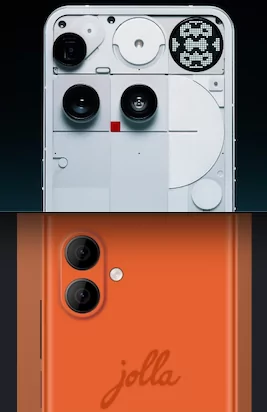
Whether it is due to sudden changes in the geopolitical balance, growing consumer awareness, or a question of costs and economic equilibrium, one thing is certain: more and more users of European technology products are interested in buying things made in Europe. This applies to everything, from software and online services to hardware devices. There are even two websites, GoEuropean and European Alternatives, which offer a comprehensive overview of European tech suppliers and products of all kinds. This trend naturally also applies to smartphones, and there are at least two European companies that are growing rapidly, thanks in part to intelligent policies for engaging users both in terms of financial support and product development. These are Nothing, which is headquartered in the United Kingdom, and Jolla, which is based in Finland.
Nothing
Nothing ha recentemente annunciato la chiusura del suo ultimo round di investimento dedicato alla community, raccogliendo oltre 8 milioni di dollari e coinvolgendo più di 5.000 nuovi investitori provenienti da oltre 80 Paesi.
“From day one, the community has been an integral part of Nothing’s journey, helping to shape how the company develops its products, challenging ideas and reinforcing the brand’s authenticity. This latest round offered the community the opportunity to invest in Nothing at a valuation of $1.3 billion, growing alongside the brand and helping to define the future of consumer AI technology,” the London-based company said in a statement. “For Nothing, the strength of the community has always been a key element of its ambition to grow rapidly. When the investment round opened for early access on 10 December, the company could not have predicted such significant growth in its community in such a short period of time. New members are joining Nothing at a particularly exciting time in its journey, sharing its mission to reignite innovation in a smartphone industry that has long struggled to reinvent itself.
Nothing’s fanbase numbers almost 13,000 people and has invested a total of over $16 million since the project’s inception. This new round of funding allows community investors to accompany Nothing on its journey as the company evolves its hardware infrastructure into the foundation for the next wave of AI-native operating systems and devices coming in 2026.
The announcement follows the recent $200 million Series C round, which closed in September 2025 and was led by institutional investors such as Tiger Global, GV, Highland Europe, EQT and Qualcomm Ventures.
The latest investment round was hosted on the Crowdcube and Wefunder platforms, with public access from 11 December.
“From the outset, we set ourselves the goal of building a global technology company based on openness, creativity and collaboration,” said Carl Pei, CEO and founder of Nothing, in a statement. “This round of investment was not just a fundraising exercise, but a concrete expression of our commitment to the community and our desire to take it with us on this journey. The new members who have joined this round demonstrate how deeply our fans believe in what we are building and in the tremendous momentum Nothing is experiencing. Together, we are reaching new heights and helping to define the future of AI-native consumer technology.
Jolla
Finnish smartphone manufacturer Jolla sold over five thousand pre-orders of its new Jolla Phone in one week, with an online marketing budget of just €2,500. The entirely organic, community-driven demand sends a clear message: people want a European Linux phone. Now Jolla is raising the stakes. If pre-orders reach 10,000 units by the end of January 2026, the company will reinstate its pioneering modular accessory system ‘The Other Half’ (TOH) and make the hardware and software interface specifications open source for the global maker community.
The €2.5 million in pre-orders came almost entirely through word of mouth, community sharing, and organic media coverage, not paid advertising.
“We spent €2,500 on online marketing. The European community did the rest,” said Antti Saarnio, president and co-founder of Jolla, in a statement. This is not just a request for our phone. It is a statement. Europe wants technology that it can control.
With 10,000 pre-orders, Jolla is committed to publishing The Other Half interface under an open licence, including: hardware interface designs and electrical specifications; software components and application programming interfaces (APIs); 3D printable reference designs The Other Half is a snap-on back cover system with pogo-pin connectors that can accommodate, for example, your own microcontroller, display and sensors, communicating directly with the Sailfish OS phone operating system.
“We’re not just building a phone, we’re building a platform,” says Sami Pienimäki, CEO and co-founder. “E-ink displays. Physical keyboards. Thermal cameras. Barcode readers. GPIO breakouts for hardware hackers. Whatever the community imagines, they can build it.”
The Jolla phone runs Sailfish OS, Europe’s only independent mobile operating system. With a physical privacy switch, user-replaceable battery and no big tech, it offers an alternative to the iOS/Android duopoly. By making The Other Half open source, Jolla extends this independence to hardware, inviting manufacturers, start-ups and companies around the world to develop on an open platform rather than a closed ecosystem. The numbers: over 5,000 pre-orders in a week; over £2.5 million in confirmed sales; £2,500 spent on online marketing; minimum of 2,000 units reached in 48 hours; target of 10,000 units to unlock TOH open source.
The final assembly of Jolla phones takes place in Salo, Finland, the historic birthplace of Nokia. Pre-orders placed before the 10,000 unit milestone guarantees the initial price of €579 with a €99 deposit. Jolla has launched a community innovation programme on the Sailfish forum, inviting users to propose and vote on which TOH modules should be developed first.
Jolla was founded in 2011 by former Nokia engineers. The company develops Sailfish OS, the only independent mobile operating system in Europe.
ALL RIGHTS RESERVED ©