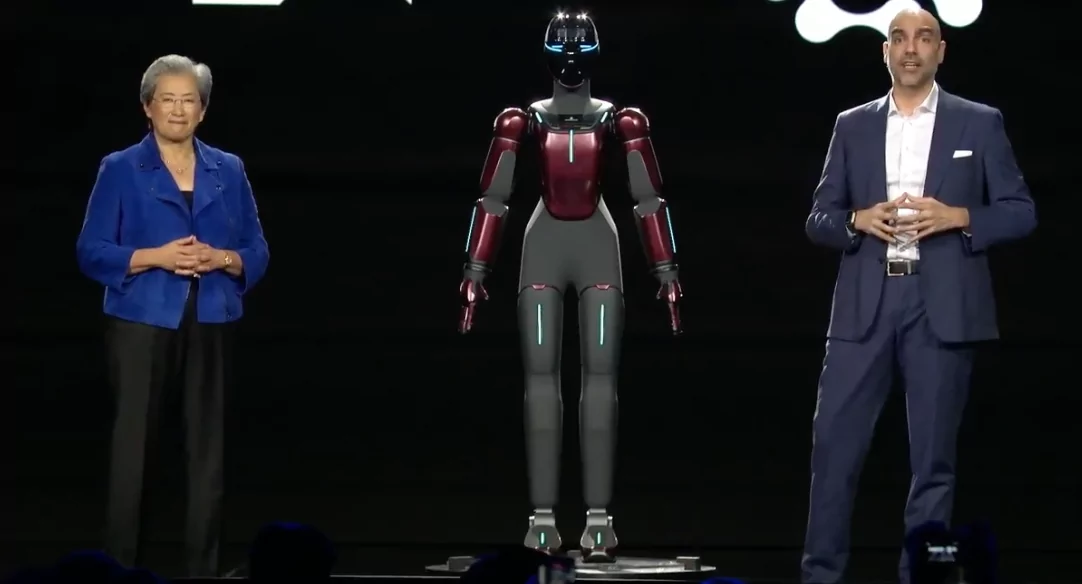
Generative Bionics, a Genoa-based start-up that recently raised €70 million for the development of humanoid robots based on physical AI, presented its first concept, called GENE.01, at CES 2026, which was unveiled on the main stage during AMD’s opening keynote. GENE.01 marks the first appearance of the company’s humanoid robot prototype and defines the visual, physical and technological identity of Generative Bionics’ future products.
During the keynote speech, AMD CEO Lisa Su welcomed Daniele Pucci, CEO of Generative Bionics (pictured together during the presentation), to introduce the company’s vision and the technologies behind the next generation of autonomous humanoid systems. The presentation, which follows the recent announcement of a €70 million funding round, represents the first milestone in the company’s industrial journey.
“Today we are presenting the concept of our new humanoid robot: GENE.01. This platform defines the identity of our Physical AI and paves the way for the launch of the robot in the second half of 2026,” Pucci said in a statement. “With GENE.01, we want to design a humanoid that is as efficient as it is intelligent, inspired by human beings, where intelligence resides not only in the brain but also in the body. AMD technologies allow us to treat the robot’s body as an integral part of the computing system, where mechatronics and artificial intelligence operate as a single system. This includes tactile skin distributed throughout the body, enabling a new level of human-centric physical AI, within a distinctive Italian design where form, function and human experience converge.”
Generative Bionics’ presence in AMD’s keynote highlights the growing strategic convergence between advanced computing architectures and humanoid robotics. AMD is both an investor and technology partner of Generative Bionics, providing and designing high-performance computing solutions on board the robot, high-end CPUs, GPUs and FPGA-based embedded platforms for vision and sensors, dedicated to real-time processing. These technologies power GENE.01’s physical AI stack, enabling instantaneous adaptations across the entire perception, computation and action chain.
“GENE.01 demonstrates what becomes possible when physical AI is supported by a truly comprehensive computing portfolio,” says Salil Raje, senior vice president and general manager of AMD Embedded. – From FPGAs and embedded processors for real-time computing, vision and control, to the latest generation CPUs and GPUs for simulation, training and scalability, all supported by open standards and an open ecosystem, AMD enables partners such as Generative Bionics to innovate faster and build systems designed to evolve. Together, we are redefining human-centric robotics, where the body itself becomes part of the intelligence and computing operates continuously and integrated with the physical world.
GENE.01 represents the foundational design from which all future Generative Bionics humanoids will evolve. The name derives from the term Gene, which indicates the fundamental unit of identity and heredity, the element from which the evolution of Generative Bionics robots begins. GENE.01 is the first seed of a new line of humanoid robots, optimised for different industrial use cases, while maintaining a consistent identity in terms of form, behaviour and interaction.
In GENE.01, the design incorporates tactile sensors distributed throughout the body: this is not an aesthetic layer added after engineering, but an active component of intelligence and safety. The full-body tactile skin is a distributed network of force and contact sensors that allows the robot to sense pressure, interactions and micro-contacts across its entire surface. Touch thus becomes a primary channel of intelligence, enabling safer physical interactions and continuous adaptation in real environments. The robot’s proportions, posture and movement are designed to promote human acceptance, reflecting an Italian approach in which design, engineering and human-machine interaction are inseparable.
AMD technology supports GENE.01 on three fundamental pillars: body as compute: AMD’s near-sensor, high-performance processing blends physical dynamics and digital intelligence in real time, transforming the robot’s body into a computational resource without compromising efficiency; interaction intelligence through touch: AMD’s low-latency FPGA-based electronics and edge computing integrate high-frequency tactile, visual and force data, enabling safe and responsive interactions; and open-source platform: AMD’s support for open toolchains and computing platforms reinforces Generative Bionics’ commitment and consolidates its open approach, allowing the Physical AI stack to be shared and extended within the ecosystem.
Together, these elements will enable robots not only to execute instructions, but also to learn from physical experience, refine behaviours over time, and respond fluidly to changing conditions in complex industrial settings.
GENE.01 inaugurates Generative Bionics’ demo-based industrial journey, which will unfold throughout 2026, accompanying the company towards its first commercial implementations and bringing autonomous industrial humanoids from concept to real-world operation in highly complex industrial environments.
ALL RIGHTS RESERVED ©