Table of contents
- A €19 trillion economy that struggles to tell its own story
- The EIB as a systemic lever
- 35 scale-ups, 11 unicorns: the names behind the figures
- EU Inc: Set up a company in 48 hours, anywhere in Europe
- Defence, security, deep tech: the EIB’s new scope
- The Italian component: CDP and the EIB – an axis that needs to be better utilised
- The 11 European unicorns backed by the EIB
- The 35 scale-ups: Europe’s growing pipeline
There is one sentence worth noting above all others: “Europe is not lagging behind. It is simply underestimated.” These words were spoken by Nadia Calviño, President of the European Investment Bank, and they do not sound like a standard defence, but rather like a bold statement.
The recent EIB Forum 2026 in March provided an opportunity to bring together data, strategies and ambitions. The title of the plan is telling: ‘Going big, going fast’. It is not just a slogan. It is an operational direction that Europe is seeking to put into practice, backed up by hard figures.
A €19 trillion economy that struggles to tell its own story
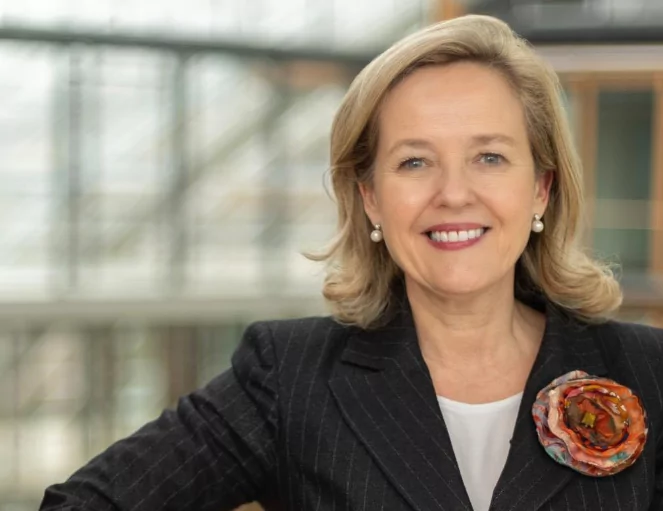
Calviño (pictured) starts with the basics. The European Union drives a €19 trillion economy, has nearly 500 million consumers in the single market, and continues to demonstrate leadership in sectors such as artificial intelligence, biotech and cleantech. Yet the prevailing narrative, particularly when compared with the United States and China, tends to portray Europe as a region perpetually playing catch-up.
The most interesting point to emerge from the EIB President’s remarks is not economic, but perceptual: in the rest of the world, the EU is increasingly seen as a power on a par with the major geopolitical blocs. “Sometimes others see us more clearly than we see ourselves” is the idea that emerges between the lines of her argument.
The EIB as a systemic lever
The European Investment Bank is no longer merely the continent’s leading public financier of infrastructure. With a budget of €600 billion and around €100 billion in funding disbursed each year, the EIB is building what amounts to a pan-European financial ecosystem. Its multiplier effect is significant: every euro of public investment generates an average of €15 in total investment.
From green bonds – an area in which the EIB is a global pioneer – to venture debt, and new mechanisms designed specifically to support scale-ups in their growth phase, the bank is reorienting itself around a clear objective: to bridge the gap between Europe’s ability to generate start-ups and its – hitherto more modest – capacity to help them scale up.
35 scale-ups, 11 unicorns: the names behind the figures
The figures that Calviño highlighted in March (also featured in Marcello Ascani’s podcast, which is how I first came across them) point to tangible results: through the TechEU programme and the European Tech Champions Initiative, the EIB has supported the growth of 35 European scale-ups and contributed to the creation or consolidation of 11 unicorns.
Among the most notable names are: Odoo (Belgium), the modular ERP system that has won over SMEs worldwide; DeepL (Germany), which has become a global benchmark in natural language processing; Contentsquare (France), one of the most widely used enterprise-level UX analytics platforms; Factorial (Spain), an HR software company experiencing rapid international expansion; Flatpay (Denmark), a fintech company focused on digital payments. And then there are Cognigy, Commercetools, EcoVadis, Framer, Fever and Perk, forming an ecosystem that spans various sectors, from SaaS to insurtech, from marketplaces to payments.
The list of scale-ups that have not yet achieved unicorn status is equally indicative of the quality of the portfolio: from Mistral AI and Aleph Alpha in European generative AI, to Qonto and Spendesk in fintech, and Scalapay – the only Italian company on the list – in the ‘buy now, pay later’ sector, as well as Back Market and Vinted in the second-hand marketplace sector.
EU Inc: Set up a company in 48 hours, anywhere in Europe
In terms of reducing red tape, the European Commission has introduced EU Inc, a company registration scheme designed to overcome the regulatory fragmentation that still hinders start-ups in their cross-border expansion. The process is straightforward: a company can be incorporated entirely online in under 48 hours, at a cost of less than €100 and with no minimum capital requirements, and will be recognised in all Member States.
The timetable has been finalised: formal approval is expected by the end of 2026, with the regulations coming into force in early 2027 and the digital portals going live later that year. If the schedule is adhered to, it will mark a structural transformation in the way businesses are set up in Europe.
Defence, security, deep tech: the EIB’s new scope
There is one point that deserves special attention. The EIB has expanded its operational mandate to include the financing of defence and security-related projects. This is not a technical detail: it is a cultural paradigm shift even before it is a financial one. Drones, cybersecurity, military infrastructure and deep tech are now falling within the remit of the European public bank’s instruments. Europe is beginning to treat security as an industrial asset, not as an expenditure item separate from the logic of innovation.
The Italian component: CDP and the EIB – an axis that needs to be better utilised
The EIB’s policy is clear: more integration, more investment, less bureaucracy, more global partnerships. Italy now needs to work with incubators, accelerators and industry players to explore how to effectively tap into this framework. Otherwise, there is a risk of becoming mere spectators in a process that affects everyone but which, without coordinated action, will ultimately reward those who are already organised to capitalise on it.
In fact, the institutional channel already exists and has just been strengthened. The EIB is the financial arm of the European Union, whilst Cassa Depositi e Prestiti is Italy’s leading national development and investment institution. Together, they work to channel European resources into concrete projects across the country. On 3 March 2026, in Luxembourg, the EIB Group and Cassa Depositi e Prestiti signed a new memorandum of understanding with the aim of deepening strategic cooperation in support of Italy’s long-term development and the objectives of European Union policies.
This is not merely an agreement in principle. The EIB and CDP have already signed joint transactions worth €1.2 billion in 2025 alone, and the new MoU broadens the scope of their collaboration: the institutions will work together to optimise the use of regional, national and European resources, including through advisory platforms, European Union programmes and financial instruments, such as InvestEU.
In terms of geographical coverage, CDP has built up a widespread presence over the years, though there is still scope to enhance this in terms of innovation: between 2022 and 2025, it mobilised over €2.6 billion for projects supporting regions, autonomous provinces and regional investee companies, with a network reaching over 78% of Italian municipalities, in areas where 97% of the population lives.
The words of CDP CEO Dario Scannapieco at the signing ceremony represent both an opening and a commitment: “Europe is an economic powerhouse that plays a crucial role on the global stage, and it is important that it acts as a unified system. Our long-standing partnership with the EIB enables us to scale up high-impact initiatives and channel greater financial resources where they can generate lasting economic and social value.”
The EIB also provides CDP with technical and financial advisory services as part of the Green Gateway programme, developed in collaboration with the European Commission to facilitate green investment by European financial institutions. This is a further step in a partnership that goes well beyond traditional finance and which, if properly channelled, could become the main vehicle through which the Italian innovation ecosystem accesses European funding.
‘Going big, going fast’ isn’t a promise. It’s a test. And for Italy, perhaps, it’s the hardest test to pass.
The 11 European unicorns backed by the EIB
Odoo 🇧🇪 Belgium | Modular SaaS/ERP suite for SMEs: from accounting to CRM, from sales to logistics. One of the world’s most widely used open-source ERP software solutions, with over 12 million users in more than 100 countries.
Contentsquare 🇫🇷 France | analytics / UX, a digital experience analytics platform that analyses user behaviour on websites and apps. It helps companies understand how customers interact with digital content in order to optimise conversions and satisfaction.
EcoVadis 🇫🇷 France | ESG / supply chain, a global rating platform for supply chain sustainability. It assesses suppliers’ environmental, social and governance performance and is now the most widely used B2B ESG rating system in the world.
DeepL 🇩🇪 Germany | AI / NLP, a machine translation service based on advanced neural networks. Regarded as the European benchmark in natural language processing, with translation quality that surpasses that of global competitors.
Cognigy 🇩🇪 Germany | AI / conversational automation, an enterprise platform for automating customer service using AI-powered conversational agents. Used by major global companies to manage millions of customer interactions via voice and chat.
Commercetools 🇩🇪 Germany | e-commerce / SaaS, headless and composable e-commerce infrastructure for global businesses. It enables the creation of personalised and flexible shopping experiences by separating the frontend and backend using an API-first architecture.
Framer 🇳🇱 Netherlands | design / no-code interactive design tool for creating websites and advanced prototypes, with direct publishing capabilities. Widely used by designers and product teams to move quickly from prototype to live site.
Fever 🇪🇸 Spain | marketplace / entertainment, a discovery platform for events, experiences and urban entertainment. It connects users and event organisers in over 100 cities worldwide, using a proprietary model for creating and distributing experiences.
Perk 🇪🇺 Europe | HR / benefits, a platform for managing corporate benefits designed to promote employee wellbeing. It helps companies create flexible, bespoke benefits packages to attract and retain talent.
Factorial 🇪🇸 Spain | HR / All-in-one HR SaaS software for SMEs: attendance, leave, payroll, performance and onboarding management on a single platform. With strong international growth, it is one of Europe’s leading players in HR tech for small and medium-sized enterprises.
Flatpay 🇩🇰 Denmark | fintech / payment, a digital payment solution designed for simplicity and scalability. It is aimed at merchants and SMEs, offering a transparent pricing structure and next-generation POS terminals, with no hidden costs.
The 35 scale-ups: Europe’s growing pipeline
In addition to unicorns, the EIB’s portfolio includes a constellation of scale-ups on a strong growth trajectory. Below is an overview based on the ETCI and TechEU programmes, organised by sector.
SaaS / Software
Personio 🇩🇪 Germany | HR software, a comprehensive HR platform for SMEs that integrates recruitment, attendance management, payroll and performance management. One of the best-funded European scale-ups in the sector, with a strong presence in the DACH region and expanding globally.
Spendesk 🇫🇷 France | fintech / expense management, a corporate expense management solution that combines corporate cards, expense reimbursements and invoicing on a single platform. Designed for finance teams in medium-sized businesses seeking real-time visibility and control.
Pigment 🇫🇷 France | business planning / SaaS, a financial planning and data analytics platform for growing businesses. It replaces spreadsheets with a collaborative and flexible environment for FP&A, sales planning and workforce planning.
Qonto 🇫🇷 France | fintech / neobank, a digital current account for SMEs and start-ups with advanced financial management features. Founded in France, it is now one of the most widely used business neobanks in Europe, with over 500,000 active customers.
AI / deeptech
Helsing 🇩🇪 Germany | AI / defence, develops artificial intelligence software for defence and national security applications. It works in partnership with European governments and is one of the few start-ups on the continent focused exclusively on AI for military and strategic use.
Aleph Alpha 🇩🇪 Germany | Generative AI, developing advanced language models with a European approach to data sovereignty and AI explainability. Positioned as a European alternative to OpenAI, it works primarily with public institutions and large corporations.
Mistral AI 🇫🇷 France | Generative AI, a start-up that develops high-performance AI models using an open approach focused on computational efficiency. Within just a few months of its founding, it has become one of Europe’s leading players in generative AI.
Fintech / payments
Mollie 🇳🇱 Netherlands | payment, payment infrastructure for e-commerce and digital platforms. It offers seamless integration with dozens of European and international payment methods, with a strong focus on SMEs in the online retail sector.
Scalapay 🇮🇹 Italy | buy now, pay later, an instalment payment solution for online and in-store purchases. The only Italian start-up on the list, it allows consumers to defer payments interest-free, offering merchants benefits in terms of conversion rates and average transaction value.
SumUp 🇬🇧 United Kingdom | payment / POS terminals and fintech solutions for small businesses and freelancers. With its simple, fee-free offering, it has made accepting electronic payments accessible to everyone across Europe.
Climate / energy
Northvolt 🇸🇪 Sweden | energy / batteries, a European manufacturer of sustainable batteries for electric vehicles and energy storage. Founded with the ambition of establishing a European battery supply chain independent of Asia, it is one of the continent’s most ambitious industrial projects.
Enpal 🇩🇪 Germany | solar energy, a German company specialising in the installation and management of residential solar panels via a subscription model. It makes domestic solar energy accessible without any upfront investment from the customer.
Health / biotech
Owkin 🇫🇷 France | health AI, applies artificial intelligence to medical research and drug development, working with hospitals and pharmaceutical companies to analyse complex clinical data whilst ensuring privacy. One of the most advanced players in health AI in Europe.
Alan 🇫🇷 France | insurtech / healthcare, a digital health insurance company that is reinventing the mutual insurance model through an intuitive app, flexible cover and an approach focused on prevention and employee wellbeing.
Marketplace / consumer
Back Market 🇫🇷 France | marketplace / circular economy, a European marketplace for the sale of refurbished and certified electronic devices. It aims to reduce electronic waste by making the purchase of second-hand smartphones, laptops and tablets convenient and reliable.
Vinted 🇱🇹 Lithuania | marketplace / sustainable fashion, a C2C platform for selling second-hand clothing and accessories. Founded in Lithuania, it has become one of Europe’s largest second-hand marketplaces, with tens of millions of active users across more than 20 countries.
ALL RIGHTS RESERVED ©