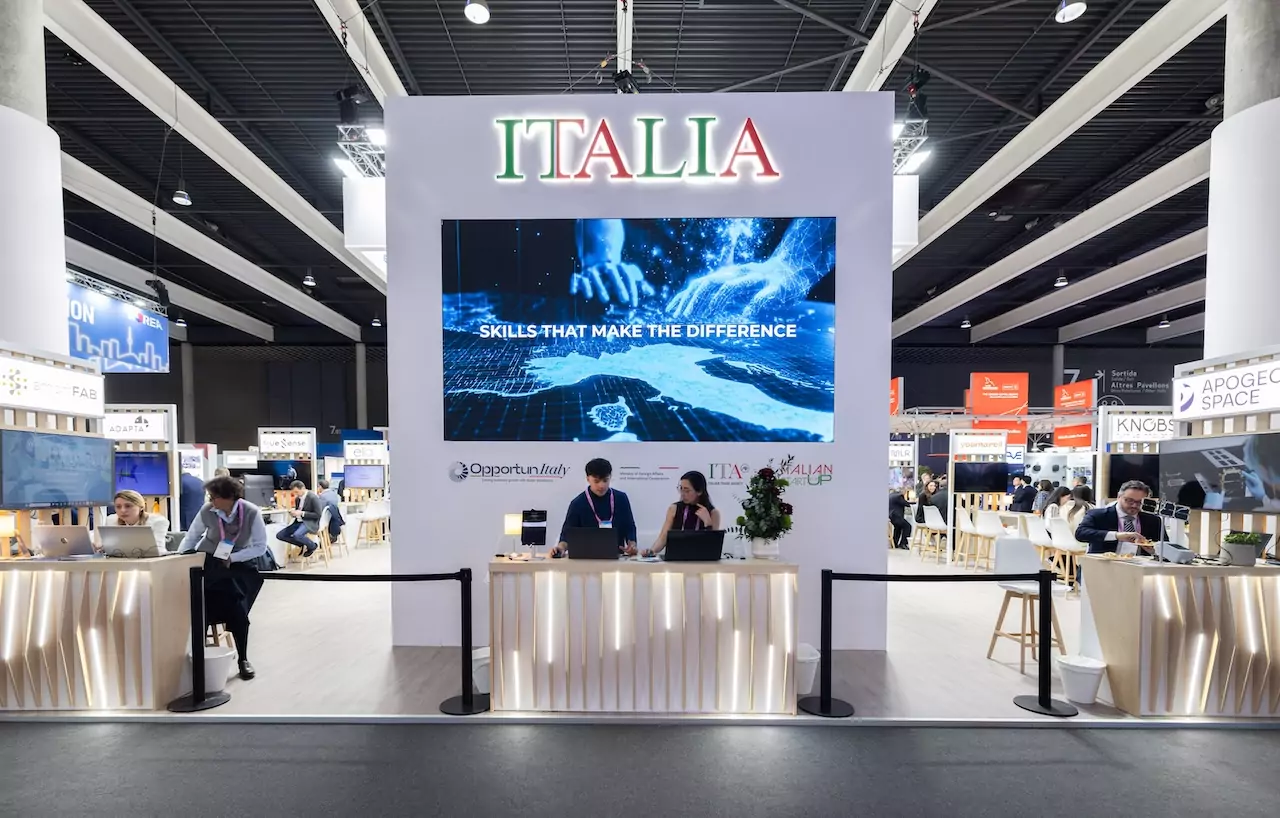
The Mobile World Congress 2026 closed in Barcelona with nearly 105,000 participants from 207 countries and territories, 2,900 exhibitors, sponsors and partners, over 1,700 speakers and nearly 2,600 journalists and analysts. These figures confirm the role of MWC as one of Europe’s leading platforms for discussion on connectivity, artificial intelligence, industry and new business models.
The most significant figure, however, concerns the composition of the fair itself: 58% of participants came from sectors now adjacent to the historic core of furniture. This is the clearest sign of an event that has long since ceased to be solely about smartphones and networks, but increasingly about smart infrastructure, software, cybersecurity, automation and applied AI. The guiding themes for the 2026 edition also point in this direction: Intelligent Infrastructure, ConnectAI, AI 4 Enterprise, AI Nexus, Tech4All and Game Changers describe a market in which artificial intelligence enters networks, processes and platforms as an operational level, no longer as a mere promise.
4YFN confirms its status as one of the most important spaces at MWC for observing the convergence of start-ups, capital and the market. The 2026 edition brought together over 1,000 exhibitors, including start-ups and corporations, more than 300 speakers and investors with total funds of $70 billion. The final prize went to Biorce, a Spanish start-up active in the automation of clinical trial operations with AI agents, which was awarded €20,000.
This is the context for Italy’s presence, led by ICE Agency, with 34 companies active in fields ranging from artificial intelligence to the Internet of Things, healthcare, smart manufacturing, logistics, mobility, cybersecurity and technologies for digital trust. Rather than participation based on publicity, Italy’s profile has been oriented towards verticality, use cases and concrete applications.
“Economic relations between Italy and Spain continue to show particularly positive signs.” According to Chiara Saulle, from the Economic and Commercial Office of the Italian Embassy in Madrid, the presence of 34 Italian companies at MWC 2026 is “further proof of our ecosystem’s ability to offer quality on international markets.” Saulle also highlights the joint efforts of the Embassy, ICE and the Consulate General of Italy in Barcelona in supporting Italian companies even after the fair.
Among the Italian companies present are Epitomea, which specialises in the automation of medical and document compliance processes; Humans, which develops products and services through intelligent interfaces and AI; Icarus, with voice assistants for call management in healthcare and services; and MLR, with WuvDay, in the field of authenticity.
and the verifiability of photos and videos; Social Thingum, active in AI, machine learning and advanced data analysis for the digital transformation of SMEs; VLAB, with TimelapseLab, which applies neural networks and artificial intelligence to remote monitoring of construction sites, including privacy aspects.
One of the themes that emerged in Barcelona concerns European products. Not so much in the sense of an industrial comeback that has already taken place, but rather as a reopening of the question: is there still room in the smartphone market for devices that try to stand out not only for their price or specifications, but also for their identity, software and relationship with the ecosystem?
In this context, Nothing and Jolla represent two different trajectories.
Nothing operates within the dominant ecosystem, but is attempting to establish a distinct position by focusing on product language, software, and community. This strategy has taken on a more defined profile in recent months, even at the corporate level: in September 2025, the company announced a $200 million Series C round at a valuation of $1.3 billion, presenting it as the start of a new phase geared towards an AI consumer platform where hardware and software converge.
It is also useful for interpreting what was shown at MWC 2026. The Phone (4a) range is not just a product update, but also a shift in brand positioning. The base model retains many of the visual elements that have made Nothing recognisable in recent years, while the Pro version introduces a more sober language, less tied to the transparency that defined the first generations. More than just an aesthetic variation, it seems to be an attempt to broaden the audience without completely abandoning the distinctive features built up so far.
Alongside design, Nothing continues to focus on software. Features such as Essential Search, Essential Space, Essential Memory and Playground reinforce the idea of an experience built on top of Android to make the device more personal and contextual. The point here is not to determine whether this ambition has already been achieved, but to observe how Nothing is trying to move from being a visually recognisable brand to a player with its own interface and user experience offering.
Jolla is positioned almost on the opposite side. In Barcelona, the new Jolla Phone was presented not only as a device, but as a proposal that refocuses attention on the idea of a smartphone built around an operating system developed in Europe. This is what distinguishes Jolla from many other exhibitors at the fair: rather than competing head-on with the big global brands, the project emphasises privacy, software control and independence from the dominant platforms.
Jolla links the new phone to Sailfish OS and final assembly in Salo, Finland, also announcing over 10,000 pre-orders collected between December 2025 and February 2026 and more than €5 million in committed sales. These figures are still far from the scale of the big players, but they serve to give substance to a project that seeks to present itself not as a nostalgic exercise, but as a coherent proposal for a niche market sensitive to issues of privacy, durability and repairability.
In terms of the product itself, Jolla seeks to translate these elements into concrete choices: support for Android apps, no dependence on Google accounts, a physical switch to disable sensors, user-replaceable battery, expandable memory. These are not neutral details, because they contribute to defining the phone’s positioning more than the pure race for power or the spectacularisation of the technical specifications.
Side by side, Nothing and Jolla represent two different ways of seeking space in the smartphone market of 2026. Jolla is attempting to bring the theme of European autonomy back to mobile, starting with the operating system and control of the software infrastructure. Nothing, on the other hand, does not question existing ecosystems, but seeks differentiation within them through design, interface and community. On the one hand, there is an attempt to build a more autonomous alternative; on the other, there is an attempt to make oneself recognisable in an increasingly standardised market.
Within this framework, the Italian delegation occupies a less prominent position than other international launches, but one that is consistent with the trajectory shown by the fair: fewer vague promises, more applied technologies; less generic storytelling, more tools for healthcare, industry, telecommunications, security and digital trust. At a MWC that confirms the transformation of mobile into a convergence platform between infrastructure, AI and industry, this is a clear and credible positioning.
ALL RIGHTS RESERVED ©