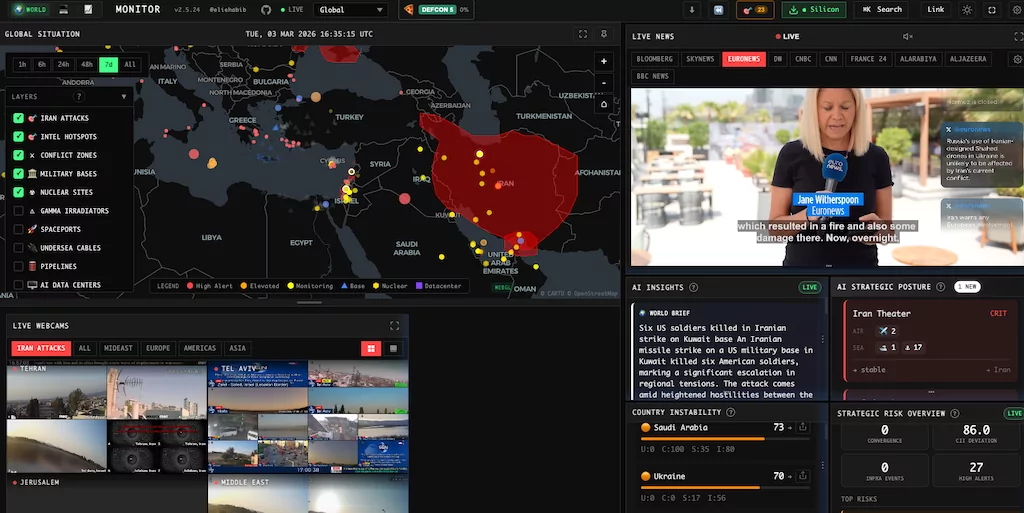
Technically, it is called open source intelligence, or OSINT for short, and refers to the ability to use freely available data to analyse world events and, from there, make analyses and even predictions. OSINT can be used to learn more about economic and social trends around the world, for business development purposes, to decide where to go on holiday, what investments to make, where to move to, and even by journalists conducting investigations and reporting in the media.
There are many OSINT tools, often specific to individual activities. For some time now, there have been news outlets specialising in services based on the in-depth use of digital tools and open source data. Perhaps the best-known example is Bellingcat. There are also OSINT data aggregators that are now available to anyone and, at a time when the world is going through a very deep crisis, they can be useful for better understanding what is happening. There are well-known tools such as those for tracking air traffic in real time, the most popular being Flightradar24, which is useful for viewing in real time which airspaces are closed and which airports are not operational, or maritime traffic, as in the case of Marine Traffic, which is currently very useful for monitoring traffic in the Strait of Hormuz, where oil tankers that normally carry crude oil to consumer countries that purchase it from producer countries are gathering. And then there are tools that integrate different sources into a single interface to offer users the most complete view possible.
One of these tools is becoming quite popular, as was the case with the maps that tracked the number of COVID-19 cases in real time (we wrote about it here), is called World Monitor and was created by a Lebanese entrepreneur named Elie Habib, who gained notoriety for being one of the two co-founders of the start-up Anghami, the first start-up in the Arab world to be listed on the Nasdaq, which was then sold to the multimedia group OSN+.
World Monitor, or similar services such as Watchwar, are a comprehensive example of what effective, organised and open use of the OSINT concept can mean. Using these tools requires a minimum of study; you need to understand their potential and the many options available in order to configure them optimally. However, it is certainly interesting to see how a quantity of information provided in real time from various sources, when unified in a coordinated tool, can really help to provide a comprehensive and constantly updated view of what is happening in the world.
ALL RIGHTS RESERVED ©