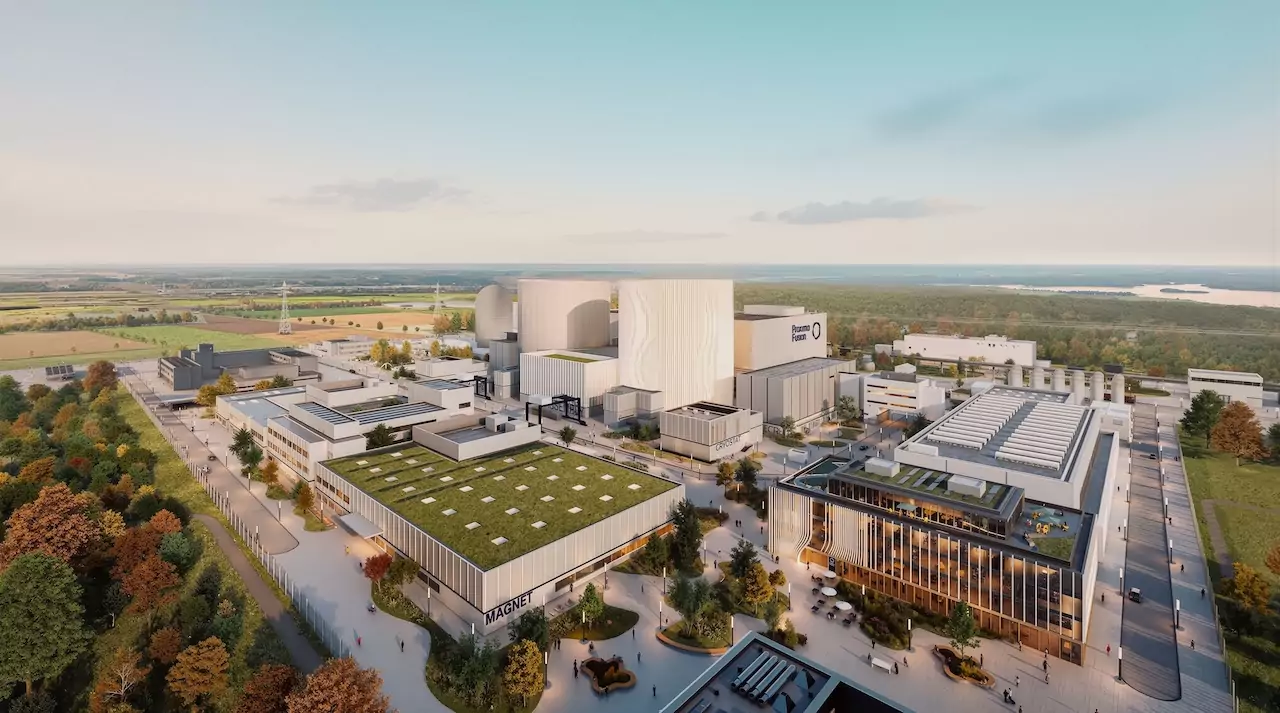
Proxima Fusion, a scale-up company committed to developing nuclear fusion, has announced that it has signed a Memorandum of Understanding (MoU) with the Free State of Bavaria, the Max Planck Institute for Plasma Physics (IPP) and RWE. Under the MoU, the partners undertake to jointly build the first demonstration stellarator, “Alpha”, for the first commercial power plant based on magnetic confinement fusion technology, called “Stellaris” (shown in the image).
Fusion energy is a clean and safe form of energy, continuous and therefore capable of covering basic needs, and largely independent of access to limited raw materials. It strengthens Europe’s energy sovereignty and industrial competitiveness and, unlike nuclear fission, does not produce long-lived radioactive waste.
The MoU sets out a roadmap towards “Stellaris”, Europe’s first grid-connected magnetic fusion power plant. The planned site for its construction is Gundremmingen, Bavaria, where RWE is currently dismantling a former nuclear power plant, thus freeing up the space needed to build Europe’s first fusion power plant. The partners have agreed to work together on the conversion of the existing infrastructure. RWE is contributing to the collaboration with its extensive experience in power plant management and its know-how in authorisation processes. This will bring significant time and cost advantages in the global competition to build the first commercial fusion power plant. Its construction in Germany is provided for in the federal government’s coalition agreement and confirmed by the German High-Tech Agenda and the National Fusion Plan.
As part of the MoU, the four partners have agreed to begin construction of the Alpha demonstration stellarator. Designed to be the most advanced stellarator in the world, Alpha aims to demonstrate positive plasma energy balance for the first time, i.e. producing more net energy than is required to generate it. Alpha therefore represents a step towards making the investment more efficient in order to reduce risks in a targeted manner, significantly accelerating the path towards commercial use. The demonstrator allows key technologies to be tested under realistic conditions, knowledge to be acquired quickly through short development cycles, and technological and economic risks to be systematically reduced, without having to immediately face the full complexity and financial risk of a commercial system.
The IPP will take the lead in plasma physics and scientific management of the Alpha project, while Proxima Fusion will be responsible for engineering, public procurement procedures and construction of the demonstrator. Project planning is based on a joint co-financing model combining public funds and private capital.
Proxima Fusion intends to finance approximately 20% of the total project cost through private international investors. RWE has also expressed its willingness to participate financially as part of the memorandum of understanding. Subject to the allocation of federal funds, the Free State of Bavaria offers, in accordance with budgetary constraints, possible regional co-financing of 20%. All four partners will coordinate their efforts to maximise the chances of obtaining federal funding under the German High-Tech Agenda.
The memorandum of understanding establishes a financing and implementation model that aligns research institutes, government and the private sector and consolidates magnetic fusion as an industrial reality in which to invest. It sets out a clear investment framework for public funding and private capital that will accelerate the industrial-scale deployment of fusion energy in Europe, create jobs and strengthen value creation across the supply chain.
Most of the investment in the Alpha demonstrator will flow directly into the industrial supply chain. For the first time, European industrial expertise in the field of fusion is concentrated around a concrete and feasible engineering project, designed from the outset for commercial development and marking the transition from research excellence to industrial implementation. The partners expect that the construction phases of Alpha and Stellaris alone will create several thousand jobs and trigger a strong surge in industrial orders and investments, supported by a multi-year pipeline of contracts along the European supply chain – from manufacturing and construction to superconducting magnets, power electronics and power plant infrastructure. The goal is to industrialise fusion energy in Europe and establish it as a key pillar of greater energy independence.
Francesco Sciortino, co-founder and CEO of Proxima Fusion, said in a statement: “This memorandum of understanding is a milestone that clearly positions the European fusion industry on the global stage. It marks the beginning of an industrial ecosystem that consolidates existing and new know-how in Europe and anchors value creation there. This opens up a long-term industrial growth trajectory for the coming decades, creating new export opportunities for Germany and Europe. With Alpha in Garching and Stellaris in Gundremmingen, we are connecting world-class research, high-tech innovation financed by both private and public funds, and their industrial implementation for the first time in Europe at a single site. Bavaria is evolving from a research centre to an industrial hub for fusion. Together with the Free State of Bavaria, RWE and the Max Planck Institute for Plasma Physics, we are working to commission Germany’s first commercial fusion power plant. This is a strong and visible signal at international level that Europe is actively shaping its own energy future.
Markus Söder, President of the Bavarian State Government: “Another milestone in Bavaria’s high-tech history: nuclear fusion is a completely new technology for stable, CO2-free and clean base load energy production in virtually unlimited quantities. This will enable us to meet the exponential demand for electricity associated with electric mobility, artificial intelligence and data centres. Bavaria is participating with the utmost determination in the global competition for this energy source of the future. Today, we launched a partnership between the RWE energy group, the start-up Proxima Fusion and the Max Planck Institute for Plasma Physics in Garching, a world leader in the field. Bavaria is playing its “double game” in fusion: we are planning an “Alpha” demonstration reactor in Garching, near Munich, and a “Stellaris” fusion power plant in Gundremmingen. In this way, the technology is being studied and its feasibility tested in reality. Proxima Fusion, with private investors, wants to build a magnet factory and expects to create up to 1,000 jobs. One of the world’s largest conferences for investors looking at this sector is currently being held in Munich. The Free State of Bavaria is supporting this research into magnetic fusion as part of the High-tech Agenda Bayern with up to €400 million, and the federal government also intends to participate with the High-tech Agenda Deutschland. This is a huge undertaking, with Alpha alone requiring €2 billion. But courage and strength are needed to explore the technologies of the future and transfer them from science to economic application. Only by investing heavily in technology can we preserve our opportunities for prosperity in the future.
Markus Blume, Bavarian Minister of Science and the Arts: “Alpha” represents a milestone on the road to building the first commercial fusion power plant on German and Bavarian soil. Seventy years ago, with the research reactor in Garching, we were a pioneering site, hosting the first nuclear plant in Germany, and today we want to be a pioneer again, with the national demonstration reactor for nuclear fusion. The Memorandum of Understanding is also the result of Bavarian innovation: we were the first federal state to define nuclear fusion as a strategic mission. With the Masterplan Kernfusion, we began the journey to bring fusion from research to application as early as 2023. What was met with scepticism at the time is now becoming a reality. We have invested and will continue to invest because we believe in this technology and are convinced of the strength of our unique ecosystem. Together, we can turn a decades-long dream into reality.”
Hubert Aiwanger, Bavarian Minister of Economic Affairs, Regional Development and Energy: “Bavaria is in an excellent position to host the first magnetic fusion demonstrator. We combine the world-class research expertise of the IPP with the engineering skills of Proxima Fusion’s founders. In this way, we transform our excellence into industrial and strategic competitive advantages.
Markus Krebber, CEO of RWE: “The potential of fusion technology for the energy supply of the future is enormous. Thanks to an excellent research ecosystem and the start-ups that have emerged from it, such as Proxima Fusion, Germany can take on a pioneering role. It is therefore positive that the federal and regional governments are jointly pursuing the goal of building the world’s first commercial fusion reactor in Germany. We at RWE want to wholeheartedly support this project. Our decommissioning sites, with their existing nuclear infrastructure, combined with our operational experience, offer the ideal conditions to secure time and cost advantages for Germany in the international competition.”
Sibylle Günter, Scientific Director of the Max Planck Institute for Plasma Physics (IPP): “The scientific results achieved in recent years have laid a solid foundation – now we can build on them through a public-private partnership for the concrete development of a new-generation fusion power plant. With the IPP, Germany is a world leader in stellarator research, and thanks to this Memorandum of Understanding, we have the opportunity to consolidate and further expand this leadership.”
In a separate announcement also concerning the Proxima Fusion project, Proxima Fusion also announced the creation of the Alpha Alliance, an industrial consortium bringing together more than 30 European and international companies to build Alpha, the demonstration stellarator for net fusion energy production. The announcement of the Alliance accompanies the important signing of the MoU between Proxima Fusion, the Free State of Bavaria, the IPP and RWE, and was established to ensure the industrial realisation of Alpha by coordinating production, systems integration and supply chains. Members contribute the necessary expertise in materials, components, assembly and infrastructure to industrialise and scale up fusion systems.
For the first time, a broad cross-section of the European industrial ecosystem active in fusion, supported by selected international partners, is coming together around a single concrete engineering project designed to scale up to commercial level.
Based on this well-defined engineering goal, the Alpha Alliance provides a structured framework to prepare the European industrial base not only for the realisation of Alpha, but also for the large-scale deployment of fusion. This approach guides investment, reduces learning cycles and accelerates the construction of a competitive fusion supply chain. The construction of Alpha could create several thousand jobs during its implementation phases and could activate a multi-year portfolio of industrial contracts, ranging from manufacturing to construction, from superconducting magnets to power electronics and power plant infrastructure.
“With Alpha, fusion enters a phase where industrial execution becomes decisive,” says Sciortino. “The Alpha Alliance brings together complementary industrial skills to ensure that complex fusion systems can be produced, integrated and deployed on a large scale in Europe.”
Members of the Alpha Alliance include: AFRY, Ampegon, Bilfinger (BNET), Daher Logistik GmbH, Diamond Materials GmbH, Dockweiler AG, ENI, ENSA, DWE, Faraday Factory Japan, Framatome GmbH, Fujikura, Kraftanlagen (Heidelberg), Kraftanlagen (Munich), Kyoto Fusioneering GmbH, Mühlbauer, Pfeiffer Vacuum GmbH, ProBeam, Rolf Kind, Siemens Energy, SIMIC, Thales, Theva, Trumpf, TÜV Rheinland, VIA Electronic GmbH, Wällischmiller GmbH and Walter Tosto.
“Fusion has become a strategic and industrial race, and Europe is entering this phase with world-class science and a solid industrial base. With Alpha, we are building the bridge between decades of publicly funded fusion research and its realisation on an industrial scale. The Alpha Alliance expresses the shared commitment of European industry to transform this leadership into industrial capacity. By aligning expertise across the entire supply chain, we are creating the conditions to build large-scale fusion systems and position Europe at the forefront of the transition of fusion energy from theory to reality,” says Lucio Milanese, chief external affairs officer and co-founder of Proxima Fusion.
Air Liquide is proud to bring over 20 years of experience in advanced cryogenics to the Alpha Alliance for leading deep-tech and fusion projects around the world. Our cutting-edge cryogenic solutions and engineering capabilities provide the critical infrastructure needed to enable large-scale superconductivity. By applying our industrial know-how, we are helping to accelerate the transition of fusion from a scientific goal to a sustainable, low-carbon source of energy connected to the grid,” said Philippe Merino, Vice President, Air Liquide Engineering & Technologies.
“The future of energy generation requires visionary ideas, a pioneering spirit in scientific research and components capable of withstanding the most extreme conditions. Proxima Fusion is a perfect example of the application of cutting-edge technologies in the fusion era. For the structural support system of the magnets in Proxima Fusion’s stellarator, Rolf Kind GmbH supplies forged components made of high-alloy stainless steels, designed to withstand extreme mechanical loads and magnetic forces at cryogenic temperatures. Projects such as Proxima Fusion’s Alpha demonstrator show how German engineering excellence, scientific precision and international collaboration can generate concrete progress. As a family-owned company with decades of experience in special alloys, we see ourselves not simply as a supplier, but as a technology partner and enabler. We thank Proxima Fusion for their trust in our expertise and are proud to be part of this pioneering project to realise sustainable energy technologies,” Markus Kind, Managing Director, Rolf Kind.
ALL RIGHTS RESERVED ©