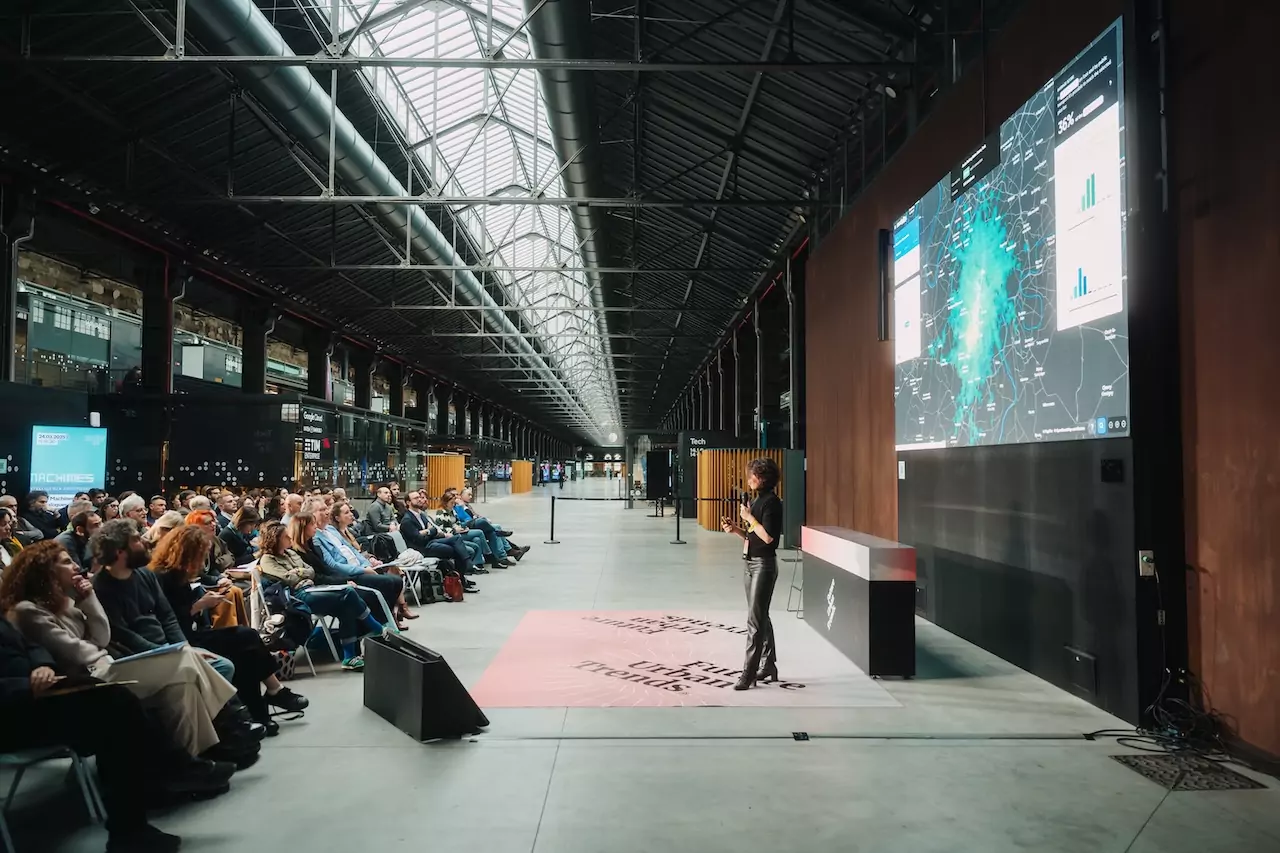
Future Urban Trends returns for its fourth edition. The event, organised by Stratosferica, is dedicated to technology, innovation, culture and urban society. The 2026 edition of the event will take place on 26 March in Turin (click here for free registration) and will address trends that are moving from theory to application on a global scale. This year’s focus is on invisible infrastructure and regenerative solutions: from logistics that free up roads to innovations in the construction sector that reverse the effects of climate change.
Taking to the stage for the first time in Italy are the founders and managers of four companies that are setting new market standards: Last-Mile Robotics, how autonomous robots are transforming pedestrian spaces into a new logistics infrastructure with Starship Technologies, a Latvian company founded by the co-creators of Skype, which has already made millions of zero-emission deliveries with its autonomous rovers. The exponential expansion of e-commerce has saturated urban streets. The answer to congestion is not to add vehicles, but to reduce their size. Last-Mile Robotics moves logistics from the roadway to the pavement, introducing fleets of autonomous, lightweight and silent devices. An invisible revolution that promises to eliminate local emissions and streamline commercial traffic, but raises new, urgent questions about design and coexistence in pedestrian spaces. Imagine that traffic congestion generated by delivery vans is just a memory. Starship Technologies is turning this vision into reality. Founded by the co-creators of Skype, the company has introduced a radical solution for local delivery: small, self-driving electric vehicles. Lisa Johnson is vice president of global public affairs at Starship Technologies. With twenty years of experience in Europe and the US, she supports governments in regulatory adaptation for robotics and embodied AI. Already active With millions of commercial deliveries already made, Starship poses a challenge to the trade union movement during the rise of the gig economy. Today, it works to connect engineering and policy makers, defining the conditions for the evolution of immediate urban planning: the redefinition of technology and society as a whole. Their robots, capable of mapping the environment and navigating safely among pedestrians, suggest a new coexistence between automation and public life, offering a scalable response to pollution and the inefficiency of traditional logistics.
Carbon-Negative Materials, construction beyond sustainability, towards atmospheric regeneration with German scale-up Made of Air, which transforms biomass waste into thermoplastic materials capable of permanently storing CO2, replacing fossil-based plastics. Carbon-Negative Material shows how the future of construction lies in carbon-negative materials, capable of permanently storing more CO2 than is emitted to produce them, transforming biomass waste into durable resources. Buildings go from being responsible for the climate crisis to active tools for atmospheric regeneration. The built environment thus becomes a carbon sink, as functional as a forest. Building cities that not only reduce emissions but actively remove them from the atmosphere. Made of Air combats climate change by transforming wood and biomass waste into negative-emission materials. Their proprietary technology converts waste material into biochar. Founder and CEO of Made of Air, Allison Dring explains how this high-carbon material is used to create durable thermoplastic compounds and works to develop climate-positive technologies.
Waterways Regeneration, smart and non-invasive technologies for the health of urban waterways with The Great Bubble Barrier, based in the Netherlands, offering an award-winning solution that uses curtains of air bubbles to block plastic in rivers without hindering wildlife or navigation. The rivers that flow through our cities are the main carriers of plastic to the oceans. Intercepting this flow before it reaches the sea is the ecological challenge of the decade. New River Plastic Interception technologies act as dynamic filters, exploiting fluid physics and non-invasive systems to capture waste without hindering navigation or wildlife. This approach restores the ecological function of waterways, integrating environmental clean-up into the daily metabolism of the city. Eighty per cent of the plastic polluting our oceans comes from rivers. The Great Bubble Barrier has developed an elegant solution to intercept this flow before it reaches the sea: a curtain of air bubbles that blocks plastic waste while allowing fish and boats to pass freely. Anne Marieke Eveleens is co-founder and chief business development officer of The Great Bubble, which was born in Amsterdam from the intuition of three sailors who, inspired by their voyages, co-developed the technology that intercepts plastic, and an environmental engineer. This technology exploits the natural movement of water along the entire depth of waterways and is already active in several European cities to protect nature reserves and UNESCO sites, diverting waste to a side collection system. A 24/7 operating system that offers cities a concrete tool to clean up their blue arteries, protecting the marine ecosystem without impacting navigability or wildlife.
Digitising the Streets, the digitisation of parking spaces for more fluid cities with Coding the Curbs, also from the Netherlands, which offers a platform that introduces smart zones, allowing digital booking of loading/unloading spaces to eliminate urban congestion. For a century, we have managed our streets with paint and fixed signs. Today, the rigidity of the street is giving way to the fluidity of data. Digitising the Street means applying digital intelligence to physical infrastructure: loading, parking and transit zones become programmable, changing their function according to the time of day and actual demand. Data-driven management optimises logistics flows and recovers precious square metres for urban liveability. The pavement is the new frontier of urban contention. Between deliveries, parking and soft mobility, space is increasingly scarce. Coding the Curbs offers a digital solution to transform the static management of roadside margins into a dynamic and flexible system. Through the creation of Smart Zones. Iskandar Tange is the founder and CEO of Coding The Curbs, which creates bookable Smart Zones. Their platform allows couriers to reserve loading and unloading spaces. He has worked with global clients and partners on countless strategic projects, co-creation sessions and workshops on mobility, smart cities, eliminating double parking and reducing traffic. With Coding the Curbs, he has created an international start-up with a team of excellence born from the collaboration between urban designers and logistics experts. The project brings intelligence back to road infrastructure. By optimising logistics flows, Coding the Curbs frees up valuable space for citizens, demonstrating how data can transform a congestion problem into an opportunity for liveability.
Launched in 2017 as a research project by Stratosferica and Urban Knowledge & Agency, Future Urban Trends is now an event-platform that serves as a reference point in Italy on urban tech issues. It is aimed at entrepreneurs, CEOs, managers and business developers of start-ups, scale-ups, SMEs and large companies, as well as researchers and talented individuals involved in key sectors of innovation and contemporary life.
The event maintains its format, which includes four international keynote speeches, an in-depth session with Italian experts in the fields of innovation and real estate, and a parallel business matching session, providing an opportunity for CEOs, entrepreneurs, public administrators and professionals to meet the protagonists of change and generate new business opportunities.
ALL RIGHTS RESERVED ©