Table of contents
There is one approach to innovation that starts with solutions and then looks for problems. And then there is another, much rarer approach, which is willing to spend time at the outset to really understand what is missing. AquaBEHER falls into the second category.
It didn’t start out as software, nor as a product concept. It arose from a gap identified in the field, following years of work within farming communities. Leonardo Caproni, a researcher at the Sant’Anna School of Advanced Studies in Pisa, puts it bluntly: “We hadn’t set out to develop software to predict the start or duration of the rains. Over five years of teamwork in the field alongside other colleagues, we gathered the needs expressed by local farming communities. And it became clear that the real limiting factor was the uncertainty surrounding the start of the rainy season. That’s where the technology came from.”
This sentence changes everything. Because it describes an innovation that does not anticipate a need, but intercepts it as it emerges, assesses it and validates it. There is no stroke of genius, just a process. There is no product roadmap; there is a problem that persists until it finds a technical solution.
Becoming part of a wider system
AquaBEHER is not a stand-alone project today. It is one of the tools developed as part of ESATRE – Ghana (Enhancing Sustainable Agriculture and Transhumance Regulation in Ghana), an initiative of the Sant’Anna School of Advanced Studies in Pisa, funded by the Italian Ministry of Foreign Affairs and International Cooperation, which aims to strengthen climate resilience through data, tools and governance. The aim is not merely to improve agriculture, but to address a broader system: natural resource management, balance between farming and pastoralist communities, and conflict prevention.
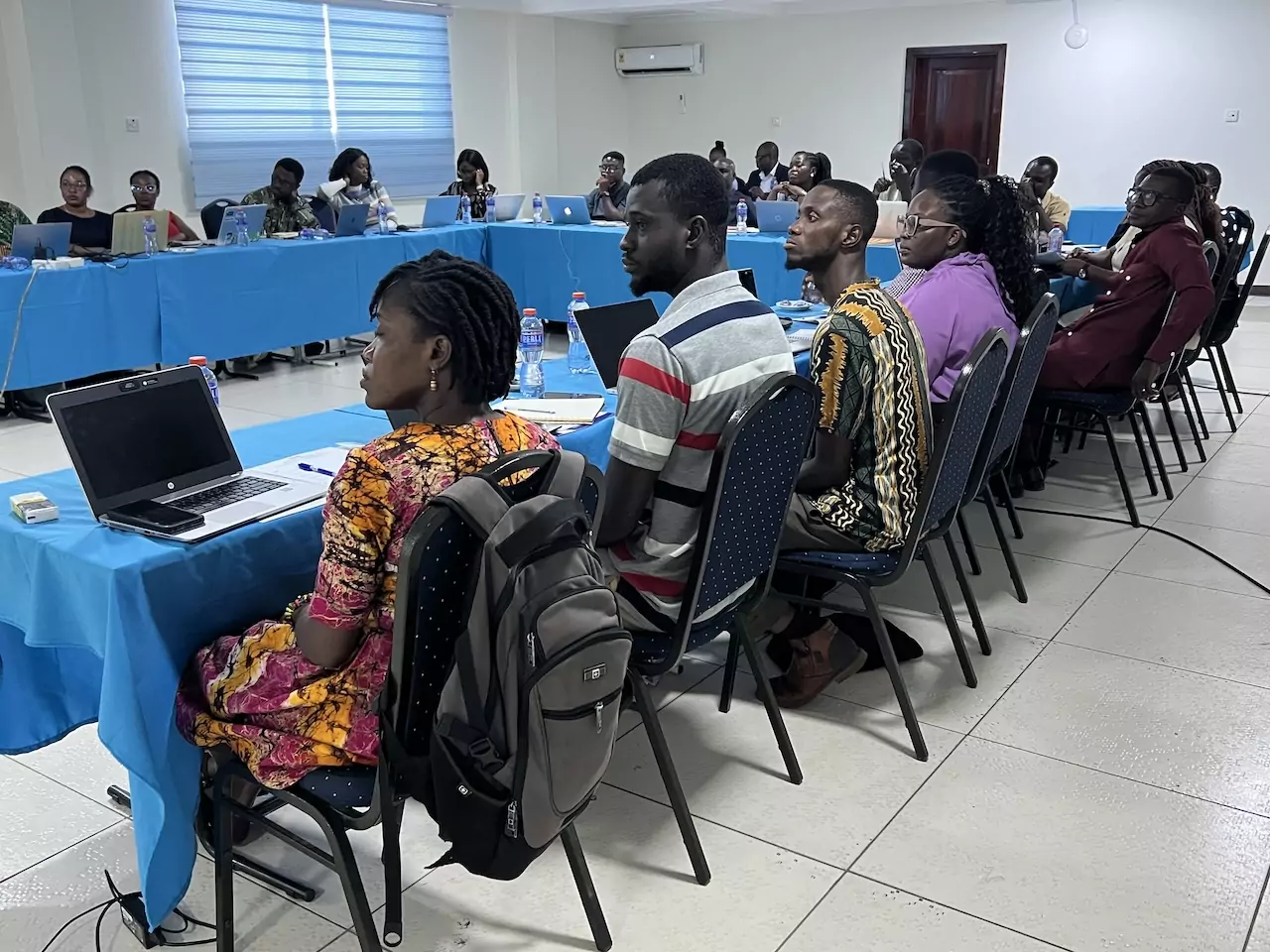
This approach has also led to concrete operational steps. In Ghana, the project has already taken shape in a workshop involving young researchers and local institutions, working directly on the use of the platform. Not a demonstration event, but a key step: transferring skills, testing the tool in a real-world context, understanding how it can be used within national structures. It is at moments like these that a technology ceases to be a prototype and begins to become a decision-making infrastructure.
Useful tips
It is within this context that AquaBEHER takes shape: a model that seeks to answer a very practical question – not when it rains, but when water is actually needed. Robel Takele Miteku, the agro-meteorologist behind the project, makes this abundantly clear: “Generally, meteorological agencies work on a climatological definition of the rainy season. We are trying to establish a definition that is relevant to crop growth, namely how much water is actually available in the soil.”
It may seem like a semantic difference, but it isn’t. Once the rainy season becomes an agronomic variable, it is no longer just general information but an operational tool. It means being able to tell those who make their living from farming not only that rain is on the way, but also whether that rain will be sufficient to sustain a production cycle on which the livelihood of their community also depends.
This is where technology ceases to be merely descriptive and becomes decision-making. And it does so under conditions that are far from ideal. The system operates with limited data, often incomplete, in contexts where infrastructure is limited. This is not a minor detail, but a design choice. As Miteku points out, “The main challenge is working with limited data given the required accuracy. With more data, we could use more complex models, but today we have to make the system work with the bare minimum.”
This lesson holds true even outside the agricultural sector: innovation does not mean adding complexity, but making use of what is already available.
Sowing data where it will flourish
But knowing when to sow is not enough if the information is not usable. That is why AquaBEHER does not simply produce data: it is conceived and developed in collaboration with those who will actually use it. Leonardo Caproni puts it plainly: “You can only successfully implement any technology if it meets real needs, and this depends on the involvement of stakeholders.” This means working with local institutions, meteorological services, researchers and end-users to understand how climate information should be produced, interpreted and distributed.
The workshop in Ghana should also be viewed in this light. It is not just about training, but also about assessment: who uses the tool, with what skills, and in which decision-making processes. That is where its true value emerges, but also its limitations. Because the problem is not merely generating information, but ensuring it reaches the point where it becomes a decision. And this requires adaptation, simple interfaces, and institutional capacity. Technology, on its own, is not enough. It must be designed in such a way that someone can actually use it.
Martha Populin, an expert in rural development and transhumance, emphasises that the project is important because it broadens the perspective beyond agriculture. Many coastal communities, particularly in Ghana, invest little in transhumance-based livestock farming, and there are few policies and funding available, resulting in a heavy reliance on meat imports. “By including transhumance in the project, we wanted to show that there is an important part of the Ghanaian diet in which little is invested,” explains the researcher, also highlighting the need for clear governance of the initiative. Across West Africa and in Ghana, tensions sometimes arise between herders and farmers, often linked to inadequate management of transhumance. “It is important that AquaBEHER is placed in the hands of those who can use it to benefit all the communities involved, whether they are herders or farmers. That is why we are holding meetings with pastoral associations, the Ministry of Agriculture and the Inter-ministerial Committee. We want to ensure that the information is used correctly and does not generate conflicts,” she adds.
Furthermore, AquaBEHER can help to manage herd movements in a sustainable way: the tool identifies areas with good grazing potential and, if the information is shared effectively with local stakeholders, herders can be guided to avoid overcrowding and damage to cultivated fields. “If used incorrectly, there is a risk of conflict and damage, whereas if used correctly, it can truly become a tool for the sustainable management of transhumance,” he concludes.
Genetics comes into play
The direction is already clear. The next step is to combine climate data with genetic improvement, developing varieties capable of adapting to increasingly unpredictable seasons. Caproni puts it this way: “We must select varieties that can adapt to climate variability. If they do not exist, we must and can produce them.”
It is not about creating one-size-fits-all solutions, but about tackling local problems with advanced tools. Caproni himself makes this clear: “The aim is to use advanced technologies to solve small, local problems, putting the fruits of innovation in the hands of farmers rather than using them to fuel large-scale extractive models.”
Here we can glimpse the next possible development: deeper integration with genetic data and assisted selection, capable of making these solutions even more precise, whilst remaining within an adaptive and personalised framework rather than a standardised one.
The seat of power
A system that takes account of the changing seasons is not just useful for deciding when to sow. It helps to plan land use, manage pastures, organise transhumance movements and allocate resources. Caproni puts it bluntly: “The ability to predict is power.”
And this is where innovation becomes a political issue. AquaBEHER is free, replicable and open-source. It can be used by public institutions or integrated into private products. But the difference between these two scenarios is enormous. Caproni emphasises: “This kind of approach should be implemented as a public service, because the information it generates translates into real-world decisions.”
According to Populin, governance must also be regional: “There may be considerable interest in various countries, both in those such as Ghana, where nomadic herders are in the minority, and in the Sahel countries, where pastoralist communities are far more numerous. The ideal would be regional governance of transhumance, with annual meetings before the start of the season to establish rules and requirements, using existing tools that have never been applied due to a lack of cooperation.”
To foresee is to decide
There is one final element, which is often underestimated: technology only works if someone is able to maintain it over time. Caproni sums it up as follows: “Technology is only useful if someone on the ground can maintain it.” This means skills, training, infrastructure and continuity. Without these elements, even the most advanced system remains a prototype. Projects such as ESATRE address precisely this aspect: they do not merely develop tools, but build local capacity, engage institutions and train researchers. Only in this way can innovation scale up and endure.
In this sense, AquaBEHER is not merely an agrometeorological tool. It is a model of direction: it demonstrates what happens when technology is born out of listening, adapts to real-world constraints and, above all, considers how to distribute the value it creates. Ultimately, the question remains open: not what we are capable of predicting, but what we decide to do with that ability. (The author’s photo shows a moment during the project development work).
ALL RIGHTS RESERVED ©