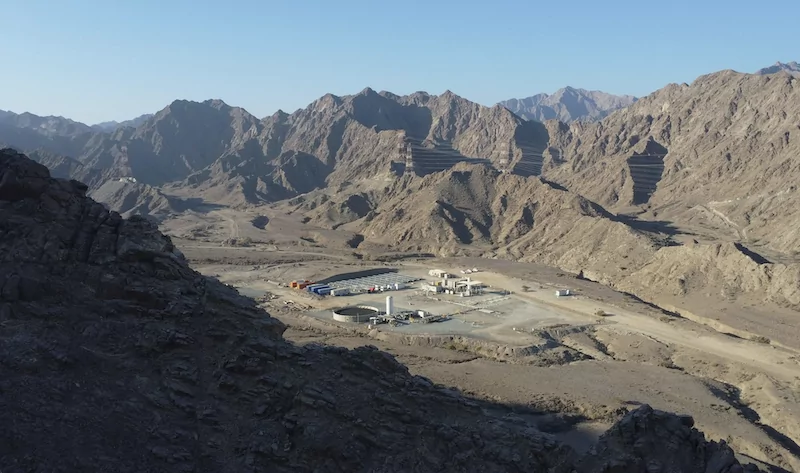
The Hajar Mountains in Oman bear no resemblance to the imagery typically associated with innovation. No glass, no campuses, no venture-capital skyline. Just harsh light, brown rocks, arid valleys and a silence that feels more geological than human. Viewed from afar, they seem the antithesis of promise. And yet it is precisely here, in a lunar landscape that seems built to resist any notion of the future, that a start-up has found one of the most interesting materials in today’s global race to eliminate .
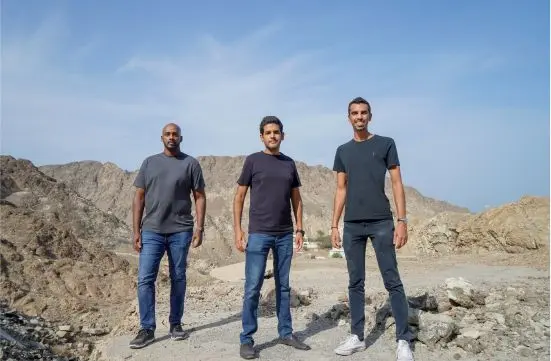
The start-up is called 44.01, after the molecular weight of carbon dioxide. Its venture stems from a simple observation made by the three young Omani founders: Oman is rich in a very particular type of rock, peridotite, an ultramafic formation that reacts naturally with CO₂ and water to transform carbon into stable minerals. In nature, the process takes a long time; 44.01 is attempting to speed it up by drilling into the subsoil, injecting CO₂-rich fluids and ensuring that this CO₂ turns into stone.
Oman is not merely the backdrop to this story: it is the very reason why this story exists. The start-up was founded in a country that is home to one of the world’s largest peridotite formations, and from there it has built a business model that bears little resemblance to the superficial aesthetics of software start-ups. This is not a platform, but an industrial concept grounded in geology.
When geology becomes a start-up
This is also why 44.01 tells a story that goes beyond carbon removal alone. It highlights a fact that is becoming increasingly clear: some of the most ambitious climate startups do not emerge solely where capital is concentrated, but where unique geological conditions, available energy and industrial pressure converge. In Iceland, for example, basalt has made the Carbfix project possible, a pioneer in in-situ mineralisation. In Kenya, Sirona Technologies and Cella have launched Project Jacaranda to combine direct air capture and mineralisation in the basalt of the Great Rift Valley. In Oman, however, the ‘treasure’ hidden beneath the desert is peridotite.
An important clarification is needed here. 44.01 is not, strictly speaking, a pure DAC (direct air capture) company. It does not build machines to capture CO₂ from the air. The heart of its technology lies precisely in mineralisation: taking CO₂ that has already been captured — from the atmosphere, from biogenic sources or from hard-to-abate industries — and permanently transforming it into rock. In some projects, this technology is combined with DAC; in others, it works with industrial emissions. The real innovation, in this case, lies not so much in the capture as in the subsurface.
For a climate startup, the difference between a good theory and a credible story lies in testing. Here too, 44.01 offers more than just a well-crafted narrative. A paper published in Nature in 2025 and highlighted by the company describes a pilot test in the Samail ophiolite, Sultanate of Oman, in which CO₂ captured from an ammonia plant was injected into peridotite: according to the reported results, around 88 per cent of the injected CO₂ had mineralised within 45 days. This is significant proof that the chemical mechanism at the heart of the promise can actually work, and much more quickly than the word ‘geology’ might suggest.
From testing to the market
From then on, 44.01 began to behave less and less like an experimental start-up and more and more like a company seeking a place in an emerging industrial supply chain. As early as 2023, it had announced a partnership with Aircapture in Oman for a DAC + mineralisation project; in 2025, it secured a $5 million extension, bringing the total Series A funding to $42 million, following the round led in 2024 by Equinor Ventures alongside investors such as Amazon’s Climate Pledge Fund, Siemens Financial Services, Climate Investment, Sam Altman’s Apollo Projects fund, and others. Also in 2025, Project Hajar received an XPrize award, whilst in the UAE – thanks to a partnership with ADNOC, one of the world’s largest oil companies – the company began scaling up its Fujairah site to an estimated capacity of 25,000 tonnes of CO₂ per year per well and up to 20 tonnes per day of injection at the upgraded site.
The added value of 44.01 is that it sells a promise of permanence. In carbon removal, this word matters more than almost any other. Planting trees, improving soils, producing biochar, building DACs, capturing biogenic emissions: every carbon removal approach operates within a different balance of costs, scale, verifiability and storage duration. Mineralisation, when it works, occupies the top tier of that hierarchy, because it aims to immobilise carbon in a stable mineral form for centuries, not simply to store it for a short time.
The CO₂ storage market now represents a trillion-dollar opportunity, said founder and CEO Talal Hasan in an interview with a popular start-up podcast (FWDstart). “By 2030, the planet will need to remove a billion tonnes of CO₂ from the atmosphere and store it permanently underground. To meet the 2050 targets, this requires a roughly 100-fold increase in global storage capacity compared to the current situation… viewing climate technology as a zero-sum race to secure resources is nonsense; change will require a colossal collective effort.” There is therefore no issue of competition in this market, where several companies, including Italian ones such as Limenet and CarpeCarbon, are already active.
The challenges
Among other things, 44.01 is interesting because it shows how carbon removal is becoming an ecosystem of localised solutions, each dependent on its own geography, supply chain and economic model. Heirloom, in the United States, accelerates limestone-related mineralisation cycles; Carbfix has made a name for itself by turning CO₂ into stone in Icelandic basalt; Sirona and Cella are attempting something similar in Kenya using DAC and underground storage. 44.01 is playing its hand with Omani peridotite, and now, increasingly, beyond Oman.
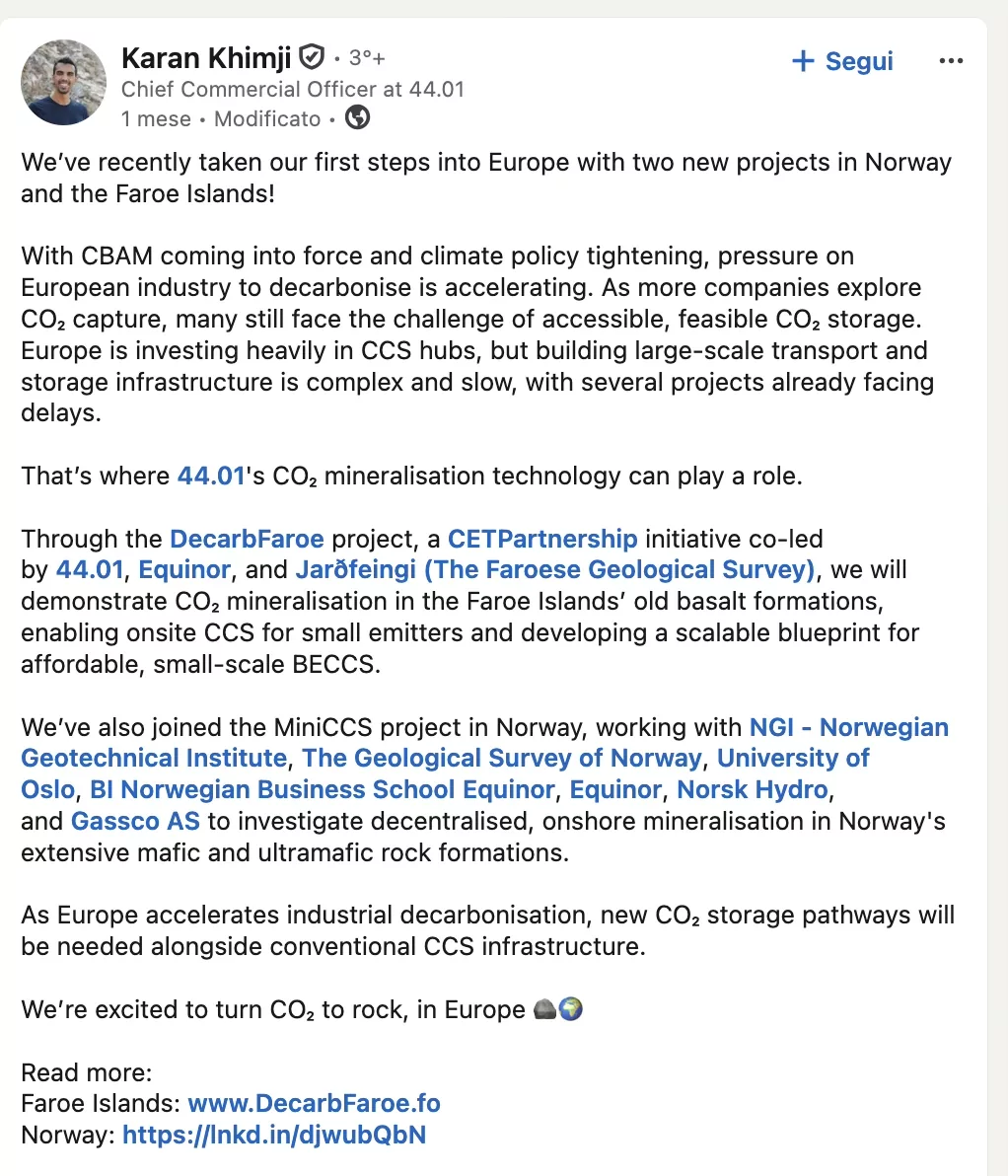
In recent months, 44.01 has announced its first steps on the European mainland with two new projects: MiniCCS in Norway, launched in February 2026, and DecarbFaroe in the Faroe Islands, announced in March 2026. The first explores the possibility of decentralised, small-scale onshore storage in Norwegian mafic and ultramafic rocks. The second, co-led with Equinor and Jarðfeingi, will use ancient basalt formations in the Faroe Islands to test mineralisation as a local and distributed CCS solution. In both cases, the message is clear: 44.01 does not want to remain the ‘Omani desert’ start-up. It wants to understand whether the model can be adapted to other geological, industrial and regulatory contexts.
In Europe, carbon removal is moving from a theoretical to a more institutional phase. The CRCF, the voluntary European framework for certifying carbon removals, carbon farming and carbon storage in products, was adopted as an EU regulation in 2024, and in February 2026 the Commission approved the first methodologies for the most mature permanent removal technologies, such as DACCS, BioCCS and biochar. Mineralisation is not yet among the first operational methodologies adopted, but it is explicitly listed by the Commission among the pathways on which the EU is evaluating future developments. For start-ups such as 44.01, this means that the game will not be played solely on chemistry or geology, but also on the ability to enter a system of certification, measurement and public trust.
Start-ups such as 44.01, of course, do not eliminate the most pressing need: to reduce emissions at source. There are no shortcuts here. This is also because, despite the progress made in some countries, the latest data from Climate TRACE show that in 2025 global greenhouse gas emissions still rose by 0.5%, equivalent to 303.19 million tonnes of CO₂e, reaching a new high of 60.63 billion tonnes of CO₂e.
This is why carbon removal is not an alternative to emissions reduction, but an increasingly necessary complement to it. Among the options currently under consideration, mineralisation is one of the most promising: if it proves capable of scaling up, 44.01 could offer a solution to a very specific problem, namely how to achieve permanent CO₂ removal quickly, cost-effectively and at scale, using renewable energy.
Certainly, the transformation of the rocks has a certain conceptual appeal: repairing some of the damage with a solution inspired by nature, which is always a great teacher.
ALL RIGHTS RESERVED ©