Table of contents
ViennaUp 2026: the tech event organised by the Vienna Business Agency returns to the Austrian capital, attracting over 14,000 people this year to take part in 65 events across 43 different venues.
The Austrian start-up ecosystem is growing, and the so-called FlexCo model, launched in January 2024, is beginning to bear fruit. By the end of 2025, over 1,300 companies had registered under this model, 45% of which are based in Vienna. The model offers a range of operational and tax benefits and applies to companies that must have fewer than 100 employees, a turnover of less than €40 million and less than 10 years in existence.
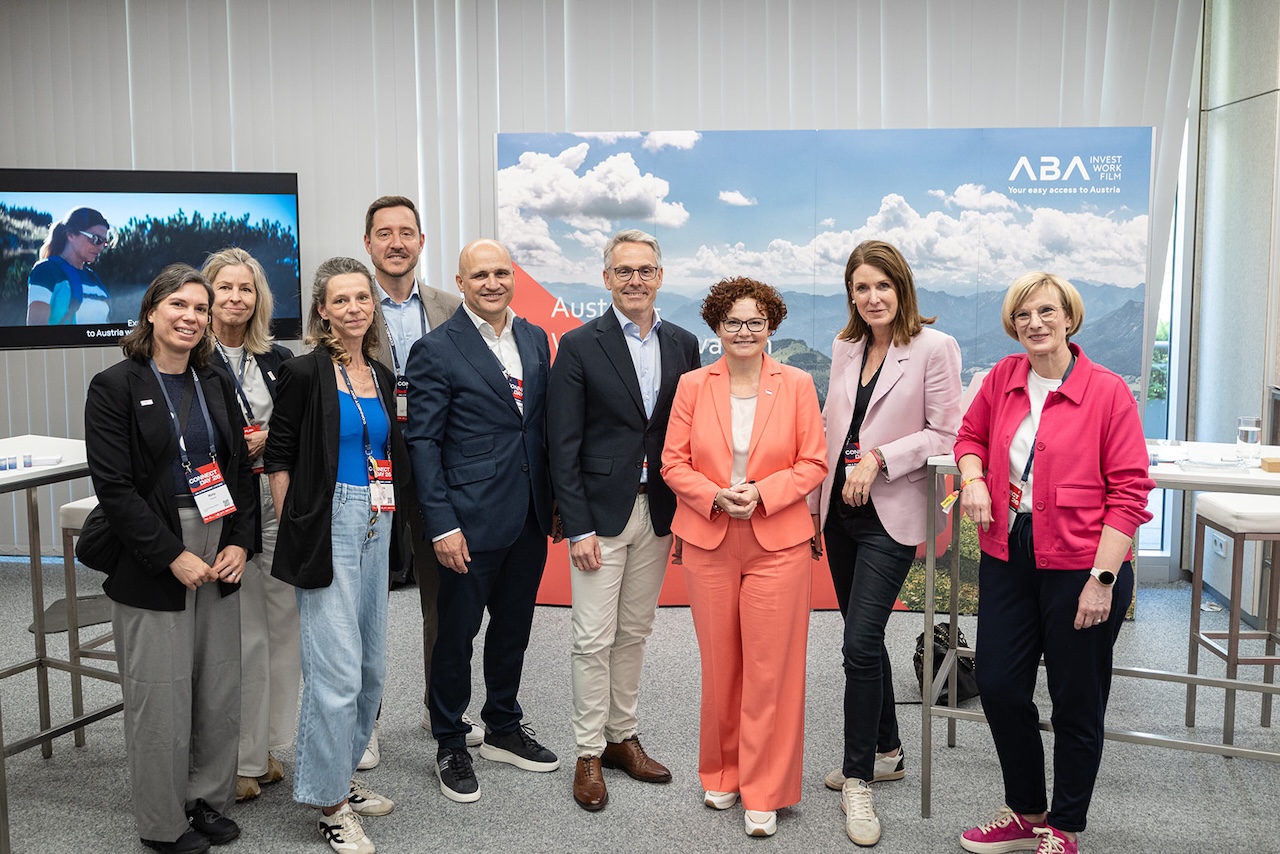
The sector received a further boost last year with the appointment – a first for the Austrian government – of Elisabeth Zehetner as State Secretary for Start-ups, who actively participated in ConnectDay, the most business-focused event of the entire programme (pictured here with staff from ABA, the Austrian Business Agency, an agency under the Ministry of Economy that handles various activities, including support for international companies choosing to expand their business in Austria).
The government is working on a three-year investment fund worth over €2.5 billion to support start-ups, with a particular focus on greentech: renewable energy, electric mobility and batteries. This strategy involves businesses, researchers and universities, such as the Montanuniversität Leoben, the Technical University of Leoben – also known as the Mountain University – located in the Styria region, whose capital is Graz, where expertise and innovation in the field of greentech are being concentrated. It is worth noting that Austria is a federal state, and so the role of the federal states is very important (in the near future, here on the pages of Startupbusiness, we will also be taking a closer look at the innovation ecosystem of another state, Carinthia, which, along with Tyrol, borders Italy).
According to ABA’s Startup Location Austria report, €217 million was invested in startups in the country during the first quarter of 2026, a figure that represents a record high, excluding 2020, a year in which the entire European ecosystem saw a surge in investment. ABA also participates, alongside the main public and private entities committed to supporting start-ups, in the production of the Austrian Start-up Monitor, the latest edition of which reports data from 2025 and provides a detailed snapshot of every aspect: founders’ gender, founders’ age, founders’ nationality, environmental and social impact, internationalisation, the origin of investment funds (with private and public venture capital being the two main categories), and the level of profitability and valuation of the start-ups (the report can also be downloaded in English via this link).
ConnectDay
However, the figures only tell part of the story; what makes the ecosystem interesting are the stories of companies that have chosen Austria as a base both to launch their businesses and to expand internationally. Just as we did in our reports from ViennaUp in previous years, this year too we wanted to meet entrepreneurs who are building start-ups and scale-ups by leveraging the advantages that the Austrian ecosystem offers them, both in terms of structural and financial support and in terms of growth potential and internationalisation. During the Vienna startup festival, news also broke that the French AI unicorn, Mistral, had acquired an Austrian AI startup called EmmiAI, which has developed sophisticated technologies and which we wrote about here; and we at Startupbusiness met many other entrepreneurs, such as David Plaseller, CEO and founder of Revitalyze. Revitalyze develops an AI-based platform designed for construction companies. “Our mission is to support construction companies in becoming more sustainable and saving costs right from the design phase; our platform analyses vast amounts of data relating to building materials that need to be demolished to make way for new constructions, an essential aspect for better disposing of and potentially recycling the resulting materials.” Revitalyze is a FlexCo based in Tyrol but already operates in the German and Italian markets, as well as, of course, the Austrian market. “ “Among our current clients are the Italian NOI Tech Park in Bolzano, the German firm Kutter, based in Bavaria with 4,000 employees, and the Austrian firm AT Thurner Bau, based in Tyrol. We also have many construction professionals and engineers using our platform, which has the advantage of bringing advanced technology such as AI to a sector that is decidedly under-digitised.” Plaseller and his team chose to set up in Tyrol thanks to public support schemes, which include non-repayable grants totalling around one million euros. This has enabled them to develop a system that is projected to generate between 150,000 and 200,000 euros in revenue by 2026; the system is delivered via SaaS and therefore operates on a recurring revenue model.
Other companies include Gate Space, which is aiming for a turnover of one million euros in 2026 and, as business development manager Marianne Röchling explains, is developing technologies for satellite mobility in space; the company is based at the Vienna Airport office park and is backed by Techstars, and Verbund, which is not strictly a start-up but an energy company with a strong focus on renewables that has created an investment vehicle which, according to venture investment associate Benedikt Weissenberger, is called VerbundX, has assets under management of €35 million, makes average investments of €1.5 million and already has deals under its belt such as those with the Romanian firm Ogre and the Austrian firm Reduxi, and is seeking new investments in Spain, Italy, Germany, Austria, Albania and Romania. Medudoc, the company led by CEO Martin Klässner, also uses the latest technologies to bring innovation to a highly sensitive field: communication and information in the medical sector: “Our job is to support healthcare facilities in providing their patients with information that is personalised, thoughtful, clear and comprehensive; we are already working with facilities in Austria, Germany and Switzerland.”
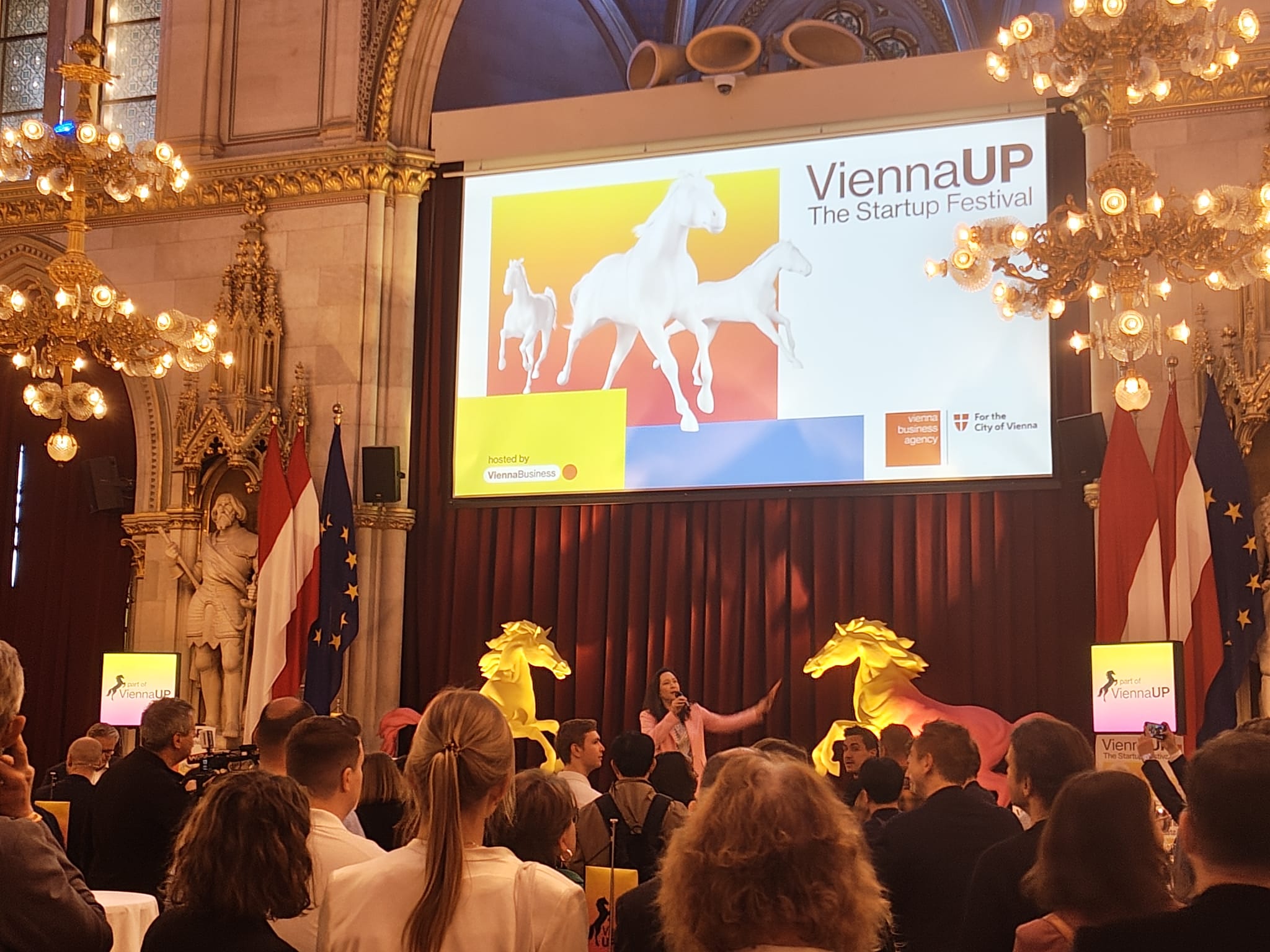
ConnectDay, perhaps the most business-oriented event of the entire ViennaUp programme, which held its opening night at the Ratthaus, Vienna City Hall, for this edition, officially opened by Peter Hacker, City Councillor for Social Affairs, Public Health and Sport, also served as the stage for the Startup World competition, which selected the Austrian startup to compete in the final in Silicon Valley. The choice fell on founders Julia Reisinger and Maria Zahlbruckner of the Vienna-based deep-tech startup Factorymaker, which is developing an AI-powered planning platform for industry (in the opening photo, the ViennaUp launch event in the ballroom of the Rathaus with Naomi Hunt, Team Leader for International Communication at the Vienna Business Agency, who hosted the evening).
“Over 14,000 entrepreneurs from all over the world visited ViennaUp to forge new partnerships and explore Vienna as a potential business location. The festival’s strategy has proved effective: last year alone, €7.6 million in investment generated by companies that have set up here can be attributed to ViennaUp,” said Barbara Novak, Vienna’s Deputy Mayor and Councillor for Economic Affairs, in a statement. “At the same time, ViennaUp demonstrates what modern economic policy should look like: innovations that create economic strength whilst promoting people’s well-being. Many of the start-ups that took part this year are working on solutions that offer clear social benefits.”
AI:AT
AI:AT stands for AI Factory Austria; indeed, like many other European countries, Austria has established its own public-private centre for the development of solutions, start-ups and technologies based on artificial intelligence. “We work with HPC,” explains Dorottya Zelei, project development lead at AI:AT, “we develop support services for anyone wishing to use supercomputers, and as ours is not yet operational, we collaborate with sister organisations of AI: AT in various European countries, including the Italian AI Factory IT4LIA and the Leonardo supercomputer, as well as with Marenostrum 5 in Spain, whilst we await our own, which will be operational from the end of 2027.”
AI:AT has already become home to numerous start-ups, including Soda Zitron Media, a fully-fledged AI-driven media company that uses artificial intelligence to achieve high-profile results on a modest budget. However, as CEO and co-founder Nino Begic admits, “it is always important to be mindful of public perception regarding how content created entirely by AI is received”. This is a view shared by Christian Tauber, CEO and co-founder of Neoalp, who is working to develop an operating system for humanoid robots that is designed to be manufacturer-independent: “We want to build the European reference platform to democratise the use of humanoid robots through a sovereign, cloud-based platform that can scale over time and is accessible to as many users as possible.”
The importance of how AI-generated content is perceived is also a concern for Matteo Rossoli, who, together with his team, is focusing on two key areas: developing a tool designed to provide practical support to journalists, which has been named Newsrooms. This tool represents a highly sophisticated and customisable version of any public LLM and is designed for both newsrooms and companies wishing to define their own ‘writing’ style for their content. “We’re still in the launch phase, but there are already some newsrooms in Austria using the tool,” he says, “and it’s important that when an article has been written by a journalist who has used our platform for assistance, this is clearly indicated to the reader; this is a condition we consider important.” Tale sensibilità diviene ancora più importante sapendo che Rossoli e i suoi co fondatori stanno anche lavorando a EUstella, quella che definiscono come l’alternativa europea a ChatGPT, quindi un LLM completo che fa leva su risorse open weight e open source e che è pensato per essere interamente made in Europe.
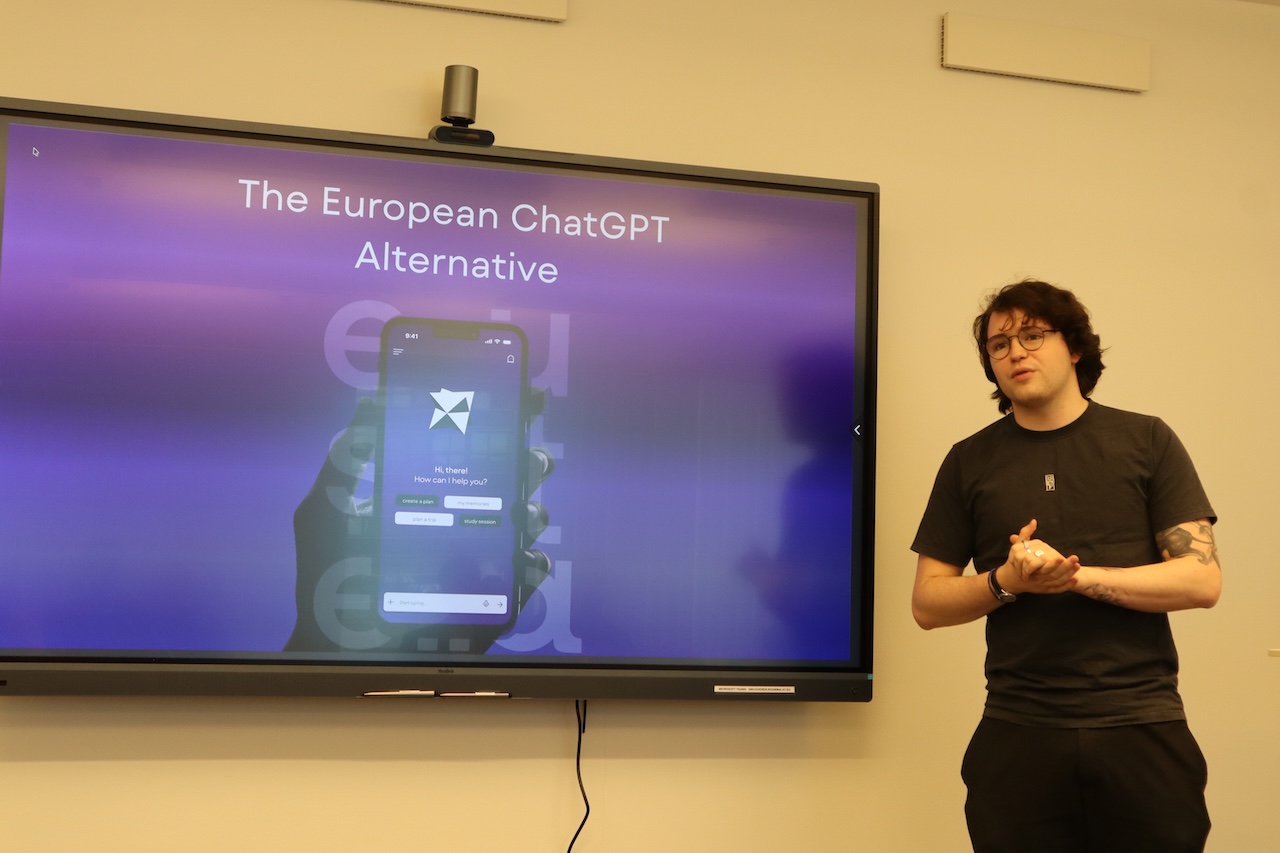
Srdjan Kupresanin, founder of Blockstruct—an artificial intelligence system for data and document management within companies that integrates with any IT platform and resolves many of the challenges of document management—takes a more pragmatic view: “We are also in the launch phase with the company; although we have seen that the product works very well, we still need to grow from a commercial perspective. Currently, our clients include Unicredit in Austria, and we would like to start working with Unicredit in Italy as well,” he says.
Is Daniel Pepl, Head of Marketing and Communications at AI:AT, which explains how the project is growing: “We currently have 30 staff and will have 70 by the end of the year. We launched in September 2025 with €40 million in funding from the EU HPS programme and a further €40 million from the Austrian federal government, Today we are working with AI Factories in other countries and are fine-tuning our supercomputer, which will be operational by the end of 2027. We are also working on several fronts, for example with the Austria Press Agency to develop open-source services and technologies for journalism, so that they can then be made available to any media organisation that wishes to use them. We are also working on training initiatives because AI needs to be understood for what it truly is, a highly powerful technology with which high-profile projects can be built, and the first to realise this are the approximately 70 start-ups that are connected in various ways with AI:AT”.
Fintech, greentech, international start-ups
It is not just artificial intelligence, but also companies operating in sectors such as fintech – a prime example being what we might call the crypto boutique Teroxx, an investment vehicle with around €200 million under management, sourced primarily from investors in the DACH region (Germany, Austria, Switzerland), though there are also Italian investors, “Our aim,” says Paul Gärtner, Chief Communications Officer, “is to ensure that crypto auctions are seen as a genuine investment; our boutique is registered in Cyprus.” “and offices in Austria, Germany, the United Arab Emirates, Lithuania and Denmark, and we describe ourselves as a digital asset boutique”, or companies that are instead firmly committed to green tech, as is the case with Jakob Dunkl and his ManyTrees Having developed a system for planting trees on any type of ground, the company’s device makes it quick and easy to create a space where a tree can take root, even in areas where greenery has not yet taken hold, such as car parks and tarmac-covered areas. ManyTrees’ innovation lies entirely in its approach and respect for greenery: “It’s true that we can already solve the problem today by putting plants in pots, even large ones, but for a plant, its direct connection with the soil really makes all the difference,” says the entrepreneur behind the company, which is also a FlexCo.
Gabriele Tatzberger, Head of Startup Services at the Vienna Business Agency, emphasises how the 2026 edition of the event focuses on scalability and growth. This year, ViennaUP also highlighted the issue of digital sovereignty: at the World Summit Awards Global Congress, digital solutions were presented that create social value and demonstrate how Europe can become less dependent on major global platforms. With the AI start-up mytalents, a Vienna-based innovation has also been included among the 40 projects recognised worldwide by the World Summit Awards. In addition, ViennaUp welcomed 28 international delegations from all over the world: from Central and Eastern Europe, as well as from India and Korea. Thanks to the Vienna Start-up Package from the Vienna Business Agency, 15 international start-ups also took part in the festival, including CheckEye from Ukraine, which uses artificial intelligence to analyse retinal images and detect diseases such as diabetic retinopathy at an early stage.
ALL RIGHTS RESERVED ©