Table of contents
We always tend to think that history lies in the past, far removed from the present and even further removed from innovation. That is not the case. And the papyri from Herculaneum are the most striking proof of this.
The secret to Open Innovation lies in building communities. From Marcello Gigante to the Vesuvius Challenge, from Naples to Silicon Valley: the story isn’t over yet. It’s an open platform.
Let’s start with a detail that says it all. When I began working with the Faculty of Arts and Philosophy in the early 1990s, one thing struck me straight away: there were a disproportionate number of Macintoshes compared to PCs. Why? Because there was a group of professors who had realised the potential of that machine before anyone else. Philosophers and humanists do not follow marketing trends: they are practical, and tech-savvy when necessary, often more so than engineers. They had recognised early on the Mac’s ability to archive, process and utilise digital materials for reference and preservation purposes.
But there was also a technical – and, at the same time, cultural – reason: Macintosh computers natively supported any character set, from the alphabets of ancient and modern Greece to the most diverse languages. It was a project – a design, as we would say today – conceived to communicate with everyone, whereas the PC expected you to learn its language.
Steve Jobs may well have copied Xerox’s systems – and done so well. As a start-up, we would have said he was a copycat. But the Macintosh was destined for something different: typographic openness, an interface with analogue devices — cameras, scanners, laboratory equipment — and a natural connection with the humanities. This made Apple dominant in the humanities, and consequently in typography, design and graphic design.
Technology was not neutral. Even back then, it was a way of looking at the world.
Gigante, the papyri and the community as a method
Before algorithms, before artificial intelligence, before global challenges, there was a man who had realised that those fragile, charred black scrolls were not mere artefacts. They were a library. A part of our memory that remains hidden, lost and buried by the eruption of Vesuvius in 79 AD.
Marcello Gigante was, in the most literal sense, a giant. A classical philologist, papyrologist, professor and one of the most important scholars of Herculaneum texts of the twentieth century — yet he never put up any barriers. I often visited his home because he had understood, before anyone else, a simple yet crucial truth: keeping up to date with the latest innovations, the latest devices and the latest available versions meant working faster and with greater capacity. In his own way, he was an early adopter ahead of his time.
Gigante did not physically discover the Villa dei Papiri. That discovery had taken place in the 18th century, during the Bourbon period, when a large Roman residence came to light whilst a well was being dug; it was first explored by Roque Joaquín de Alcubierre and then by the Swiss engineer Karl Weber. Also in the 18th century, Antonio Piaggio had attempted to unroll those papyri without destroying them, constructing a handmade machine that has gone down in history.
Gigante took up that legacy and turned it into a cultural mission. In 1969, he founded the International Centre for the Study of the Herculaneum Papyri in Naples — now named after him, the CISPE, housed in the historic Faculty of Arts and Philosophy building of the University of Naples Federico II on Via Porta di Massa — with a specific aim: to put the papyri back at the centre of global research and to promote the resumption of excavations at the Villa. He had intuited something very contemporary: innovation does not arise solely from technology, but from the ability to build communities around a major challenge. And the challenge was enormous: the Villa contains a library with thousands of papyri, some dating back to the 2nd and 3rd centuries BC, of which only half have been read to date.
In 2001, the year of his death, partly as a result of the cultural pressure that had been building up for decades, the Superintendency, the Campania Region and the Municipality of Herculaneum signed a memorandum of understanding for a feasibility study into the excavation of the Villa, funded by the Region with six billion lire from EU funds.
Not just Pompeii: why Herculaneum and Oplonti change everything
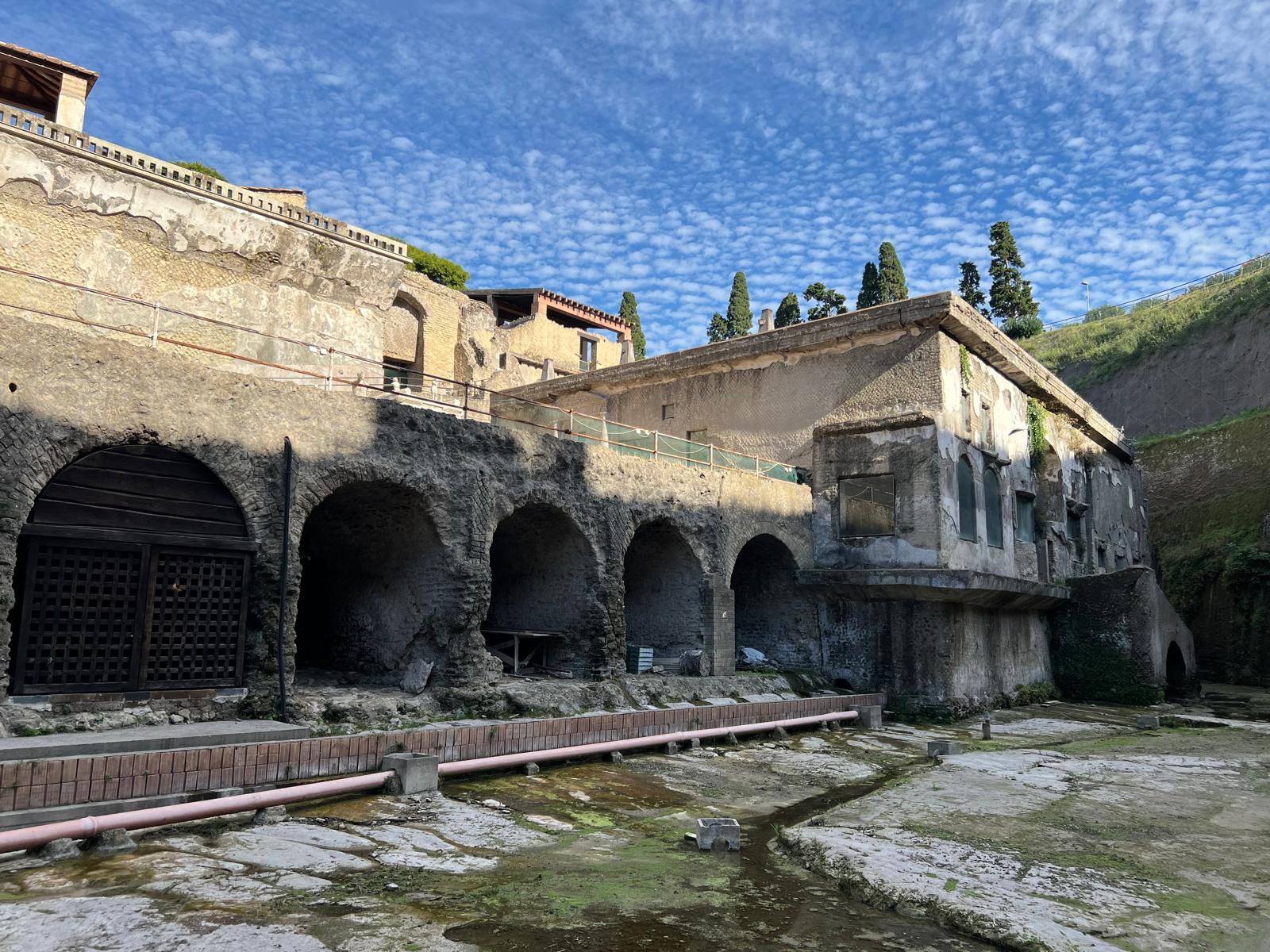
Pompeii is the city frozen in time: streets, houses, frescoes, bodies. An urban snapshot that never ceases to amaze. Herculaneum is something different — smaller, wealthier, better preserved, buried not by ash but by pyroclastic mud that sealed everything with almost surgical precision: wood, fabrics, food, papyri. Oplonti is something else entirely: a luxury villa, probably belonging to Poppea, Nero’s wife, with frescoes unrivalled in the Roman world.
Three sites — the Archaeological Park of Pompeii, the Archaeological Park of Herculaneum, and the Archaeological Park of Oplontis — just a few kilometres apart. Three different stories of the same morning, 24 August 79 AD. Each one is worth visiting as if it were the only one.
What are papyri used for?
What they aren’t for, perhaps.
Papyrus formed the backbone of human knowledge for over four thousand years: from 3000 BC to the year 1000 AD. It was the ‘cloud’ of the ancient world — and the longest-lasting one. By way of comparison: the book in codex form is two thousand years old, the printing press five hundred and seventy, and digital technology is not yet fifty. And yet we talk about obsolescence as if it were a recent invention.
Papyrus scrolls come into their own when they speak to us once more. And when they do, they do not merely tell us what the ancients thought. They help us to understand how we have got to where we are today: the relationship between law and power, between ethics and the law, between human order and the order of the world.
An example of this can be found in Gigante’s most important work. *Nomos Basileus*, published in 1956, draws on Pindar’s famous fragment 169: ‘The Nomos is king of all things, of mortals and immortals.’ Gigante did not interpret this as a mere command or the arbitrary exercise of power. He saw it as something deeper: a cosmic, foundational law, capable of holding together the city, justice, coexistence and thought.
But there is something even more precious about the Herculaneum papyri, something that makes them unique compared to any other ancient source: they are encased in a time capsule. Buried by Vesuvius, they have not been reinterpreted, revised, selected or discarded by any victor of history. They did not pass through medieval scriptoria that copied only what they deemed useful. They have not been subject to censorship, rewriting or strategic omissions. They have come down to us exactly as they were, frozen in a single moment. A stroke of chance that makes them extraordinarily reliable — and extraordinarily precious.
That is why they are not merely a means of reconstructing lost texts. They serve to raise unfiltered questions: what holds a community together? What is the relationship between the law and justice? When does the law build civilisation, and when does it become merely an exercise of force?
From Pindar to Gigante, from Herculaneum to artificial intelligence, the thread is the same: the past is not past if it continues to shape the future.
America in love with Herculaneum
If Italy needs America for its future, America needs Italy for its history.
There is an American thread running through the story of the Herculaneum papyri – a long-standing one that is less well known than it deserves to be.
David W. Packard, son of one of HP’s founders, funded a project to restore and protect the ancient site of Herculaneum in collaboration with the Superintendency and the British School at Rome, declaring his willingness to support the re-exploration of the Villa dei Papiri as well. That commitment gave rise to the Herculaneum Conservation Project, established in 2001 by the Packard Humanities Institute: conservation, maintenance, research and promotion. This was not merely sponsorship: it was a cultural, managerial, scientific and operational investment. Almost 30 million euros by 2017, a figure that today appears to be approaching 50.
And then there is the Getty Villa in Los Angeles, built in the 1970s by J. Paul Getty and modelled directly on the Villa dei Papiri in Herculaneum — not on the villa that can be visited, because the Villa dei Papiri is not yet open to the public, but on the plans and surveys from the 18th-century excavations. A replica built on the basis of maps and measurements, rather than direct experience. A reinterpretation, a symbolic bridge between Vesuvius and California. As if that still-buried villa had continued to inspire the imagination on the other side of the ocean for almost two centuries — without anyone yet being able to actually enter it.
Vesuvius Challenge: open innovation for the world’s oldest start-up
Today, that community has gone global and is known as the Vesuvius Challenge.
It is an international challenge that brings together machine learning, computer vision, computational geometry, papyrology, archaeology, philology and open science. The aim is simple in theory: to read the charred papyri from Herculaneum without opening them, without destroying them, and without touching them. To transform a seemingly silent object into a legible surface through X-ray scanning, three-dimensional reconstruction, virtual unrolling and artificial intelligence models capable of detecting traces of ink invisible to the human eye.
The project was created by Nat Friedman, Daniel Gross and Brent Seales. The first two come from the world of technological innovation — Friedman was CEO of GitHub, whilst Gross is an investor in the field of AI with a background at Apple following the sale of his company, Cue. The third, a professor of computer science at the University of Kentucky, is one of the pioneers of so-called ‘virtual unwrapping’, the technique that allows manuscripts too fragile to be physically opened to be read digitally. It is this convergence of disparate worlds that makes the Vesuvius Challenge a prime example of interdisciplinary innovation.
The results are already historic. Prizes totalling 1.8 million dollars have already been awarded. The papyrus PHerc. 1667 has been virtually unrolled and read: not just a few scattered letters, not an isolated fragment, but a continuous text with columns of Ancient Greek that have become legible again after almost two thousand years. It contains a philosophical treatise on ethics, probably of a Stoic nature, with reflections on human nature, impulses and moral progress.
Now the challenge is stepping up a gear: a new one-million-dollar prize for anyone who manages to read another papyrus in its entirety. A global call for developers, researchers, data scientists, classicists, engineers and visionaries. An ‘ancient’ start-up: open, distributed and interdisciplinary.
The tech economy that funds the past
The Vesuvius Challenge is not backed solely by academics. It is supported by a network of private sponsors from Silicon Valley’s tech scene, the fields of artificial intelligence, quantitative finance, open source and the new global philanthropy.
Among the main donors: Nat Friedman with $2,250,000, Elon Musk’s Musk Foundation with $2,084,000, Alex Gerko, founder of XTX Markets, which specialises in applied mathematics and algorithmic trading, with $450,000, Joseph Jacks of OSS Capital with $250,000, Daniel Gross with $225,000, Matt Mullenweg, the man behind WordPress, and Automattic, with 150,000; Emergent Ventures, with 100,000; and Stripe founders John and Patrick Collison, with 125,000 dollars.
This is not traditional patronage, nor is it a museum initiative. It is a private initiative offering prizes to those who succeed in deciphering what remains of the texts buried in 79 AD. Money from the world of modern technology is being invested to hear, perhaps for the first time in two thousand years, the fragile, charred voice of the ancient world.
It is a fascinating paradox: today, part of the work of uncovering the past is funded by those who have built the digital future.
The trigger point
Digital technology, meanwhile, is not a stable system. We have already seen this: from floppy discs to hard drives, from CD-ROMs to solid-state storage and on to the cloud, every generation of storage media has promised eternity and then revealed its limitations. Digital technology is the most high-performance form of storage we have, but it is the least stable, compared to a book, and above all compared to a papyrus scroll that has survived two thousand years beneath the ashes of Vesuvius.
From the community founded by Marcello Gigante to the global Vesuvius Challenge community, from Herculaneum to Silicon Valley, from humanistic thought to open-source algorithms, the lesson is clear: cultural heritage is not merely an archive to be preserved. It is a platform. A treasure trove of knowledge. An ecosystem that can speak once more, if we know how to create the conditions to listen to it.
And Naples, once again, is not merely the setting for the story. It is the catalyst.
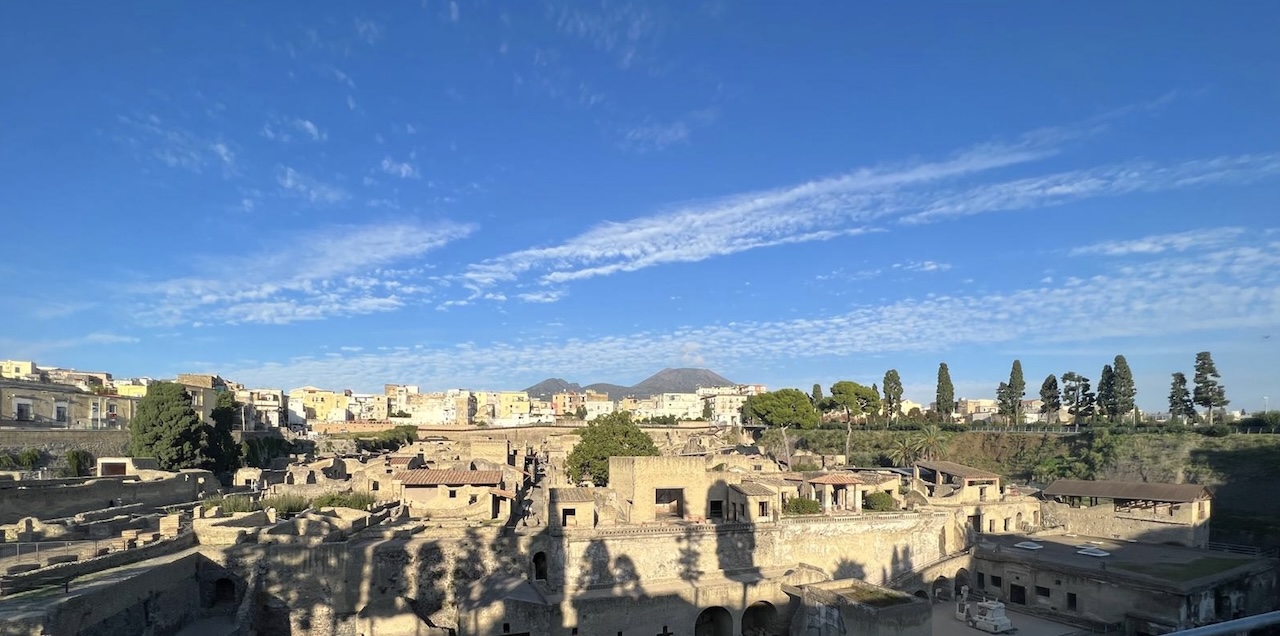
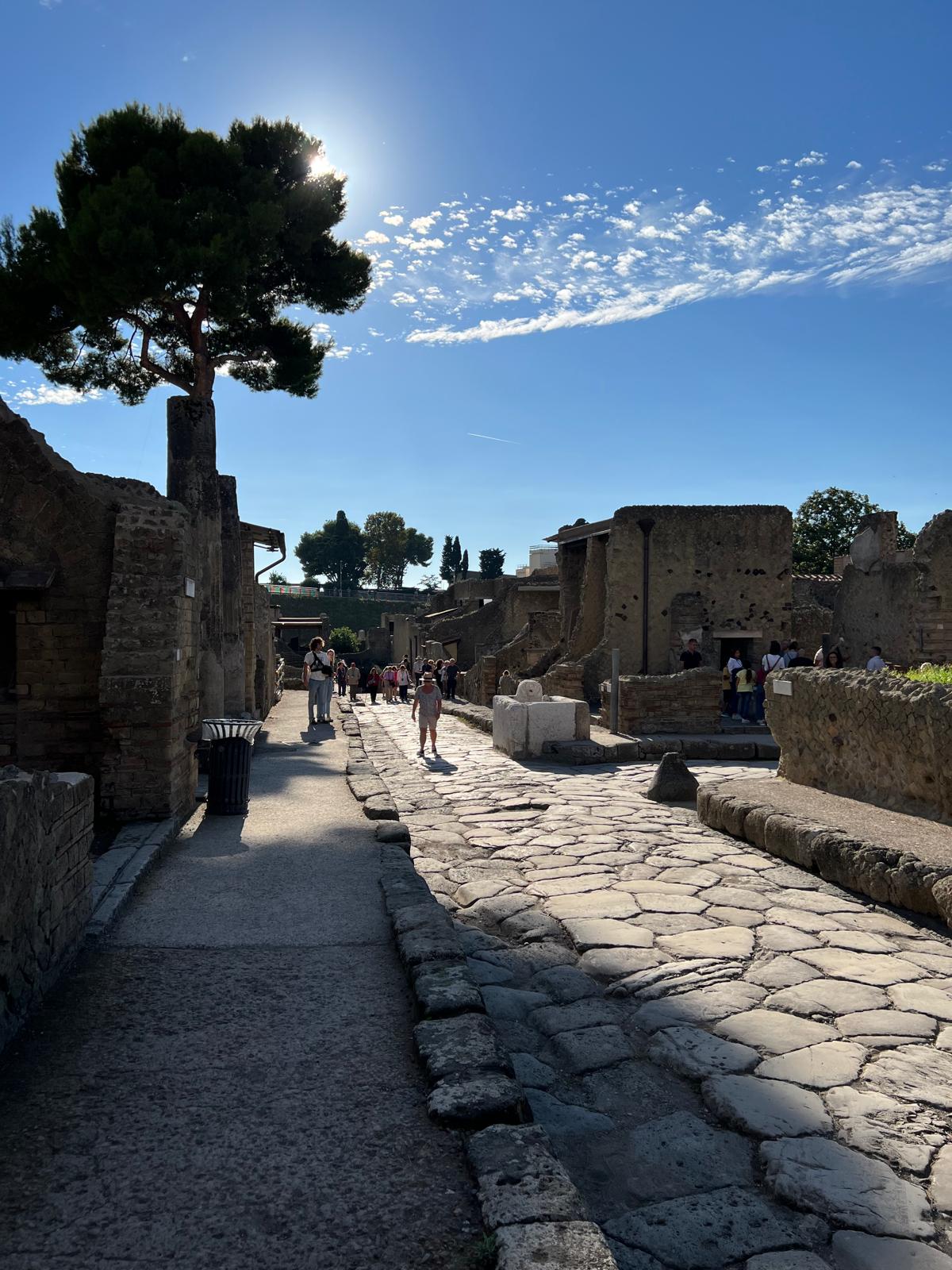
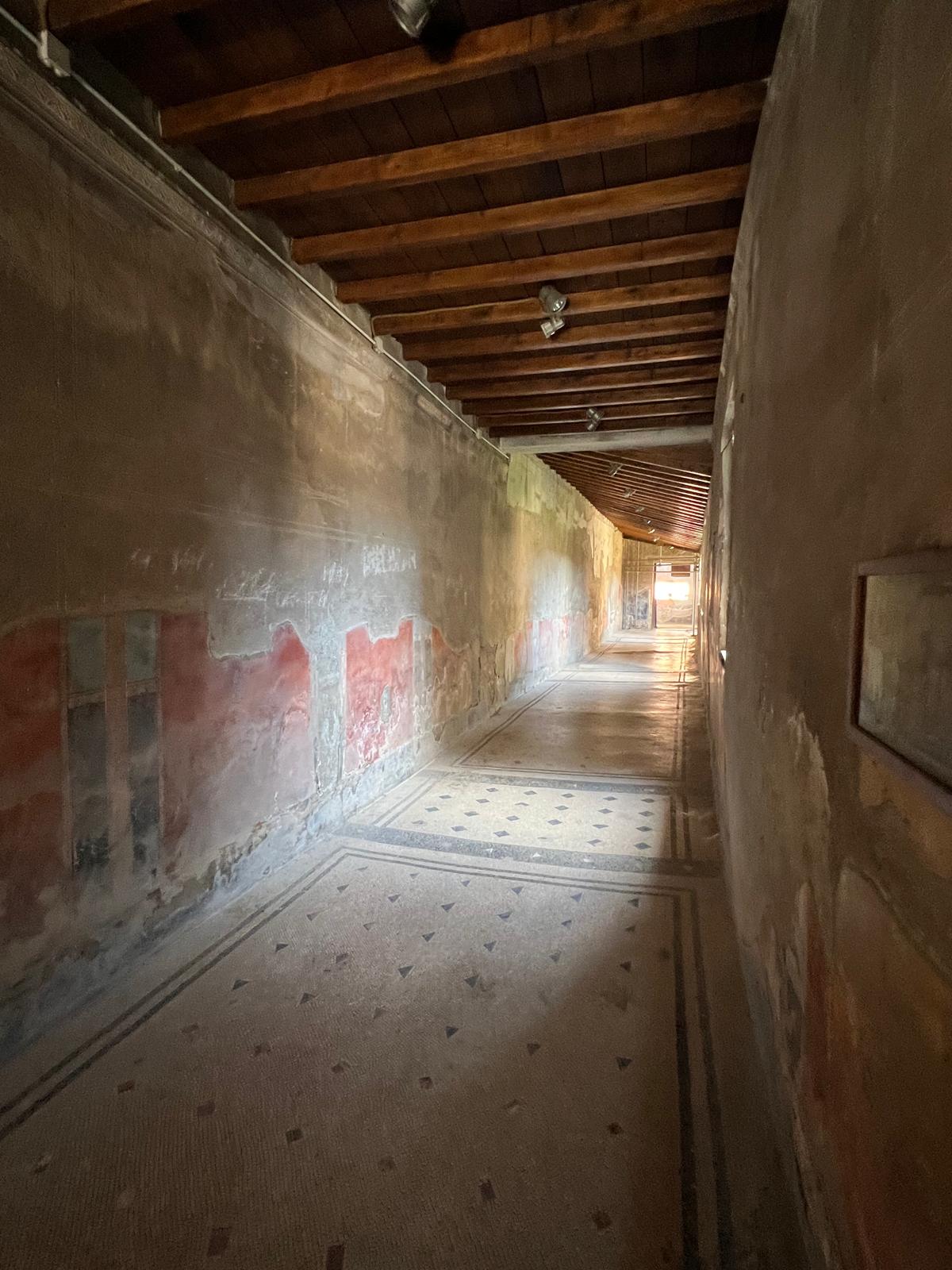
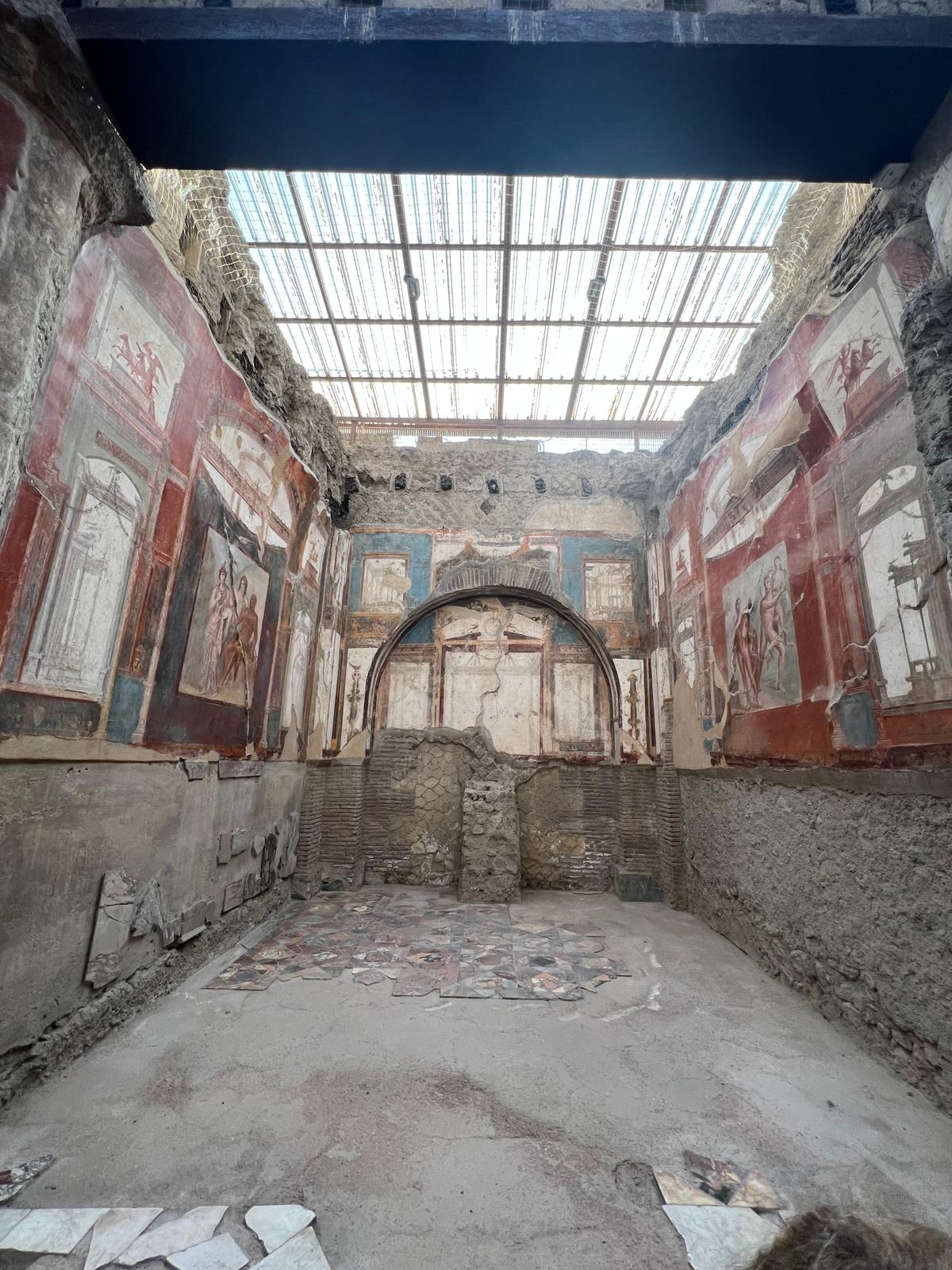
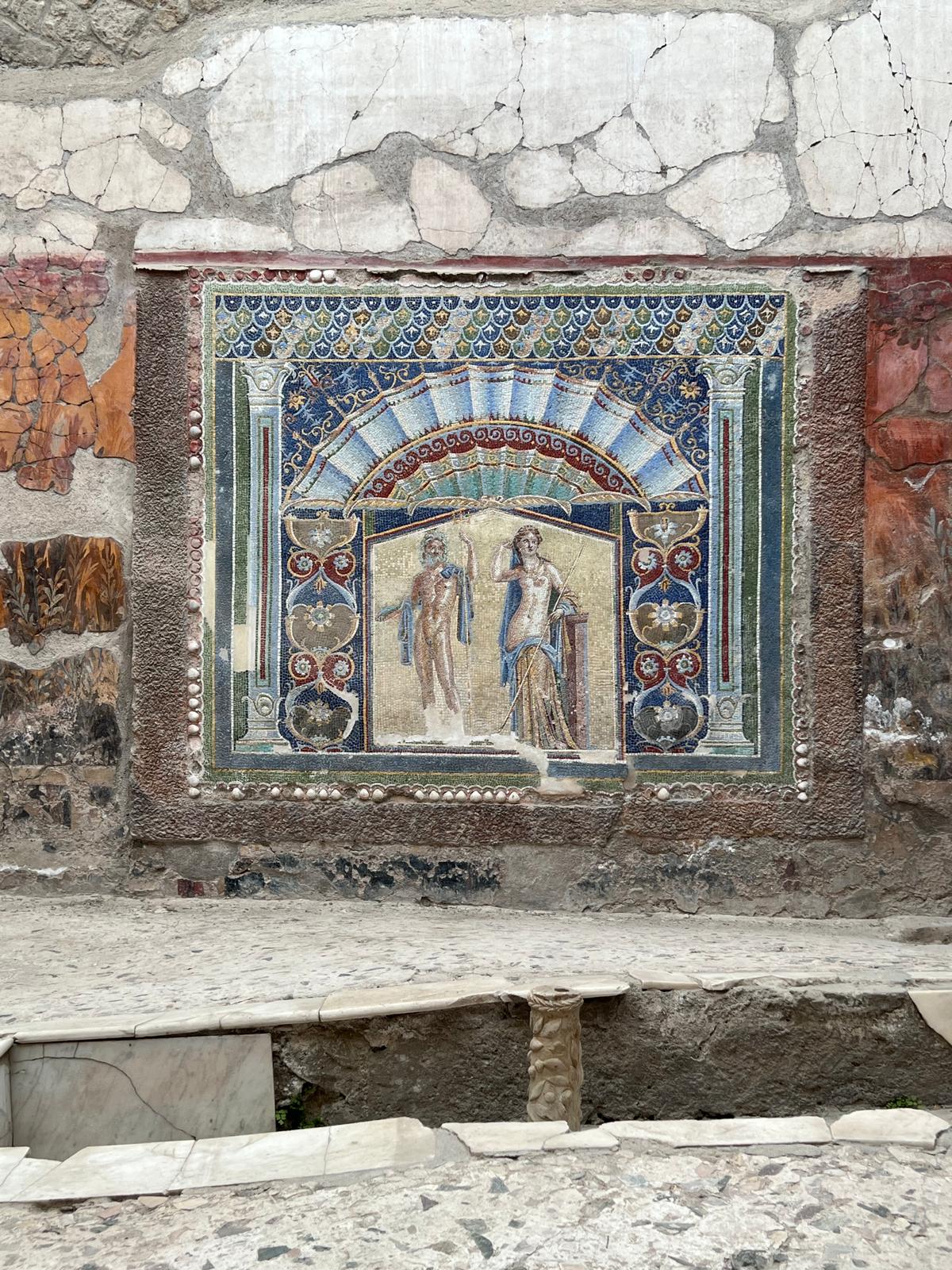
Antonio Prigiobbo is a designer and innovation journalist, a manager and a social investor. On Startupbusiness, he writes about innovation, ecosystems and design. (All the photos show views of the archaeological park at Herculaneum and were taken by the author)
ALL RIGHTS RESERVED ©