Table of contents
OpenPie, a Chinese enterprise artificial intelligence infrastructure company, is preparing for a stock market listing in Hong Kong under Chapter 18C, with the aim of attracting cornerstone investors and engaging international financial advisers to guide the process.
The founder, Ray Von, a former executive at Pivotal Software, has confirmed that the company aims to be ready for an IPO in 2027, although the timing will depend on market conditions and the availability of strategic investors. OpenPie has already met most of the requirements of Chapter 18C, which facilitates the listing of innovative technology companies on the stock exchange. Hong Kong is seen as the ideal platform for raising capital from Europe and the Middle East, whilst maintaining credibility with Chinese Fortune 500 clients who prefer companies registered in their home country.
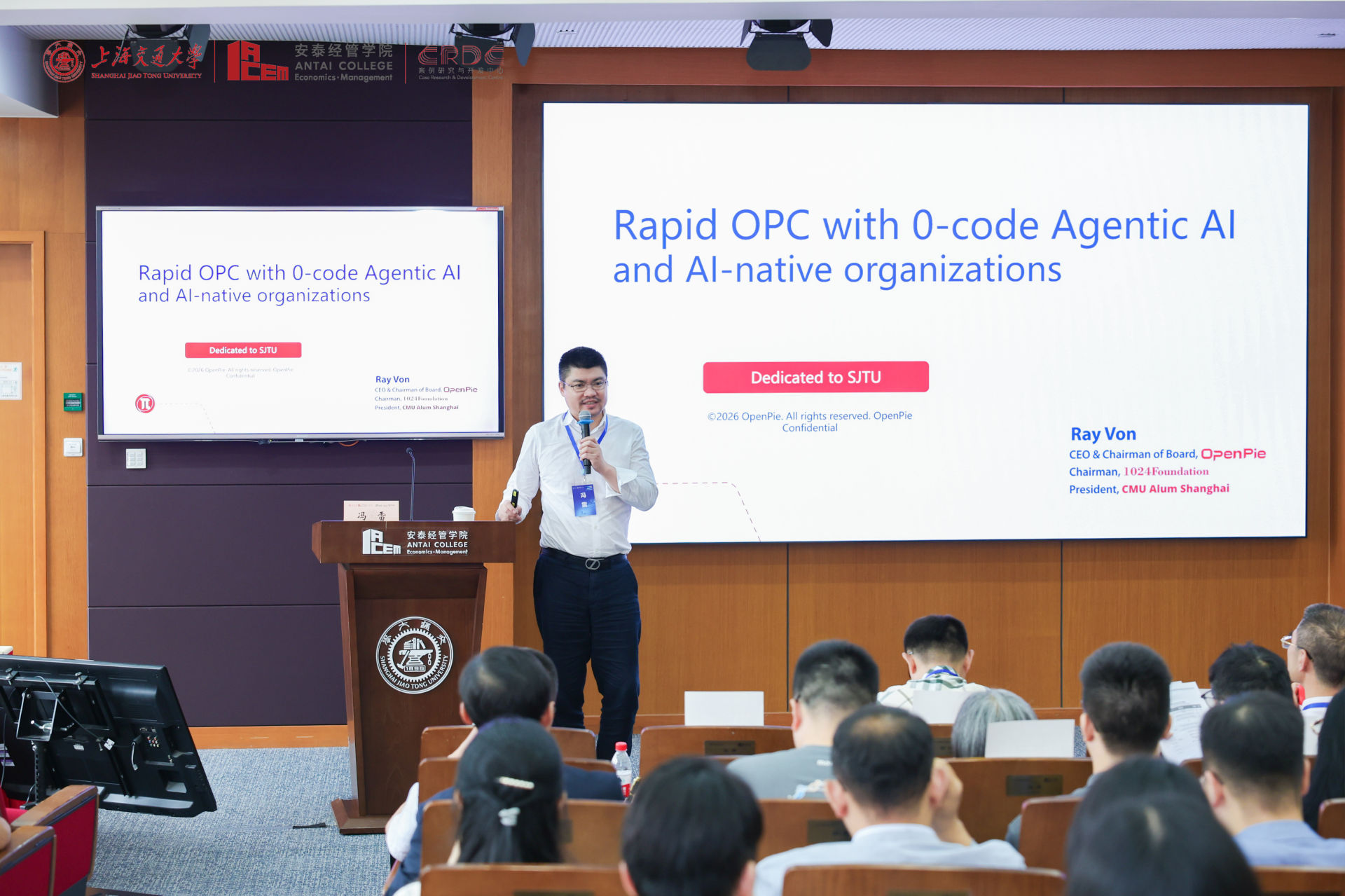
The aim is to raise up to 200 million dollars, securing a couple of cornerstone investors. Von (pictured above) emphasised that Hong Kong’s liquidity and international profile make it more attractive than Shanghai’s STAR Market or Shenzhen’s ChiNext, whilst not ruling out the possibility of a dual listing.
Since 2021, OpenPie has completed five funding rounds: two seed rounds in the same year, a pre-Series A round in 2022, and two further rounds in 2024 and 2025. Shareholders include Tencent, Dongwu Securities, Suzhou Oriza Holdings, Yuanhe Zhongyuan and Shanyuhai Investment Group. Institutional investors hold around a third of the share capital, whilst management and employees retain two-thirds through an ESOP, ensuring the company’s operational independence.
Tencent invested around 20 million dollars in 2021 at a valuation of 100 million, providing credibility and favourable contractual terms in line with international standards, whilst avoiding the restrictive buy-back clauses commonly found in China. Meanwhile, the company has established a strong partnership with Alibaba in the areas of government and corporate clients.
Business model
In 2023, OpenPie took a new direction: moving away from traditional deep learning frameworks towards the integration of ontologies – the structured cataloguing of business data – with large language models, following the example of players such as Databricks and Palantir. Thanks to ontologies, the company can develop ‘skills’ that power LLMs and give rise to more accurate and reliable agent-based artificial intelligence applications. The advent of LLMs has finally provided concrete use cases, enabling OpenPie to offer on-premises solutions that combine data sovereignty with tangible value for businesses.
Unlike Palantir, which relies on closed-source technology stacks and makes extensive use of services, OpenPie has opted for an open-source, self-service model, designed to scale across medium-sized enterprises whilst reducing operating costs. Von compares the difference in approach between OpenPie and Palantir to the contrast between Android and iOS. The company combines open-source models such as Alibaba’s Qwen with proprietary ontology frameworks, offering customers sovereign AI assets that combine technological flexibility with data independence.
Partnerships and joint venture opportunities
European countries such as France, Germany, Spain and Switzerland represent promising markets, thanks to their emphasis on data sovereignty and their mistrust of US cloud providers. OpenPie could set up joint ventures with financial institutions, telecoms firms, cloud providers, data centres and traditional software houses, capitalising on their established customer bases and distribution channels.
The establishment of independent entities outside China – for example in Singapore or Spain – is being considered to reassure European customers. The proceeds from the IPO would be used to support international operations, expand research and development in agent-based AI, and build partnerships in Europe and the Middle East.
The open business model, based on ontologies and centred on data sovereignty, sets OpenPie’s offering apart from its US and Chinese competitors.
Towards the turning point
Von expects to break even in 2027, with profitability driven by on-premises deployments of large language models integrated directly with corporate data. This approach, which brings artificial intelligence into companies’ infrastructure, aims to transform operational workflows into tangible and lasting value.
Unlike many artificial intelligence companies that subsidise the use of tokens, OpenPie’s model generates sustainable revenue by integrating AI agents into businesses’ operational workflows.
Von’s career path – from Oracle to Pivotal and on to OpenPie – reflects a consistent focus on data models and computing. The decision to remain in China, rather than follow the US cloud-native model, has given rise to a company tailored to markets where data sovereignty is crucial.
With Europe increasingly focused on digital independence, OpenPie’s strategy offers a compelling proposition for investors seeking exposure to the next phase of enterprise AI infrastructure.
According to Alberto Antinucci, an Italian expert on applied AI and digital transformation in China, the next phase will not depend on models with an ever-increasing number of parameters, but on the quality and governance of data. Analysts argue that certified synthetic datasets from proprietary sources will be needed.
These datasets must be linked to ontologies, traceable and verifiable, and clearly distinguished from real and derived data. This opens up a strategic opportunity for OpenPie, whose architecture could enable it to establish itself as a leader in certified synthetic data.
If it succeeds in this endeavour, OpenPie will emerge not only as an alternative to Palantir or Databricks, but also as a key provider of infrastructure for reliable synthetic intelligence, Antinucci concluded.
ALL RIGHTS RESERVED ©