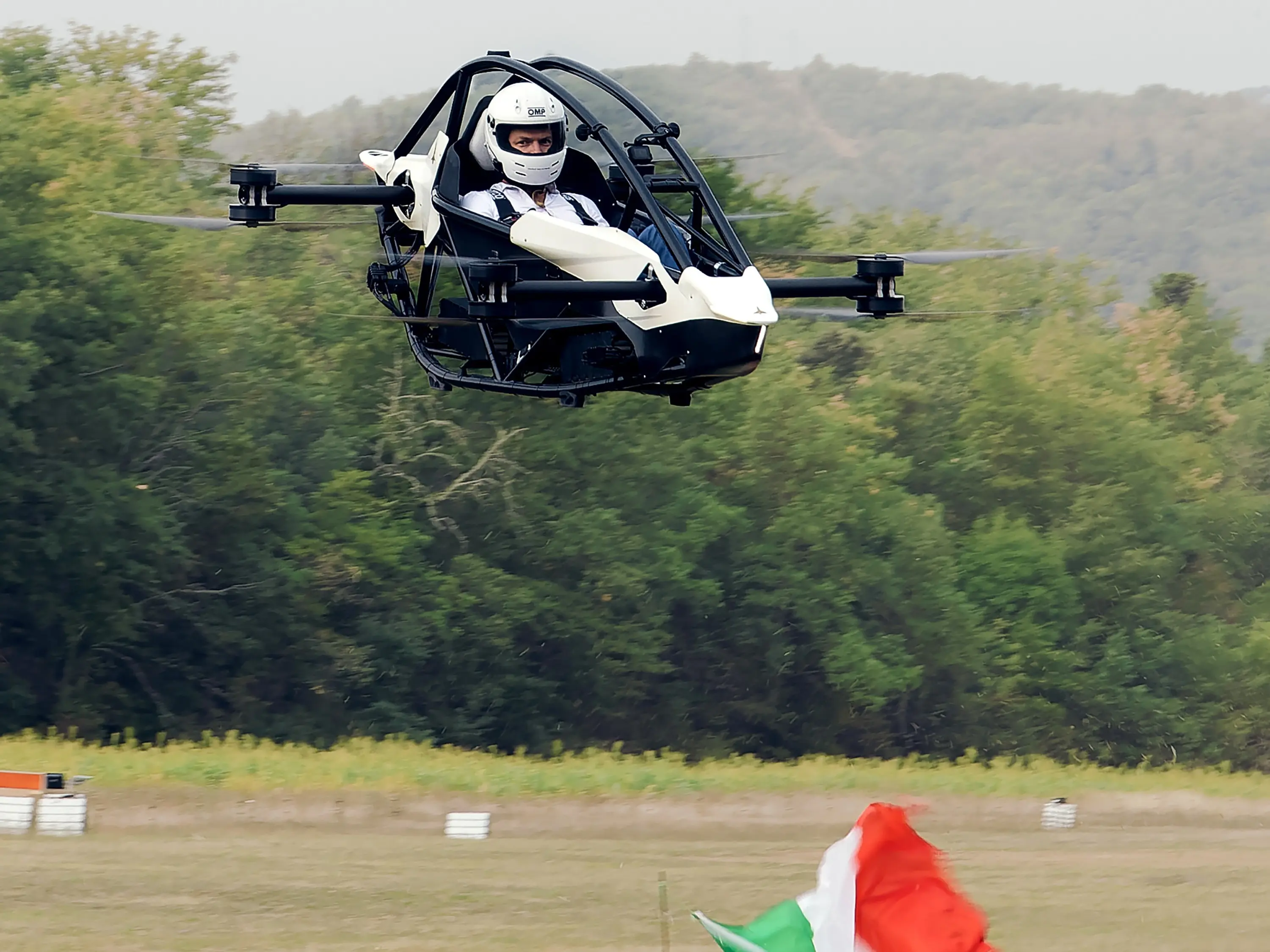
Jetson, an aerospace company that manufactures the Jetson ONE – the first commercially available personal eVTOL (electric vertical take-off and landing vehicle) – has announced that it has been granted its first ultralight aircraft registration, I-E953, issued by the Aero Club d’Italia (AeCI).
This classification is unprecedented in Europe. Unlike the three previous experimental registrations held by Jetson, under the supervision of AeCI, the Jetson ONE has now been formally recognised within the Italian ultralight and sports aviation sector as a non-experimental aircraft, thereby obtaining the same operational privileges as an ultralight VDS (recreational or sports flight) helicopter of the same class.
This result marks the culmination and completion of a shared, open and deeply collaborative process with AeCI, in accordance with current aviation regulations governing private flights using eVTOL aircraft – a goal long considered unattainable for this new category of aircraft.
This certification confirms that the Jetson ONE can operate in accordance with current Italian regulations governing VDS ultralight aviation, bringing it into line with conventional ultralight helicopters in terms of functionality. The Jetson ONE now meets both the specific requirements for identification as a VDS aircraft and the requirements in accordance with US Part 103 regulations, meaning that the aircraft can operate on both sides of the Atlantic. Whilst in the United States there is the significant advantage of exemption from the requirement for registration or a pilot’s licence, in Europe – and more specifically in Italy – registration is required for VDS ultralights to certify compliance with national regulations classifying them under this category, and the pilot must hold an ultralight pilot’s certificate and a medical certificate.
“Over the past three years, we have worked tirelessly to open up the market in Italy and, in doing so, to open the doors to citizens across Europe, offering them the freedom and thrill of private flight,” said Stephan D’haene, CEO of Jetson, in a statement. “What makes this achievement truly significant is that we have achieved it within the existing regulatory framework.” “Working closely with Aero Club Italia, we have mapped out a concrete path for sports and recreational flights using eVTOLs in Europe – a goal the sector has been pursuing for over a decade. For the first time, an aircraft such as the Jetson ONE is recognised as having all the privileges accorded to microlights.”
Credit is due to the Aero Club d’Italia, under the leadership of its president Stefano Arcifa, for welcoming Jetson’s new technology and for ensuring that Italy maintains its position at the forefront of the recreational aviation market in Europe. This specific approach continues to promote innovation and consolidate Italy’s leadership advantage in the aerospace sector, including the ultralight VDS sector.
It is no coincidence that the official presentation of the identification marks took place during the first air show organised by the Aero Club d’Italia in Castiglione del Lago: a moment intended to highlight, before the recreational and sport flying community, the symbolic and practical significance of this milestone for the entire sector.
Arcifa states: “It is with great satisfaction that the Aero Club d’Italia issues this first identification certificate, following a thorough trial phase. Thanks to the national regulatory framework, based on self-certification principles, the AeCI is at the forefront of the European ultralight scene, enabling – as in this case – research and development activities that are essential for new forms of personal mobility.”
Captain Andrea Spresian, in his capacity as flight operations manager and test pilot for the JetsonONE, personally oversaw every stage of the flight test campaign, contributing to the design modifications necessary to ensure full compliance with the requirements for microlight aircraft: “This milestone represents the culmination of a long and challenging journey, which I have experienced both as a test pilot and as head of flight operations. Over the past few years, we have worked closely with the Aero Club d’Italia to build, step by step, a regulatory framework that simply did not exist for a completely new category of aircraft such as the personal eVTOL. Seeing the JetsonONE recognised today as a non-experimental ULM (ultralight motorised aircraft, ed.), with the same operational privileges as an ultralight helicopter, confirms that safety, technical rigour and constant dialogue with the authorities can pave the way for a new generation of aircraft.”
Giovanni Bertolone, a senior consultant at Jetson, highlights two aspects: “I am very pleased with the result achieved because it is the fruit of both the enthusiastic work of Jetson’s international European team and the experience of the Italian team in liaising with prestigious national institutions such as the Aeroclub d’Italia. I would also like to thank ENAC (the Italian Civil Aviation Authority, ed.) which, within the framework of current regulations, has permitted the use of Jetson’s unmanned prototypes, which were essential for the launch of flight testing. The data collected provides a solid foundation on which to launch new versions in the future – versions which are already in demand by the market – thereby expanding the scope of applications.”
Historically, in Europe and outside the United States, personal eVTOL aircraft have been restricted to experimental classifications, which has limited their use and, until now, hindered their widespread adoption. With this new classification, the Jetson ONE is now officially recognised and no longer considered an experimental prototype; it can now operate in accordance with current Italian regulations governing ultralight aviation; it enjoys the same privileges as ultralight helicopters in Italy; and it paves the way for future eVTOL registrations to follow suit.
Gabriele Cruciani is a world-renowned scientist, entrepreneur and technological innovator. As a professor of organic chemistry at the University of Perugia, his pioneering work in computational drug design and molecular modelling has influenced modern pharmaceutical research worldwide. The recipient of numerous international scientific awards and the author of many highly cited publications, Cruciani has dedicated his career to pushing the boundaries of science and technology. His decision to become the first owner of a Jetson ONE in Italy reflects the same pioneering spirit that has characterised his scientific achievements: a passion for innovation, exploration and the future of personal flight, which he has dreamt of since childhood.
“We believe that Jetson ONE plays an important role in changing public perception of eVTOLs,” says Tomasz Patan, founder and CTO. “We are bridging the gap between science fiction and reality. Flying cars are on their way, and Jetson ONE is a first step towards this goal.” “With over 85 Jetson ONE pilots trained to date, the company has access to unique, real-world flight and system data, rather than simulations or estimates. This gives us a significant competitive advantage and reassures policymakers who support our new and innovative technology.”
Demand for the Jetson ONE has been phenomenal, fuelling our ambition to “make everyone a pilot”. The company has received over 678 pre-orders at a price of 148,000 dollars, with a deposit of 8,000 dollars required to reserve a serial number.
The Jetson ONE is a single-seater personal flying vehicle (pictured) that allows anyone to fulfil their dream of flying. The ONE model is built with a lightweight aluminium spaceframe inspired by racing cars and a carbon-Kevlar composite body. Thanks to its intuitive joystick controls, anyone can learn to fly it in just a few minutes. It is powered by eight powerful electric motors, has a flight time of up to 20 minutes and reaches a top speed of 63 miles per hour (102 kilometres per hour). It runs on high-discharge lithium-ion batteries and can carry a pilot weighing up to 95 kg (210 pounds).
The Jetson ONE has been specifically designed to meet the requirements of Part 103 in the United States, making it accessible to many. In Europe, and more specifically in Italy, it is now possible for people holding the appropriate pilot’s licence and medical certificate to experience flying an eVTOL.
ALL RIGHTS RESERVED ©