Table of contents
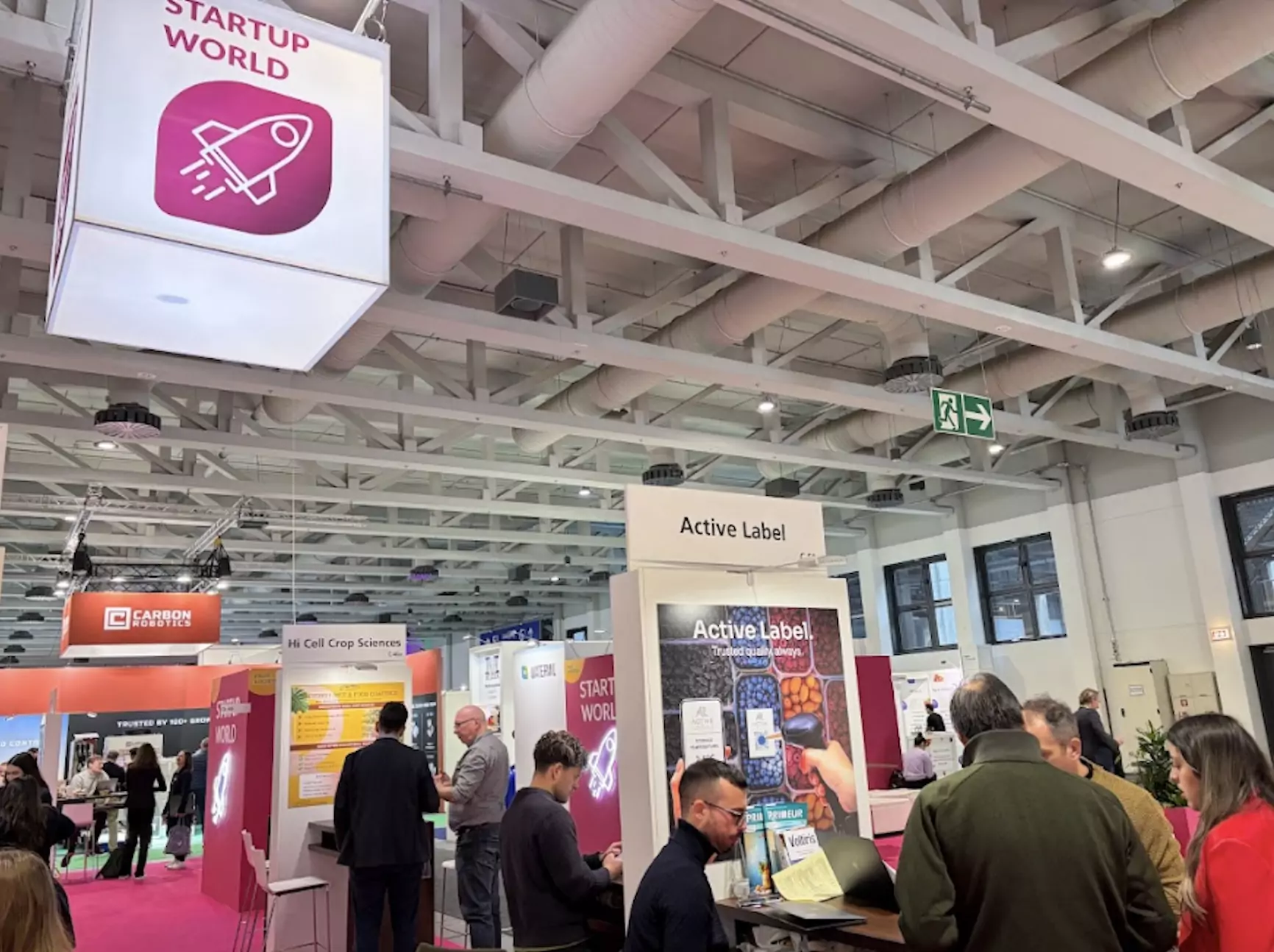
Fruit Logistica is the world’s largest trade fair for the fruit and vegetable sector. 2,600 exhibitors, 90 countries, 26 pavilions. Italy is the leading country in terms of the number of companies present, with over 400. Yet, if you go down to Hall 3.1 and look for the Startup World area, you will find only three Italian companies. Three out of eighteen startups selected from eleven countries. A fourth, Plantvoice, has chosen to position itself outside the dedicated area, with its own stand among the traditional exhibitors.
Four companies, four different approaches to innovation in the sector. And four stories that each tell, in their own way, what it means to start a business in the agrifood sector in Italy.
A label that reads freshness
Active Label is one of three Italian companies in the Startup World area. CEO Carlo Ricci shows what at first glance appears to be a normal QR code printed on a label. But it isn’t. “It is the active material that records all changes in temperature, light and humidity,” he explains to Startupbusiness. “Using a handheld device or an app, the information is extracted and transferred to a dashboard that has integrated artificial intelligence and gives you suggestions based on what we call a freshness index.”
The principle is simple: turn packaging into a monitoring tool. The product travels through the supply chain — from the field to the warehouse, from the lorry to the shelf — and the label records everything. If there has been an incident along the way, you know about it. If the cold chain has been broken, you can see it. And the cost? “Comparable to any packaging. For the user, it’s a service, with no additional hardware costs.”
Behind the apparent simplicity lie four international patents and sophisticated optical reading techniques. Active Label is targeting the European market and is securing its first customers. “There’s a lot here about fresh produce, about perishable goods,” says Ricci, looking around the pavilions. “We can see that there are no other solutions that are very similar. We have few competitors because it is a cutting-edge innovation, even if they only look like labels, so to speak.”
Natural ingredients instead of chemicals
A few stands away, Agreenet. Stefano Ferioli, co-founder, explains the product: PìFresc, a two-centimetre compostable sticker that aims to replace sulphur dioxide treatments in the preservation of fresh fruit. “Sulphur dioxide is a substance that mainly preserves grapes and blueberries, increasing their shelf life,” says Ferioli. “It is the only chemical treatment allowed, but it presents health issues. We know it is toxic, which is why there are limits on its use.”
PìFresc uses natural food ingredients that are already used in food products and releases substances that inhibit mould growth without posing any safety issues. This approach is also in line with European regulations against single-use plastics and chemical treatments after harvesting.
The start-up was founded in Turin in 2023 and is currently building its commercial pipeline. “We work where fruit is produced and exported,” explains Ferioli. “Italy is one of these markets, but we also target South America, Chile, Peru and South Africa.” At Fruit Logistica, they are looking for distribution partners, someone to bring the product to the target markets. When asked how he feels about being one of the very few Italians in the start-up area, his answer is pragmatic: “We knew there wouldn’t be many Italian start-ups. We are focused on building our commercial pipeline.”
The farmer who built a marketplace
And then there is Farmeo. Bartolomeo D’Aprile comes from Gioia del Colle, in the province of Bari, and his story is different from the others. He is not a technologist who discovered agriculture. He is a farmer who discovered a problem and decided to solve it.
“We experience Italy from the agricultural production and commercial side,” he says. “Over the years, I have developed certain needs. First and foremost: I used to meet with marketers, and in most cases, they were a small circle of people who guaranteed payment. When you wanted to enter different markets, you encountered situations where payments were not certain.”
Hence the idea: a B2B marketplace that connects farmers and buyers, but not like any other e-commerce site. Farmeo starts with data. Drone images, computer vision, algorithms that count trees, estimate fruit yields and analyse calibre. “Today, the purchasing market is based on block purchases,” he explains. “You go to the field, see how many plants there are, make a quantitative estimate and buy. All of this is highly uncertified and unguaranteed. A ten per cent error compromises your future earnings.”
The Farmeo platform transforms this process. The buyer logs in, searches for the product, finds the farm with verified data, number of trees, estimated fruit yield, size percentage, and can purchase using a buy now pay later mechanism that protects both parties.
The most significant detail? Farmeo is bootstrapping. No rounds, no venture capital. He built it with his own resources, from the ground up. He has an American competitor, Produce Pay, which has raised over $400 million in equity and debt. He invested his own money and a 2% error rate on computer vision for citrus fruits. “No one will give us money in Italy,” he says, without drama. It’s a fact, not a complaint. And that’s exactly why he’s in Berlin.
A sensor in the sap
The fourth Italian company is not in the Startup World area. Plantvoice has chosen to position itself with its own stand among the exhibitors, outside the area dedicated to startups. A positioning choice: to be perceived as a company, not as a project in its initial phase.
The technology consists of a biocompatible sensor that is inserted into the plant’s stem and analyses its sap in real time, acting as a sort of plant electrocardiogram that detects water, nutritional and environmental stress. The start-up, founded by brothers Matteo and Tommaso Beccatelli and based in Bolzano in the NOI Techpark, closed a €500,000 capital increase in 2025 and expanded its range to three different sensors. “In addition to the sap sensor, which is where it all started, we have come full circle,” explains the team. “When you perform a series of actions on the plant, you can see what actually happens, when I water more, when I eliminate insects.”
Feedback at Fruit Logistica was positive, with fruit producers showing particular interest. By Friday, the last day, we had run out of business cards.
The missing data
Four Italian start-ups. Four concrete solutions: a smart label, an alternative to chemicals, a marketplace from the field, a sensor in the plant. None of them are hyped, but they all have a product. However, four out of 2,600 exhibitors at a trade fair where Italy is the leading country is still a significant number.
In the Startup World area, just a few stands away from the three Italian companies, a Swiss startup — Noriware — presents a film for packaging made from seaweed. It has closed a seed round of 4.3 million Swiss francs. A seed round. In Italy, announcing that you have raised 500,000 euros is already newsworthy.
It’s not a question of the quality of start-ups. It’s a question of the ecosystem. Of how many arrive at a fair like this. Of how many leave. And of how many, among those who leave, find the conditions they need so they don’t have to do it alone.
ALL RIGHTS RESERVED ©