Table of contents
There are places where geopolitics can be understood better than in newspapers. Fruit Logistica is one of them.
Berlin, Messe. 26 pavilions. 2,600 exhibitors from over 90 countries. 67,000 visitors expected from 151 countries. 82% are decision-makers: large-scale retail buyers, purchasing managers, CEOs. People don’t come here to look. They come to buy, to sell, to decide what will end up on supermarket shelves around the world over the next twelve months.
It is the largest trade fair on the planet for the fruit and vegetable sector. But reducing it to ‘fruit and vegetables’ would be like saying that CES in Las Vegas is about gadgets. Fruit Logistica is about power. The power to feed people.
Ukraine and Palestine under the same roof. Russia is not.
Egypt has an entire pavilion, almost 100 exhibitors, a record growth. China has increased its presence by 33%. Turkey by 12%. Israel, despite everything, by 20%. And then there are Ukraine and Palestine. In the same building. A few corridors away.
Russia, on the other hand, is not there. It cannot be there. Messe Berlin has banned Russian and Belarusian exhibitors from March 2022, in line with European sanctions. This absence weighs heavily at a fair where agriculture proves to be the only infrastructure that never stops. Not even under bombs.
Because agriculture never stops. It cannot stop. It is the infrastructure that comes before all others. Before energy, before telecommunications, before transport. You can live without the internet. You cannot live without food.
Walking through these pavilions means seeing globalisation for what it really is: not an abstract concept, but boxes of Moroccan oranges, Saudi dates, Peruvian blueberries, Polish apples and New Zealand kiwis. It means understanding what we will find on the shelves. What we will eat. And who decides for us.
Innovation is not what you think it is
When we talk about innovation in agriculture, our thoughts turn to drones, artificial intelligence and sensors in the fields. At Fruit Logistica, you discover that true innovation lies elsewhere.
It is the cold chain that allows a Mexican avocado to arrive in Munich at just the right stage of ripeness. It is the packaging that extends shelf life by a week. It is the logistics that optimise containers. It is the coating that protects the fruit from mould.
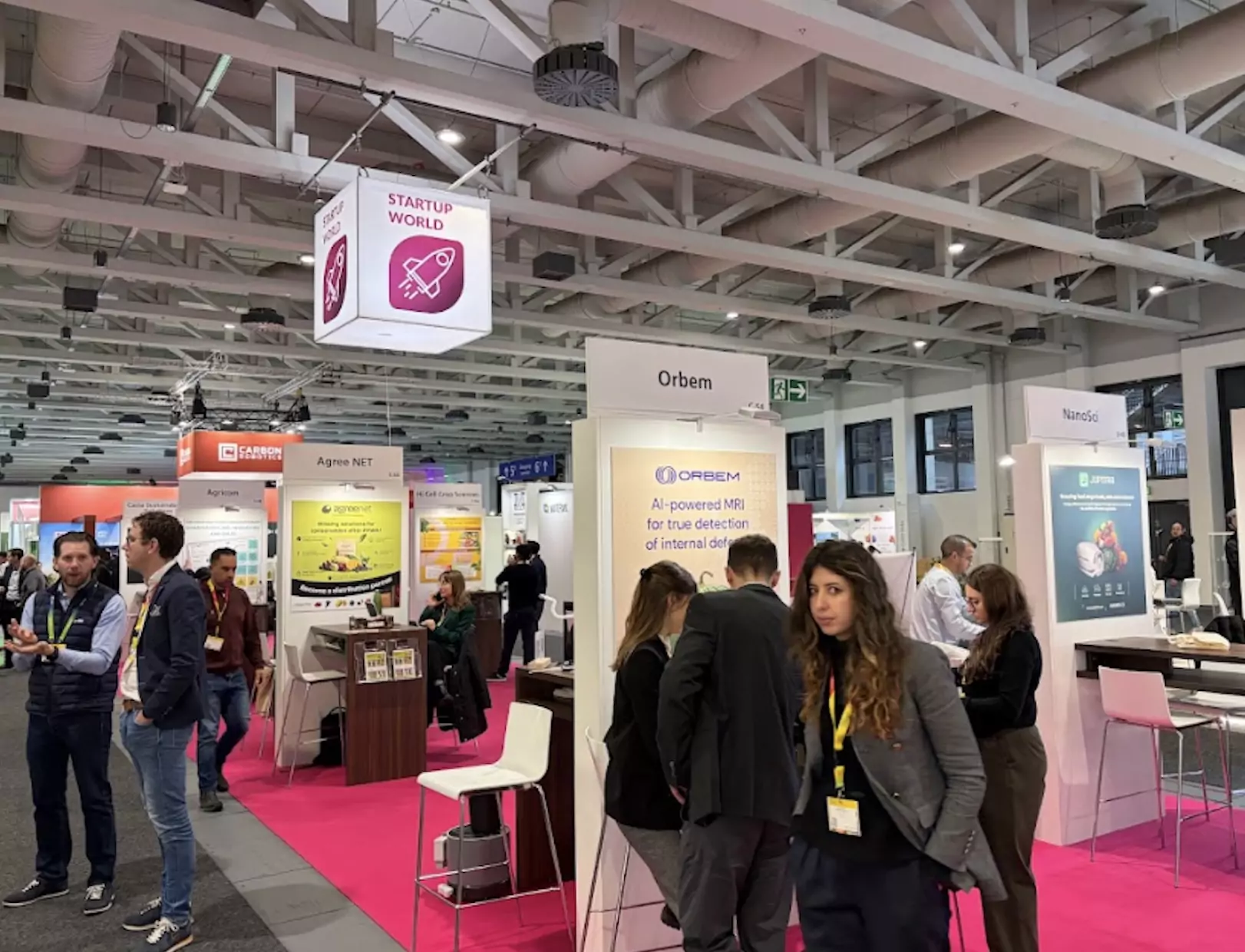
The big Italian companies are here. They are involved in biotech, robotics and automation. They are in the main pavilions, with stands covering hundreds of square metres. The start-ups? Look for them. They are in ‘Startup World’, a dedicated area that has been expanded to three days this year. On paper, this is a positive sign. In practice, it is a handful of stands in a corner that buyers never come across.
The Italian paradox
Italy ranks first in terms of number of exhibitors, with over 400 companies. In fact, it is a fair within a fair. However, there is something that seems out of place.
You enter the Italian pavilion and hear Italian being spoken. Everywhere. Northern accents, southern cadences, dialects. Meetings are between Italians. Handshakes are between compatriots. Negotiations are in Italian.
I stop to listen to two entrepreneurs. They are talking about fourth range products, pre-washed and bagged salad, the kind you find in the supermarket ready to be dressed. “Yes, fourth range products are good, they make more money. But then you have to buy the machinery, get the certifications… I’m better off selling salad by the hundredweight.”
There you have it. In one sentence, a portrait of a part of Italy. Innovation exists, it is known, it is known to work. But the leap is not taken. Better the hundredweight. Better the familiar.
You’re in Berlin. The most international trade fair in the world. And you’re listening to a conversation you might hear in a provincial bar.
Walk a few hundred metres. Enter the Dutch pavilion. A different atmosphere. English everywhere. German buyers talking to South American exporters. Scandinavian distributors negotiating with Spanish producers. True internationalisation.
Three start-ups out of 2,600
The Italian start-ups present in the dedicated area can be counted on one hand. Three. Active Label, Farmeo, Agreenet. Concrete solutions, real products, no hype. But three out of 2,600 exhibitors. In a trade fair where Italy is the leading country in terms of total number of exhibitors.
The problem is not quality. It is representation. It is the system that does not bring them here. It is the ecosystem that does not support them.
Tomorrow, day two. I will go and look for those three start-ups. To understand why they are here, what they are looking for, what they expect. And what they tell us about the relationship between Italy and innovation in the sector that, more than any other, should be ours.
ALL RIGHTS RESERVED ©