Table of contents
- The sad nine-euro sandwich does not exist. Not here.
- The pavilions are emptying. The start-up area is not.
- Those who sell greenhouses in Europe speak five languages. At least.
- Innovation is removal. Pompur removes the allergen.
- With the microphones turned off, the exhibitors speak
- The airport reopens. The fair closes.
Third day in Berlin. Black ice at BER airport, wheeled suitcases in the corridors, exhibitors dismantling their stands. But those who stay are rewarded with genuine conversations, food that isn’t like motorway service station fare, and an Innovation Award that rewards those who take away rather than add.
Friday morning, 8:47 a.m. The sky above Berlin is a grey that does not bode well. The night brought black ice to the runways of BER, Brandenburg Airport, which kept thousands of passengers grounded the day before. The fair already knew this: the last day is always a race against time, but this year the race started a day early. Exhibitors dismantled their stands before the doors even opened. Visitors arrive with wheeled suitcases, ready to take more than talk.
And yet. And yet those who remain find.
The sad nine-euro sandwich does not exist. Not here.
First observation, and it’s not trivial: the food here is good. Anyone who frequents Italian trade fairs is familiar with the ritual of the sad nine-euro sandwich, that soggy thing that looks like it came from a motorway service station on the A1 in the 1990s. Messe Berlin has a different approach. Real international cuisine, not the caricature you find in shopping centres. Gyoza, bibimbap, stir-fried noodles. A German corner with würstel that actually taste good. Freshly made pasta, and that’s not just a figure of speech: there’s a guy rolling it out while you wait.
And then there’s the catering at the stands, which is a world away from what we normally see. It seems trivial, but it’s not: when you spend ten hours on your feet talking to strangers, what you eat for lunch determines how you talk at four in the afternoon. Berlin knows this. Perhaps we should take note.
The pavilions are emptying. The start-up area is not.
While the main pavilions lose visitors at the slow pace of an aquarium leaking water, the Startup World area remains crowded. Curious visitors rather than buyers. People who have time, who look, who ask questions. The salespeople of young companies, those who have stayed, those who have not booked the 2 p.m. flight, talk. And they talk willingly, because when the noise subsides, conversations become real.
A German exhibitor tells me that in three days he spoke to two hundred people and signed two contracts. The maths is simple: a 1% conversion rate. “But those two contracts are worth the whole year,” he says. An Israeli woman who monitors crops explains to me that the real buyers came on the first day. Friday is for dreamers and operators. “And you’re here,” she points out. Touché.
Those who sell greenhouses in Europe speak five languages. At least.
The most memorable scene of the day is not a stand, nor a product. It is a man sitting at the stand of a company that builds greenhouses. He is a salesman, not a buyer, and the distinction matters. In fifteen minutes, I see him switch from Italian to French with a group of colleagues who greet him, then to English with someone who interrupts him with a technical question, then to Romanian with a person who has come to see him, and finally to imperfect but functional Chinese with a potential customer from Asia.
It’s not exhibitionism. It’s the job. Anyone selling greenhouses in Europe in 2026 has to talk to those who buy them in Romania, those who design them in France, and those who manufacture them in China. Language is not an accessory: it is infrastructure. And this gentleman has built it piece by piece, country by country. As I look at him, I think of how many Italian salespeople I have known who only speak school English. And I think that perhaps we have a problem.
Innovation is removal. Pompur removes the allergen.
The 20th Fruit Logistica Innovation Award will be presented at 1 p.m. in the foyer between Halls 1.1 and 2.1. Twenty years of innovations that have shaped the industry. This year, the ten finalists tell a clear story: innovation is not about adding. It’s about taking away.
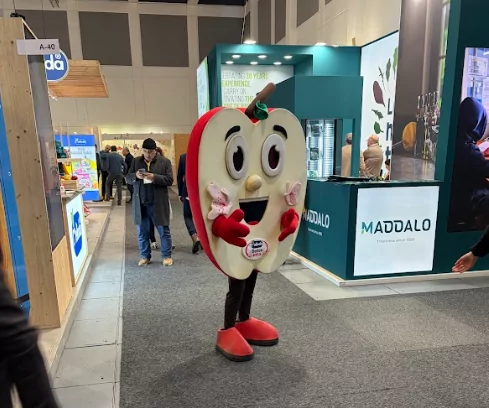
And the winner is whoever removes the most. Pompur, from the German Züchtungsinitiative Niederelbe, takes home the FLIA Fresh Produce 2026 award. It is an apple, but not just any apple. It is the first apple certified by the European Centre for Allergy Research Foundation for those allergic to apples. Years of work to eliminate the allergen that kept millions of consumers away from this fruit. Remove to include. The apple was playing on home turf, of course, as we are in Germany, but I must admit that at the tasting counter it was really one of the best things I tried during the three days of the fair. The flesh was crunchy, the flavour full, with no strange aftertaste. If I didn’t know the story behind it, I would simply think it was a good apple.
FLIA Technology goes to the L50 Drone by ABZ Innovation, Hungary. The first European agricultural drone with LiDAR system and 50-litre capacity. Eliminate uncertainty in spraying, eliminate waste, eliminate GPS when not needed because the sensor reads the terrain in real time. Fifty kilos of technology flying over vineyards and olive groves, promising less pesticide use and better application.
Among the finalists, similar stories: Tribelli Seedless by Enza Zaden removes seeds from peppers. Poptis removes preparation from cucumbers. Compack removes plastic from packaging using mushroom waste. The message is clear: the future of fruit and vegetables is no more complicated than the present. It is simpler. And this simplicity costs years of research, millions in investment, and a courage that is not visible in the crowded corridors of the first two days.
With the microphones turned off, the exhibitors speak
Once the press releases have been sent out, the exhibitors start talking. A Frenchman who makes innovative packaging tells me that the real challenge is not the product, but the speed of large-scale distribution. “They want sustainability, but they want it to cost the same as plastic did twenty years ago. It doesn’t work like that.” An Italian from the logistics sector shakes his head: “The problem isn’t innovation. It’s that everyone here sees the innovation, but only three people buy it at home.” A Chinese man smiles: “In China, we do the same things, but faster. And cheaper. This fair helps us understand what you really want.”
No one wants to be quoted. Everyone wants to be heard. That’s the difference between a press release and a conversation.
The airport reopens. The fair closes.
At 4 p.m., the gates close. BER has resumed flights, and the rush to the gates turns into an orderly exodus. On the S-Bahn carriages heading towards Alexanderplatz, at least six different languages can be heard, but the tone is the same: tiredness, satisfaction, and that particular euphoria of those who have accomplished something that was worth the journey.
Fruit Logistica 2026 concludes with ice on the runways and the sun finally breaking through the clouds. Perhaps too easy a metaphor. But sometimes the easy metaphors are the true ones.
Next stop: Italian start-ups that have made the journey to Berlin. What they brought with them, what they found, and why Italy continues to produce innovation that we then export poorly.
ALL RIGHTS RESERVED ©