Table of contents
In Italy, only 3.1% of people with disabilities choose to become entrepreneurs. In Europe, the average is 7.8%. An 11-percentage-point difference that does not reflect a cultural divide, but rather a system that has structurally decided that people with disabilities must be employees. Not entrepreneurs. Not founders. Not builders of something of their own.
Yet the figures reveal a paradox that should be a source of embarrassment to anyone involved in labour policy. In Italy, there are around 3.1 million people of working age with severe functional limitations, and of these, only 32.5% are in employment. Self-employment, entrepreneurship, freelance work and starting a business are paths that the system has never envisaged for them. Or worse, it has chosen to exclude them (ISTAT data: the figure of 3.1 million refers to the total number of people with disabilities in Italy – not just those of working age). For the 15–64 age group, the employment rate for people with disabilities is 32.5%, compared to 58.9% for the general population. Source: ISTAT, Report to the Senate Committee, September 2023. See also Il Sole 24 Ore, 1 December 2024.)
A law designed to hire, not to build
Law No. 68 of 1999 (Law No. 68 of 12 March 1999, ‘Provisions on the right to work for people with disabilities’) introduced the targeted placement scheme and recruitment obligations – reserved quotas – for companies with more than 15 employees. In force, last updated on 30 December 2025. Source: Normattiva.it) is the ‘cornerstone’ of the employment of people with disabilities in Italy. It introduced targeted placement, recruitment obligations for companies above a certain threshold, agreements and regional funds. However, it is a law built around a single concept of work: that of employment, recruitment and the relationship between worker and employer.
Entrepreneurs with disabilities are not recognised in this law. They are not recognised in regional employment funds, they are not recognised in the Ministry of Labour’s calls for proposals, and they are not recognised in publicly funded career guidance programmes. When people in Italy talk about ‘inclusion in the workplace’, they almost always mean employment as a staff member. Entrepreneurial independence is treated as an exception, a borderline case, something to be considered only when standard employment is not feasible.
Invisibili nei bandi, invisibili nell’innovazione
The landscape of calls for proposals for start-ups and innovation in Italy has grown considerably in recent years. The PNRR has allocated significant resources to the development of innovative businesses, whilst Invitalia has launched initiatives such as Smart & Start Italia (a financial support programme managed by Invitalia for innovative start-ups, operating nationwide). It does not include specific criteria or dedicated pathways for founders with disabilities. Source: Invitalia), and the regions have increased the number of calls for proposals for youth and female entrepreneurship. Yet none of these schemes includes a section, a pathway or even a single requirement that takes into account the founder’s disability.
This is not a matter of a lack of sensitivity on the part of those who drafted them. It is a systemic gap: entrepreneurs with disabilities have never been regarded as a relevant category within Italian industrial policy. Innovation funds reward ideas, skills and networks. But they do not take into account that a person with a disability might have the idea, the skills and the networks to turn it into a business. The OECD report “The Missing Entrepreneurs 2023” is clear on this point: in European countries, self-employed people with disabilities are 11% less likely to have employees than those without disabilities. The gap is not one of motivation, but of access to resources (OECD/European Commission, “The Missing Entrepreneurs 2023” – November 2023. The report highlights that in European countries, self-employed people without disabilities are 11% more likely to have employees than those with disabilities. The gap is structural, not motivational).
The hidden cost of invisibility
In the public debate on inclusion in the workplace, a recurring narrative persists: that of people with disabilities as recipients of protections, concessions and quotas. This narrative, whilst well-intentioned, ultimately constructs an identity centred on dependency. And this identity comes at a cost that is rarely taken into account: the cost of lost independence.
Anyone who decides to start a business whilst living with a disability faces the same challenges as any other founder: raising capital, building a team, validating a market, and managing the uncertainty of the early years. But they also face additional obstacles. Access to innovation networks often requires physical attendance at events and hubs that are not designed to be accessible. Accelerator programmes rarely offer adapted pathways. Venture capital firms and business angels lack evaluation frameworks that view disability as an asset, rather than a limitation.
The result is that those who succeed do so in spite of the system, not because of it. And those who do not succeed – who make up the vast majority – are counted in the unemployment statistics and then used as an argument for renewing the very measures that excluded them from entrepreneurship in the first place.
What needs to change: three specific demands
There are no easy solutions, but there are concrete steps that Italy could take immediately, without waiting for structural reforms that take years to implement.
The first step is to introduce a quota in public tenders: all tenders for start-ups, innovation and entrepreneurship funded by public money – whether European or national – should include a reserved quota or award additional points to businesses founded or co-founded by people with disabilities. This is not a form of welfare, but rather a recognition of a genuine competitive advantage: disability often leads to a deep understanding of markets and needs that the majority overlook.
The second is to create specific support programmes. Entrepreneurship helpdesks exist within Chambers of Commerce, regional authorities and public incubators, but none of them have staff trained to help entrepreneurs with disabilities navigate the legal, tax and strategic issues that intersect with their circumstances. A dedicated technical support fund, however small, would have a measurable impact.
The third is to collect and publish data in a systematic manner. In Italy, there is no register, no monitoring, nor even a periodic survey of entrepreneurs with disabilities. We do not know how many there are, in which sectors they operate, or how successful they are. Without data, there can be no policy, and without policy, there can be no change.
Entrepreneurship is about independence, not a luxury
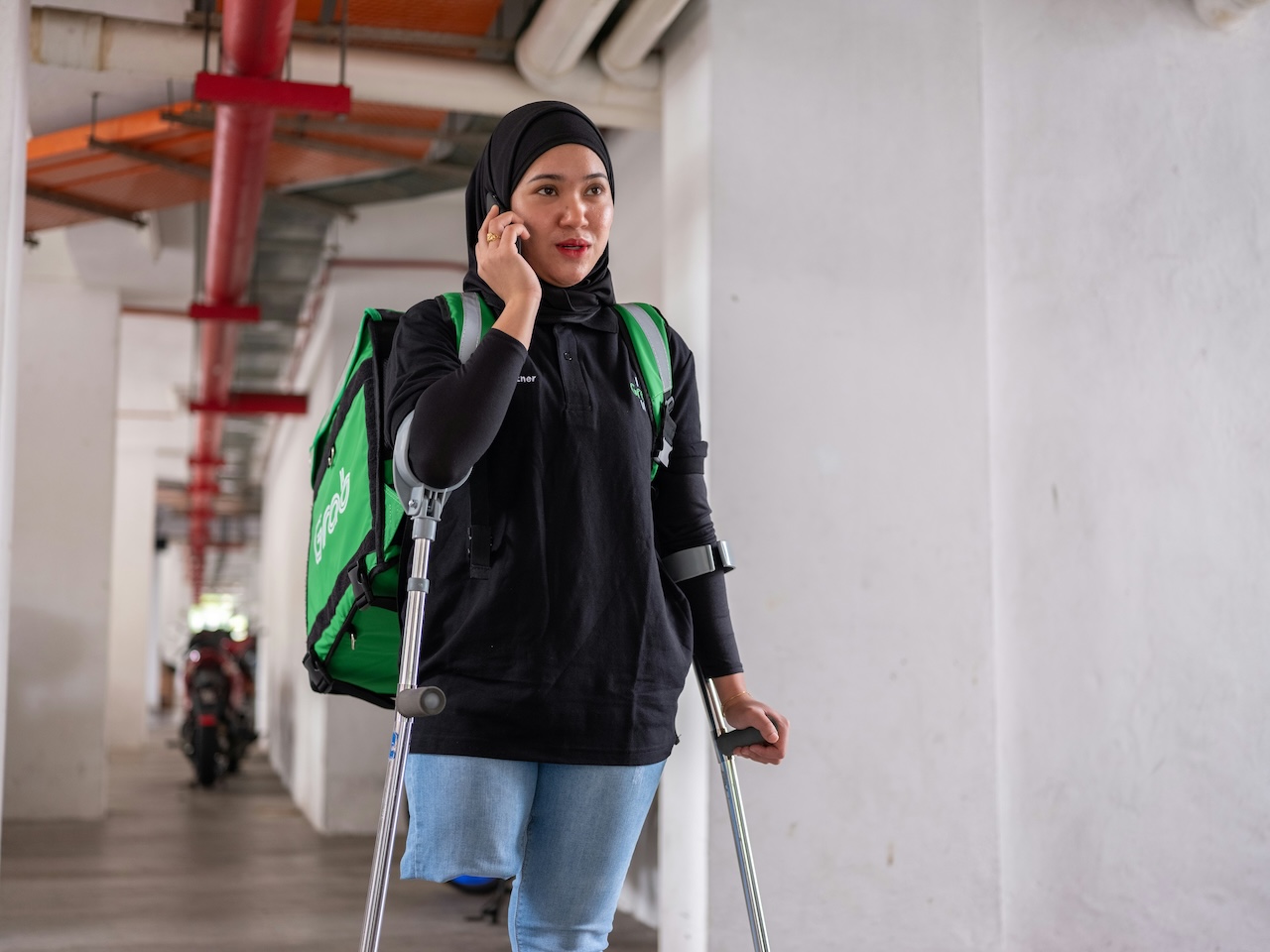
As vice-president of LADI, the Free Association of Disabled Entrepreneurs, I feel a responsibility to state clearly what the data confirms and what common sense often refuses to acknowledge. People with disabilities who choose to build something of their own are not exceptional cases to be celebrated at conferences. They are a group of entrepreneurs whom the system has chosen to ignore, and who exist in spite of this invisibility, not because of it. We want to build. We do not want to sit and wait. (photo by ThisisEngineering on Unsplash)
ALL RIGHTS RESERVED ©