Table of contents
There is a kind of innovation that doesn’t make a splash. It doesn’t arrive with a high-profile launch, it doesn’t make the headlines in Italian (or indeed European) financial publications, and it doesn’t scale up within a few months. It arrives quietly, changes structures, and reshapes physical and mental spaces. And it is precisely this type of innovation—slow, systemic, and pervasive—that tells us the most about how the world of start-ups is profoundly influencing corporations and society as a whole.
There is a kind of innovation that doesn’t make a splash. It doesn’t arrive with a high-profile launch, it doesn’t make the headlines in Italian (or indeed European) financial publications, and it doesn’t scale up within a few months. It arrives quietly, changes structures, and reshapes physical and mental spaces. And it is precisely this type of innovation—slow, systemic, and pervasive—that tells us the most about how the world of start-ups is profoundly influencing corporations and society as a whole.
The latest initiative is called ‘Spazi per l’Italia’, a project through which Poste Italiane is opening up its buildings to co-working spaces, digital nomads and start-ups. At first glance, this might seem like a standard property deal. But when viewed in the right context, it is much more than that.
From empty post boxes to innovation hubs
Think about it for a moment. When was the last time you sent a letter? A postcard? Perhaps letters between lovers, friends or relatives still survive. But the heart of communication has shifted elsewhere: email, voice messages, mobile platforms, instant notifications. From postcards to WhatsApp, everything is in flux and everything happens in an instant, thanks, of course, to the mobile revolution.
These days, the only things arriving in our letterboxes are local adverts – ironically, the very same ones that follow you on your smartphone – a few automated utility bills, or the odd fine. As for actual letters, there are practically none.
This means that every post office in Italy – those buildings that are often historic, often centrally located, and often beautiful – has seen the physical scope of its primary function gradually diminish. Logistics has also changed radically: Amazon has redefined market expectations, whilst couriers and established operators such as SDA, now part of the Poste Italiane group, have transformed the very nature of physical sorting. The result? Huge, unused spaces in prestigious buildings that are difficult to breathe new life into. And lifeless spaces lose value, dragging down the neighbourhood around them, whilst continuing to incur maintenance costs.
And it is precisely this contradiction that provided the impetus for the creation of the first co-working spaces in Italy: repurposing the property, adding value to it, and creating new investment opportunities.
The previous one
This is not the first time Poste Italiane has taken steps in this direction. In 2015, I had the opportunity to work on this issue first-hand. At the invitation of Enrico Gasperini, an innovator and visionary, I had contributed to the development of the Digital Magics network in Southern Italy, in support of the start-up ecosystem. The results in the South were such that the project was extended to Lazio, and it was there that I oversaw the development of Poste Italiane’s first co-working space, created in partnership with Talent Garden and opened in 2016. Now Poste Italiane is going it alone.
This is one of the clearest examples of cross-pollination between start-ups and large organisations: long-established companies that are beginning to learn from start-ups, embracing new ideas, accelerating their development, and experimenting with new approaches, new functions and new business models. Not theory. Practice.
Italy’s largest regional platform
Today, that initial experiment has become a fully-fledged system. The Spazi per l’Italia project (spaziperlitalia.poste.it) is the natural evolution of that journey, and its potential is hard to underestimate.
Poste Italiane has a widespread presence across the whole country, even in areas where the innovation ecosystem has never reached. We are talking about an organisation which, despite being listed on the stock exchange, is controlled by the MEF (Ministry of Economy and Finance, ed.), Cassa Depositi e Prestiti and institutional investors. An entity with the scale to become Italy’s largest regional platform for start-ups and innovators, especially given that it has had active open innovation programmes and M&A operations in the tech and logistics sectors for years. Who knows when we’ll be using the Poste Italiane app to have a sandwich delivered to our door.
The question that immediately sprang to mind when I first heard about the project was almost instinctive: is there a space in Capri? In Ischia? In Procida? That way, as I live in Naples, I can put a bit of sea between myself and anyone looking for me.
But there is a story that makes all this less random than it seems. Years ago, together with Claudio Silvestri and others, we put together a project to mark the centenary of *Torna a Surriento*: the idea, in true cultural start-up style, was to create a multimedia encyclopaedia of Neapolitan songs – a project which, like many start-ups with an idea that was simply too good to be true, still exists today, mainly in our heads. From that adventure, however, at least one concrete thing emerged: I became a journalist writing about innovation. It was in that job that I also discovered a detail which I still find enlightening today: ‘Torna a Surriento’ was written specifically to open a post office.
It was 1902, and the De Curtis brothers wrote the song to persuade Minister Giuseppe Zanardelli, who was visiting Sorrento, to grant the town a post office.
Opening a post office has always been the way for a small village to become more modern, better connected and more vibrant, not to mention the permanent jobs it created. Now, more than a century later, that very same post office could become the way for that village to connect with the innovation economy.
It is worth remembering that start-ups, even when they fail, act as a revitalising force for the entire production system. And in this case, they also bring innovation to the state.
A property development or a public infrastructure project?
That said, the most important question remains: is Spazi per l’Italia purely a property development project, or could it become something more?
Some spaces on the website are already fully booked. That’s good: it means there’s demand. But that’s precisely why it’s worth asking what the eligibility criteria, prices and governance model are. Not all spaces will be open for co-working: Poste is considering renting them out to other public bodies as well, such as the INPS.
Switching from a permanent position that costs you money to a rented one isn’t a bad business model, and institutional rentals are set to continue for many decades to come.
Behind the scenes, there is another change taking place: part of the state is moving away from simply occupying space for the sake of administration and is beginning to generate revenue from it, to share it, and to repurpose it. It is good that the state is repurposing itself. But we must be careful that this is not the only thing happening.
Poste Italiane is an infrastructure that has been funded by the Italian people for over a century. The spaces now being opened up for co-working were built, maintained and paid for by the state. There is an issue of accessibility, affordability and inclusion that cannot be ignored.
This isn’t about grandstanding. It’s about understanding whether this initiative, as well as optimising a property portfolio, can serve as a genuine springboard for those who are currently on the fringes of the innovation ecosystem.
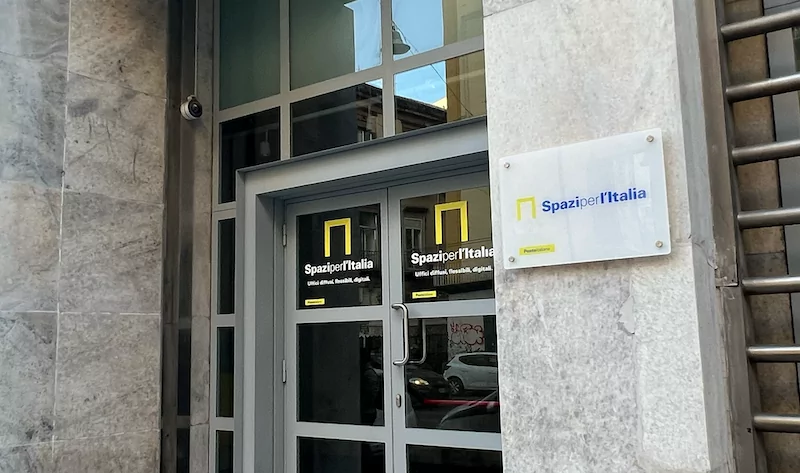
The signs are there. We’re heading in the right direction. Now we need to see if the vision lives up to the building. Because if these spaces truly manage to become accessible, inclusive and community-focused, then they could be much more than just a property development: they could become a real springboard for those who are currently outside the innovation loop. (in the author’s photo, the entrance to the Poste Italiane building in Piazza Matteotti, Naples, the entrance from Via Monteoliveto)
Note to the reader: Antonio Prigiobbo is a journalist, author, founder and editor-in-chief of NaStartup
ALL RIGHTS RESERVED ©