Table of contents
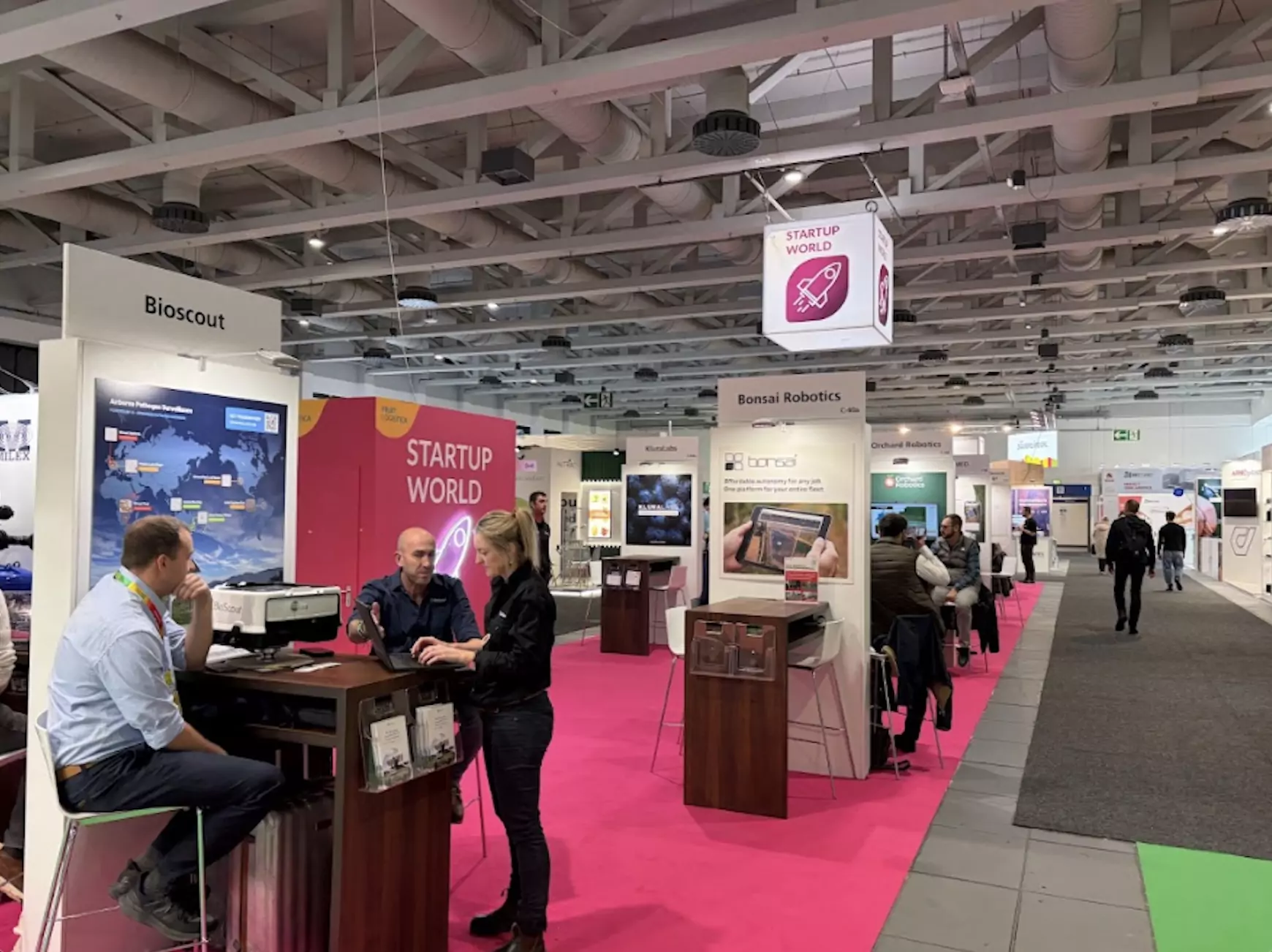
Fruit Logistica dedicates an area called Startup World to start-ups. It is a corner of Hall 3.1, with eighteen stands from eleven countries and a stage for pitches. To find it, you have to look for it: it is not at the entrance, it is not in a passageway, it is not where fruit and vegetable buyers spend their time. Buyers are in the pavilions of the producing countries, Egypt, Brazil, Spain, or in the halls where the product is traded by volume. The startup area is for those who have time and curiosity. And at a trade fair where time is the scarcest commodity, this is already a problem.
Yet, if you go in and stop to talk to the exhibitors, what you find is a fairly accurate snapshot of where innovation in the sector is heading. With a few surprises and a few confirmations.
The obsession is called shelf life
The first thing that strikes you when walking among the stands is an almost obsessive convergence: most of the start-ups present are working, in one way or another, on preserving fresh produce. Shelf life, active packaging, mould reduction, ethylene control. No generic artificial intelligence, no spectacular drones: just better preservation, for longer, with fewer chemicals.
Noriware, a Swiss start-up, produces packaging film made from seaweed extracts. This 100% bio-based material is not classified as plastic under European PPWR regulations, which means that when the ban on single-use plastics comes into force for fruit and vegetables, they will already be compliant. They have closed a seed round of €4.3 million. A seed round for seaweed packaging.
KluraLabs, from the United Kingdom, has developed an active plastic material that releases very low concentrations of antimicrobial gases inside the packaging. They have just launched their first product with Marks & Spencer and are testing its application on bread: “We can remove preservatives from the product and put them in the packaging,” explains one of the founders. “Bread without preservatives, in our packaging, lasts as long as bread with preservatives in standard packaging.” They have closed a Series A round of funding.
And then there is the story that strikes you most.
A Polish engineer, COVID-19 and cold storage rooms
Adam Kądziela is the CEO of NanoSci, a Polish start-up with laboratories in Gdańsk. The product is an air purification system based on photocatalysis: it eliminates mould, bacteria, ethylene and volatile organic compounds in closed environments, greenhouses, cold rooms and refrigerated transport systems. No filters to replace, no maintenance, energy consumption three times lower than UVC disinfection.
But the interesting part is how he got there. “We started during Covid,” he tells Startupbusiness. “I am an engineer with a PhD in chemistry. I wanted to help, I wanted to do something for society during the pandemic. We developed an air filtration system for enclosed spaces such as offices, lifts and public transport.”
The problem? No one wanted to pay to breathe better. “Air purification has enormous value when it saves a tomato or an apple. If it saves a human being, no one is willing to pay.” It’s a phrase that should be framed.
Hence the pivot: the same technology that was supposed to protect people from the virus now protects fruit, vegetables, salads and olives from mould in warehouses. “When I asked the first investors to finance an air purifier, they asked me about the ROI. It’s like asking the refrigerator manufacturer about the ROI. It’s not an accessory. It’s infrastructure.”
According to the team, NanoSci has raised a total of around €3 million, including €2 million from the EIC Accelerator. It is already working with producers in Spain on tropical fruit, with pharmaceutical cannabis companies and with the bakery sector on bacteriological control. At the fair, it was one of the stands that was definitely worth stopping by.
Magnetic resonance imaging on fruit
And then there is Orbem. Munich, a spin-off of the Technische Universität München. What they do is take magnetic resonance imaging, yes, the kind used in hospitals, and make it industrial: a thousand times faster, without human operators, integrated into production lines. Scanning in less than a second. Service-based business model: you pay per scan.
The first, instinctive reaction is that it’s madness. Performing an MRI scan on a fruit that you then eat. It’s the kind of technology that seems to have come out of an overly ambitious pitch deck. But when they explain the case of eggs, everything changes.
Orbem’s flagship product is Genus Focus: it determines the sex of the embryo inside the egg, non-invasively, in less than a second. It is an alternative to the culling of male chicks, a practice already banned in several European countries. To date, they have scanned over 170 million eggs. They have just closed a €55.5 million Series B round, with General Catalyst among the investors.
Fifty-five and a half million. For a start-up that performs magnetic resonance imaging on eggs. The comparison with the Italian ecosystem is merciless and, perhaps, pointless.
Orbem is now expanding the application to fruit and vegetables, watermelons, avocados and mangoes, to detect internal defects without opening the product. “Tell me what you want to see in the watermelon,” says the team at the stand. “We create a digital twin of every single fruit.” No sampling: every piece, one by one.
The paradox of Italian customers
One surprising fact that emerges when talking to international start-ups is that more than half of those present in the Startup World area already have customers in Italy. Not only in biotech or packaging, where Italy has historically been strong, but also in robotics, drones and greenhouse sensors. Italy is a target market for international agrifood innovation, even though Italian start-ups in this area can be counted on the fingers of one hand.
AgStacked, based in the Netherlands, uses artificial intelligence for quality forecasting: it aggregates weather data, supply chain data and field data to build forecasts on the quality of incoming produce. If a container from South America takes four weeks, the buyer knows in advance what to expect and can prepare by stocking up more from other suppliers, arranging inspectors and organising packaging lines. Pre-seed funding from Heartfelt Capital and APX. Three co-founders who met at a networking dinner in Amsterdam in 2023.
BioScout, an Australian company operating in Europe, installs sensors in fields that suck in air, capture spores on adhesive tape, photograph them with an integrated microscope and analyse them with AI. The result is a daily alert to the producer: low, medium or high risk of fungal infection. The producer decides whether and when to treat, and with what intensity. “We have a few units in southern Italy, not far from Bari,” says the European manager, “on vineyards and orchards.” They too: Italian customers, Australian start-up.
Quantified Sensor Technology, also from the Netherlands, produces wireless sensors for high- and medium-tech greenhouses. They measure everything: water, nutrients, energy, pot weight, EC and dripper pH. They won the GreenTech Americas Challenge 2024.
What the start-up sector does not mention
The point is not that there is a lack of start-ups in the agrifood sector. There are plenty of them, they are doing concrete things, and some have raised significant amounts of money. The point is the format. A start-up area in a corner of a trade fair with 2,600 exhibitors sends a message: it says that innovation exists, but it is not yet integrated into the mainstream of the sector.
Fruit and vegetable buyers, the people who decide what ends up on the shelves at Coop, Carrefour and Auchan, don’t visit the Startup World area. It’s not because they don’t want to: they simply don’t have the time. They have one day, maybe two, to meet suppliers, sign contracts and negotiate volumes. The startup area is for those who are curious to explore. And finding curious people with time on their hands at a trade fair like this is extremely difficult.
The basic fact remains: a German start-up raises €55 million to perform magnetic resonance imaging on eggs, a Swiss start-up raises €4 million for algae packaging, and a Polish start-up transforms an idea born out of COVID into a business focused on purifying the air in warehouses. In Italy, the same type of start-up, deep tech, hardware, conservation, struggles to close a €500,000 round.
It’s not a complaint. It’s an X-ray. And like all X-rays, it shows what cannot be seen from the outside.
ALL RIGHTS RESERVED ©