Table of contents
The fourth edition of SusHi Tech Tokyo (Sustainable High City Tech Tokyo) concluded on 29 April after three days at Tokyo Big Sight, cementing its position as the largest event dedicated to innovation on the Asian continent. The event, organised by the Tokyo Metropolitan Government, attracted over 770 exhibiting start-ups, around 60,000 visitors, 151 scheduled sessions and delegations from 49 countries. Four thematic pillars were chosen for 2026: artificial intelligence, robotics, urban resilience and entertainment, in line with the industrial agenda that the metropolitan government is pursuing through the plan known as 10x10x10 (in November 2022, the Tokyo Metropolitan Government drew up its own strategy for start-ups, entitled ‘Global Innovation with Start-ups’, with a 10x10x10 innovation vision to open the doors to the future, which aims to increase tenfold the number of unicorns, the number of start-ups and the number of collaborative projects between the administration and start-ups, ed.).
In her opening address, Tokyo Governor Yuriko Koike announced that she had achieved the target of allocating one billion dollars to start-up policies a year ahead of schedule, a milestone that the Tokyo Metropolitan Government now aims to replicate through a new wave of public-private investment in the coming financial year. Japanese Prime Minister Sanae Takaichi also spoke at the opening of the convention, describing SusHi Tech – now in its fourth edition – as a significant platform for generating innovative initiatives in the face of global challenges, placing it within the framework of the national government’s Startup Five-Year Plan.
The debut of the Italian Pavilion
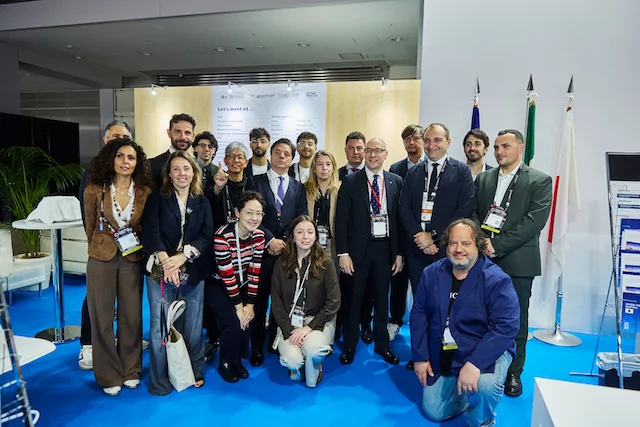
Among the new features of the 2026 edition is the debut of the Italian National Pavilion, organised by ICE – the Italian Trade Agency for the promotion abroad and internationalisation of Italian businesses – under the slogan “Italy: Deep Tech with a Human Edge”. The Italian space, located in the West Exhibition Hall – Pavilion 4, hosted nine high-growth start-ups selected from the sectors of artificial intelligence, data intelligence, geospatial technology and smart infrastructure.
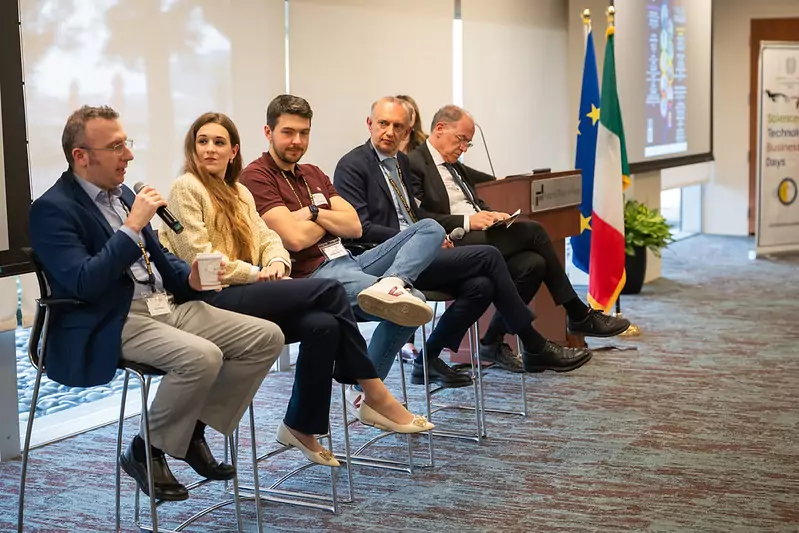
The ribbon-cutting ceremony was attended by Tokyo Governor Yuriko Koike, the Italian Ambassador to Tokyo Mario Vattani, and Gianpaolo Bruno, Director of the ICE Office in Tokyo. Also present at the inauguration were the Mayor of Turin, Stefano Lo Russo, and the Councillor for the Municipality of Bologna, Anna Lisa Boni, who were in Tokyo for the G-Nets Leaders Summit. On 27 April, on the Meteor Stage, the nine Italian companies took part in a dedicated pitch session, the collective’s first test in front of the Japanese ecosystem.
The institutional framework, the Ambassador’s remarks
“We are grateful to have a highly visible pavilion at one of the most important events in the field of technology, now on a global scale,” Mario Vattani told Startupbusiness. “Some of these start-ups already have ties with Japan, whilst others are entering this hugely important market. The areas covered by these companies are the same as those in the Italy-Japan Action Plan 24/27, initiated by our government and the Japanese government, which have elevated the Italy-Japan relationship to a strategic partnership.”
Vattani, who has served as Italian Ambassador to Japan since 27 February 2026 following his role as Commissioner-General for Italy at Expo Osaka 2025, is taking up his post in a year of symbolic significance for relations between the two countries: the 160th anniversary of diplomatic ties. The framework has recently been strengthened: the bilateral action plan has been extended to include artificial intelligence, robotics, semiconductors and biomanufacturing. At the same time, Japan has been associated with Horizon Europe as a key non-European partner, a development that opens up common ground for scientific and technological cooperation between Italian and Japanese start-ups.
Torino al G-Nets Leaders Summit
Alongside the start-up programme, Tokyo Big Sight hosted the 3rd G-Nets Leaders Summit, an initiative promoted by the Tokyo Metropolitan Government since 2022 that brings together mayors and governors from 55 cities across five continents to discuss the theme “A New Urban Future Built on Climate and Disaster Resilience”. Representing Italy, alongside Governor Koike, was the Mayor of Turin, Stefano Lo Russo.
“We are delighted to have been invited by the Governor of Tokyo to take part in both SusHi Tech and G-Nets, the global alliance on resilience,” said Lo Russo. “In this context, cities will discuss the overarching issues, the major challenges of climate mitigation and the role of innovation in this sector. As for innovation, Turin has embarked on a journey that has seen the city designated as the European Capital of Innovation in 2025. As mayor, it is important to be here today to represent the city, but it is even more important, as an Italian citizen, to see how Italian companies can hold their own in global contexts of this calibre and play a leading role.”
The Turin programme also included a meeting with senior executives from Hitachi, the industrial group which, in December 2025, was awarded the contract to supply vehicles for the future Line 2 of the Turin metro – one of the most significant infrastructure projects within the ongoing industrial cooperation between Italy and Japan.
Bologna in the network of cities
Among the Italian cities present in Tokyo is Bologna, represented by Anna Lisa Boni, Councillor for European Funds and the National Recovery and Resilience Plan (PNRR), the Ecological Transition, and International Relations. The profile of the Bolognese delegate, formerly Secretary General of Eurocities – the network bringing together over 200 major European cities – brings to Japan the experience of the Emilian capital in ecological transition programmes and urban innovation policies, from the Tecnopolo to the Emilia-Romagna Data Valley, right through to Cineca’s Leonardo supercomputer and the Italian headquarters of the European Centre for Medium-Range Weather Forecasts. The presence of both Turin and Bologna within the G-Nets framework presents an image of Italy at SusHi Tech not merely as a delegation of start-ups but as a network of innovation cities.
Tokyo Metropolitan Government
Speaking to Startupbusiness about the institutional significance of the 2026 edition, Keiichi Yoshimura, Director-General of the Bureau of Industrial and Labour Affairs at the Tokyo Metropolitan Government, said: ‘SusHi Tech Tokyo has gone beyond being the largest global innovation conference in Asia and has demonstrated the potential to evolve into a key global platform, capable of playing an important role in building a sustainable future, bringing together political leaders from over 50 cities around the world. In particular, the special keynote address delivered jointly by Prime Minister Sanae Takaichi and Governor Yuriko Koike sent a strong signal regarding Japan’s commitment and leadership in promoting innovation.”
Speaking about the Italian Pavilion, Yoshimura added: ‘The first Italian Pavilion at SusHi Tech Tokyo represented a significant step forward, highlighting how the conference has evolved into a truly global platform. The strong ties between Italy and Japan, reinforced by recent high-level exchanges and the 30th anniversary of the Tokyo-Rome twinning, were vividly reflected in this debut. The Italian Pavilion stood out for its refined and welcoming atmosphere near the main stage, joining France, Germany and the United Kingdom in forming a strong European presence.” The reference to the twinning refers to the Joint Communiqué signed on 5 February 2026 in Rome by Governor Koike herself and the Mayor of Rome, Roberto Gualtieri, during the anniversary celebrations.
Speaking on the role of international delegations, Masayuki Hara, Global Deputy Director of the Tokyo Metropolitan Government, added: “The role of an international delegation at SusHi Tech is to raise their country’s profile in Japan, showcase the expertise of start-ups and support organisations, gain an understanding of Japanese ecosystems, the business environment, corporate practices and the Japanese mindset, and to develop international relationships, including personal ones.”
Commenting on the debut of the Italian Pavilion, Hara adds: ‘The debut of the Italian Pavilion, with an entire nation represented at an institutional level, demonstrates a strong commitment to building future collaboration between Italy and Japan, not only in the arts and food and wine, but also in business, technology and start-ups. Just as we are developing a new fighter aircraft between Italy, the UK and Japan, each bringing its own strengths, expertise and advantages, we can build a complementary relationship.” The reference is to the GCAP (Global Combat Air Programme), the sixth-generation air combat system jointly developed by Italy, the UK and Japan, cited as a model of trilateral industrial cooperation that can inspire the Italy-Japan dialogue, including in the start-up sector.
Italian technologies on display
The delegation organised by ICE brought nine companies to Tokyo that operate in the sectors where Italy is establishing its position in the Japanese market:
- Icarus Technology, an AI-powered voice assistant for healthcare services capable of handling calls, prescriptions and medical appointments, signed a proof-of-concept agreement with a Japanese partner during the event – the first tangible outcome of Italy’s participation in SusHi Tech 2026.
- TimelapseLab, an innovative SME specialising in smart construction site monitoring, using time-lapse devices and digital platforms for remote site tracking, is tapping into a Japanese market that is structurally focused on infrastructure construction and urban regeneration.
- MLR, an innovative SME based in Puglia, has brought WuvDay to Tokyo – a platform for certifying digital content developed in response to the spread of disinformation and AI-generated content, an issue attracting growing attention in the Japanese market as well.
Alongside these companies, the pavilion brought together six other start-ups: Athlos, Digitarca, Electe, Koala, Lunocode and Take Over Rilievi Integrati, operating in the fields of artificial intelligence, data intelligence, geospatial technology and smart infrastructure. This focus reflects ICE’s commitment to showcasing to the Japanese market an Italy at the forefront of technology, capable of moving beyond the traditional sectors associated with ‘Made in Italy’.
A comparison with the other delegations
Italy’s debut took place against a backdrop of growing national participation. Egypt also made its debut at this year’s event with a national delegation, thanks to the collaboration between ITIDA and JICA as part of Project Ninja. Among the organised European delegations, alongside Italy’s debut, were France – a long-standing partner of the SusHi Tech programme, which held a dedicated pre-convention at Station F in Paris in February 2026 – as well as Germany and the United Kingdom.
The Japanese host unveiled for the first time the 45 SusHi tech global start-ups and domestic growth-stage companies making their international debut in a dedicated pavilion, alongside the new Tib Catapult cluster – an initiative that aims to bring together 200 member companies specialising in space, life sciences, mobility and food tech.
The debut of the Italian Pavilion at SusHi Tech Tokyo 2026 marks a shift from the individual presence of Italian start-ups in Japan to a coordinated, sector-wide participation, within the framework of the bilateral strategic partnership and in conjunction with the network of cities through G-Nets. The joint presence of a startup delegation, local authorities and the embassy, alongside the strengthening of Japan’s position in Horizon Europe and the industrial cooperation already underway – from GCAP to the Turin metro – lays the groundwork for continuity in upcoming events aimed at strengthening Italy’s presence in Asia.
ALL RIGHTS RESERVED ©