Table of contents
Chance. Or serendipity, as I prefer to call it when I want to be precise.
It introduced me to a new landscape of innovation thanks to my meeting with Vincenzo Trione, the new president of the Triennale Milano, who was jointly appointed by the Minister for Culture, Alessandro Giuli, and the Mayor, Giuseppe Sala.
The meeting took place in Naples.
As a guest of curator Isabella Valente, who launched the series of talks entitled “Dialogues on Contemporary Art in Naples”, Vincenzo chose his city – which is also mine – to share some reflections.
As always, I was there. Keeping an eye on cultural events and gatherings in Naples, as I’m in the habit of doing. And so I bumped into my old professor again. We’re actually the same age, but when you’re driven by that certain restlessness I know so well, you sometimes find yourself studying certain subjects with people your own age, or end up teaching them to people much older than yourself. Both things have happened to me, on several occasions. Vincenzo is one of those rare cases where I’ve had the good fortune – and the challenge – of learning as a student, of engaging with and clashing with someone who had chosen a different path.
The Palace, its history, its identity
In the heart of Parco Sempione, the Palazzo della Triennale is one of the most significant examples of Italian Rationalist architecture. Designed by Giovanni Muzio and opened in 1933, it looks as though it has stepped straight out of a metaphysical painting by De Chirico — and this is no coincidence, given that Giorgio de Chirico’s Fontana dei Bagni Misteriosi still stands in the surrounding garden, alongside Gio Ponti’s Torre Branca. These are different expressions of a Milan capable of weaving together memory, experimentation and vision.
The history of the Triennale has its roots in the great tradition of the International Exhibitions of Decorative Arts: it was first held as a biennial event in Monza in 1923, before moving permanently to Milan, where it acquired its own legal status and, under the guidance of figures such as Gio Ponti and Mario Sironi, gradually became a bridge between artistic culture, architecture, industry and design, engaging in dialogue with the international avant-garde.
Today it houses the world’s largest permanent exhibition of Italian design. And this is what makes it unique: whilst other design museums around the world showcase the work of several countries, the Triennale has chosen to explore what Italian design is and has been. A clear choice that defines its identity. Alongside the permanent collection, there are major temporary exhibitions, international installations, a research centre, the headquarters of Lotus magazine, the historical archive, a theatre and a concert hall that have always been dedicated to experimentation.
Triennale Milano vs Venice Biennale: a comparison of two philosophies
During the meeting, Trione traced the history of the Triennale, comparing it with the Venice Biennale. Two public institutions, two radically different approaches. The Biennale is organised into separate sections – cinema, architecture, art, theatre, music and dance – each with its own autonomy and identity. The Triennale, on the other hand, is by its very nature a framework: a place that brings everything together, which does not separate the different art forms but encourages them to engage in dialogue.
It is a difference in method that reveals a difference in outlook.
Trione, a historian who interprets the times and shapes them
Vincenzo Trione is an art historian, critic and university lecturer. He teaches Art and Media and the History of Contemporary Art. But it would be an oversimplification to stop there.
He acknowledged the outstanding work of his predecessor, Stefano Boeri, particularly in relation to international exhibitions and the ‘Design the Future’ initiative. But Trione is not one to simply preserve the status quo. He is a historian who experiments, who charts the contemporary, who writes books but is not content merely to describe: he wants to build.
It is this very background that led him to become an adviser on contemporary art to the Mayor of Naples, Gaetano Manfredi – a former university rector, former president of the CRUI, former minister, engineer and, today, also president of the ANCI. This is a role that Trione wished to retain even after accepting the presidency of the Triennale, openly stating that this was a condition for continuity. Not a conflict of interest: a commitment to what he considers important.
The latest exhibition he has curated, currently on display in Milan, is entitled ‘Metaphysics/Metaphysics: Modernity and Melancholy’. This provides further evidence of the consistency between his critical thinking and his curatorial practice.
The Triennale as an engine of innovation
And that’s when the conversation really got interesting.
Trione has outlined a vision that sets his presidency apart from those that preceded him – Boeri, the architect and ‘starchitect’, and De Albertis, the entrepreneur. He is a historian, an academic and an innovator. And the Triennale he envisages is not merely a cultural institution: it is an engine of innovation.
Not only in terms of safeguarding, preserving and sharing, but also by playing an active role in nurturing future talent: the very talent that the market seeks and that universities, on their own, struggle to develop. A platform capable of integrating with businesses and interacting with the production process.
He quoted Gillo Dorfles – whom I had the honour of meeting – an art critic, philosopher and painter who passed away in 2018 at the age of 107, with a statement that serves as a manifesto: “The Triennale embodies the spirit of 20th- and 21st-century design, with a central focus on architecture and design, yet at the same time it revives the concept of the arts system found in the Renaissance workshops and the Bauhaus: the idea of bringing architecture and design into dialogue with contemporary art will be a decisive asset, alongside music, science and technology.”
A Triennale where contemporary art is not relegated to the background, but where design engages in a generative dialogue with science and technology.
Start-up Futurism: a necessary provocation
This view strikes a chord with me, because it ties in with something I have believed in for a long time.
Italy must reclaim its leading role in start-up creation, particularly in the field of design. In the past, design drove innovation by encouraging businesses to create what had not yet been imagined. Today, the pressures of globalisation, the dematerialisation of the economy and new demands for sustainability are changing the rules. With AI, designers can now overcome limitations that once belonged solely to the realms of science and engineering. They can see themselves as entrepreneurs. They can harness Italian talent, using the tools of the start-up economy, to make a difference in the world through ‘Made in Italy’ – not as a legacy to be preserved, but as a driving force for a new future.
We could call it, drawing on a glorious tradition, ‘Start-up Futurism’. I chose this term deliberately, rather than the more convenient ‘Futurism 2.0’: using a numbered version would have been disrespectful to the ideas of those who actually built that movement.
A bridge between history and innovation. Between Naples and Milan. Between the past – which is not a static archive – and the future, which can be shaped.
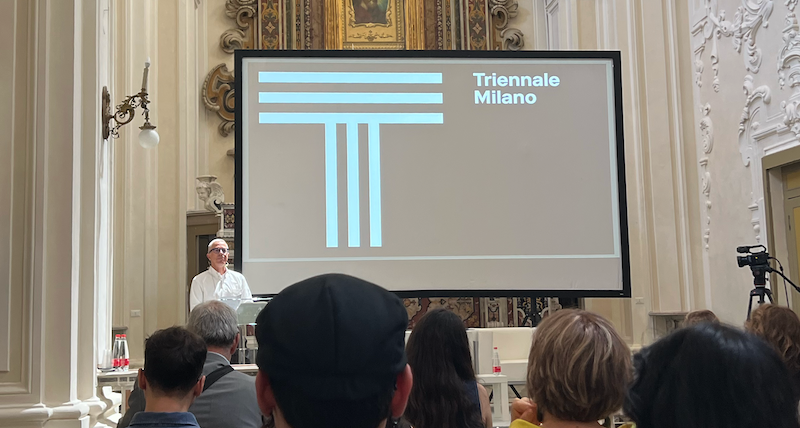
This is the story of how Vincenzo Trione came to lead the Triennale (pictured: a moment from the event in Naples).
Note to the reader: Antonio Prigiobbo He is a designer and innovation journalist, a manager and a social investor. He writes about innovation, ecosystems and design for Startupbusiness, and his reflections fit seamlessly within the publication’s ecosystem: “As someone from Naples, I am curious to see what Trione will build, and I hope to be able to create opportunities as a designer and as editor-in-chief of NAStartUp – and perhaps through a direct link between these reflections and the publication for which I write. Startupbusiness, founded and edited by Emil Abirascid – who, not coincidentally, is also co-founder of Designtech, the Milan-based hub that bridges the worlds of design, technology and start-ups – has for years been a prime vantage point at this crossroads. Given that he doesn’t write it alone, Emil has built something rare: a media outlet that is also an ecosystem, with CoFactory in Milan’s Certosa District, the Design Momentum acceleration programme, and the explicit mission to bridge the gap between creativity, digital manufacturing and business innovation. This is precisely the frontier on which the new Triennale di Trione is operating. Interests, studies, commitment and journalism all converge here. It is no coincidence that we find ourselves telling the same story from different angles. “.
ALL RIGHTS RESERVED ©