Table of contents
If we look at the geography of artificial intelligence as we know it today, the map of technological power has already been drawn. The United States and China have carved out a seemingly unbridgeable lead in the field of large language models (LLMs) and pure software. The enormous financial resources required to train generative models, the concentration of data centre infrastructure and the oligopolistic control of digital platforms mean that Europe’s attempt to catch up in this specific area is a belated, if not unrealistic, endeavour. Competing on an equal footing in the realm of abstract software means playing a game with rules written by others.
However, reducing the entire artificial intelligence revolution to computer screens or chatbot responses is a mistake in perspective. There is a second wave, far more profound and radical, in which algorithms emerge from the immaterial realm to merge with the physical world: physical AI. This involves the integration of computational intelligence directly into mechanics, advanced sensor technology and embedded systems. And in this field, Europe – and Italy in particular – can not only compete but is well placed to assume global leadership.
The reason lies in the very nature of our economic fabric. Our historical strength has never been the creation of software giants, but rather precision manufacturing, robotics, component manufacturing and the ability to invent, engineer and produce complex physical objects. The strategic challenge for the coming decades lies in reinventing the products we bring to market, equipping them with autonomous perception and decision-making capabilities.
The paradox of technology transfer
To bring about this transformation, the European ecosystem must resolve a structural paradox. On the one hand, our universities and research centres produce world-class science in the fields of robotics and physical AI, often surpassing their overseas counterparts in terms of scientific quality. On the other hand, we have historically struggled to translate this excellence into market value. Traditional technology transfer often falls short: a patent or a scientific publication does not, on its own, translate into an industrialisable product architecture, let alone a company capable of standing on its own two feet in the market.
In the world of pure software, the path to launching a start-up is straightforward: an idea, a few lines of code, a cloud platform and an initial prototype launched onto the market within a few weeks. In physical AI, the complexity is on an entirely different scale. There is technological risk, hardware prototyping times, supply chain constraints, certifications and the need to integrate disparate disciplines. The scientist who has conceived a new algorithmic paradigm rarely possesses the industrial expertise to scale it up to production; conversely, the traditional financial investor struggles to back projects that require lengthy physical development times before generating revenue figures.
To bridge this structural gap between the cutting edge of research and the realities of industry, a different operational model is emerging, one that goes beyond the logic of traditional incubators or simple financial venture capital: the venture studio.
The venture studio as an industrial co-founder
Unlike pure venture capital, which comes into play once a start-up has already established its identity and has a validated product, a venture studio operates at the ‘zero stage’. It acts as a genuine industrial and technological co-founder, bridging the gap between scientific discovery and market execution right from the outset.
It is not simply a matter of funding an idea, but of supporting the founders by sharing with them the risks and the hard work involved in building the business. This means getting stuck in from day one to translate scientific insight into a robust industrial framework, but with one crucial distinguishing feature: immediate openness to the market. The model is not developed behind closed doors in a laboratory, awaiting a belated launch, but immediately addresses the real needs of the supply chain, involving strategic partners and industrial investors right from the very earliest stages of the process. In this way, commercial validation takes place in parallel with technological development, ensuring that the product meets a genuine market demand.
It is an approach geared towards the methodical development of the business, which reduces implementation risk and speeds up the time to market. For this model to work, it must be underpinned by constant and rigorous dialogue with leading centres of academic excellence, selecting projects in such a way as to combine scientific and industrial vision. The ultimate aim of this process is to present investment-ready start-ups – equipped with robust technologies and clear industrial viability – to the market and to a pool of qualified investors.
Smart matter: how AI is transforming traditional objects
The effectiveness of this vision is measured by its ability to generate new technological trajectories capable of redefining entire business sectors through smart physical products. Looking at the latest initiatives emerging from this ecosystem, it is clear that physical AI is pushing the boundaries of innovation far beyond those of the traditional factory.
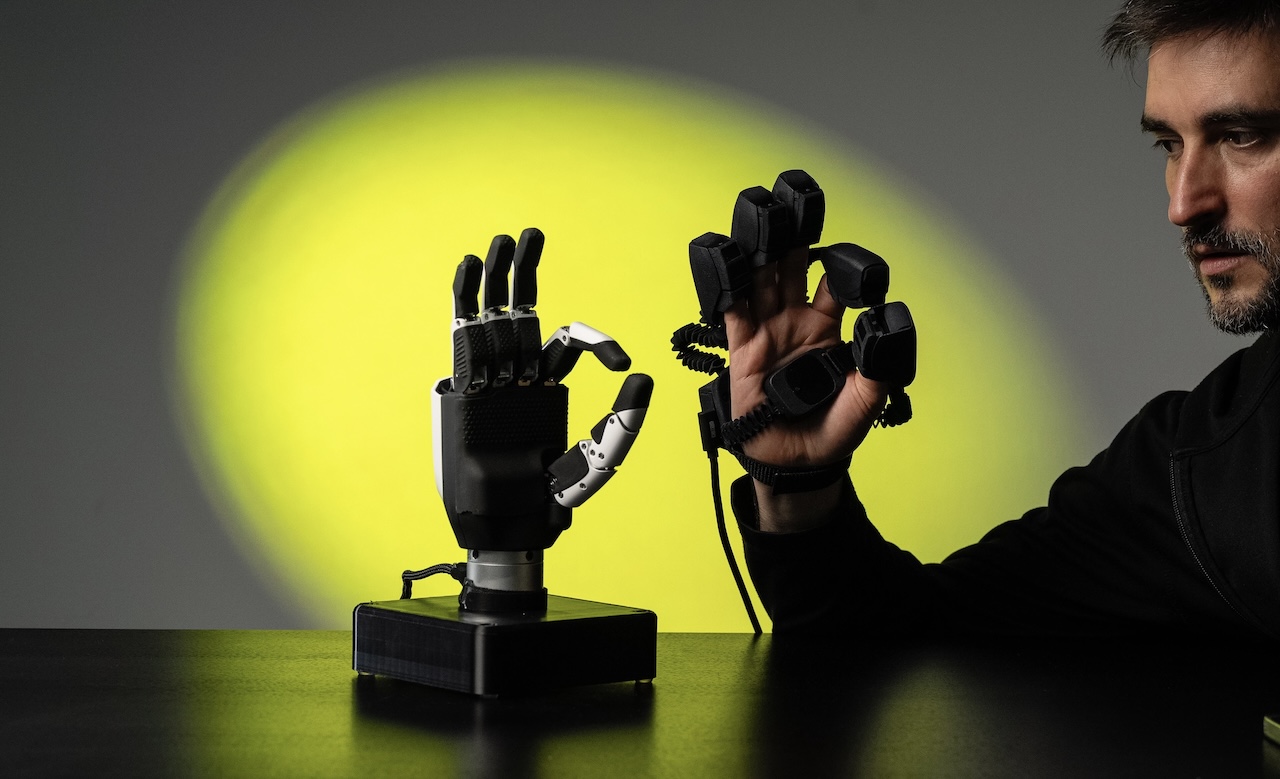
A prime example is the convergence of artificial intelligence and bionics in the medical sector. Historically, the field of prosthetics and assistive devices has followed purely mechanical or pre-programmed kinematic principles. Next-generation projects such as that of Ars Bionica demonstrate how physical AI now enables the design of advanced devices capable of perceiving their surroundings and interpreting the user’s actual intentions in real time, whilst dynamically adapting to their physiology. In this context, the challenge of technology transfer is not merely scientific; it lies in translating complex technology into an engineered solution that is affordable and replicable on an industrial scale, capable of meeting the stringent regulatory requirements of the healthcare sector.
Another area of great interest is the application of physical AI directly to traditional manufactured products, with a view to reinventing their use and expanding the market’s horizons. This is the path being explored by companies such as eSkins, which has developed a pioneering solution in the world of ski mountaineering. In this case, artificial intelligence and embedded sensors are not abstract digital accessories, but are integrated into a traditional piece of sports equipment to transform it into an active system, capable of assisting the skier and reacting in real time to the dynamics of the ascent. The strategic objective is not the technology itself, but its impact on the business: the introduction of physical AI makes it possible to democratise a discipline that has historically been technical and niche, significantly broadening its user base to include new enthusiasts. Here too, the crucial step in the model involves defining a solid value proposition and validating commercial distribution channels, working alongside the founders to transform an excellent application-based idea into a mature industrial product ready for the global market.
A strategic choice for the national economy
Europe has lost the first battle of the digital age – the battle over intangible data and software platforms. But the contest over physical AI is still very much up for grabs. For an industrial system such as Italy’s, which is deeply rooted in a culture of physical products and manufacturing excellence, this transition represents not only an opportunity for economic growth, but a strategic necessity for survival.
Continuing to follow American or Chinese models in the field of general-purpose software risks leading to a dead end. Our path to future competitiveness lies in infusing intelligence into materials, hardware and products. Shortening the time it takes to commercialise scientific discoveries and adopting structured business models such as the venture studio to mitigate technological risk are the key steps to ensuring that our manufacturing tradition remains at the heart of the global economy. Tomorrow’s leadership will be forged in the physical world.
Note to the reader: the author is head of the venture studio at e-Novia
ALL RIGHTS RESERVED ©