The journey continues to discover Genoese and Ligurian companies that are innovating in collaboration with Fondazione Genova Startup.
It’s 7.47 pm, ten minutes before half-time. In the stands, ten thousand people are already wondering whether they’ll manage to get to the bar, order, pay and get back to their seats before the second half. The answer is usually no. That annoying, slow, inevitable queue is the problem that Giacomo Perazzo has set out to solve. A problem that has become a business.
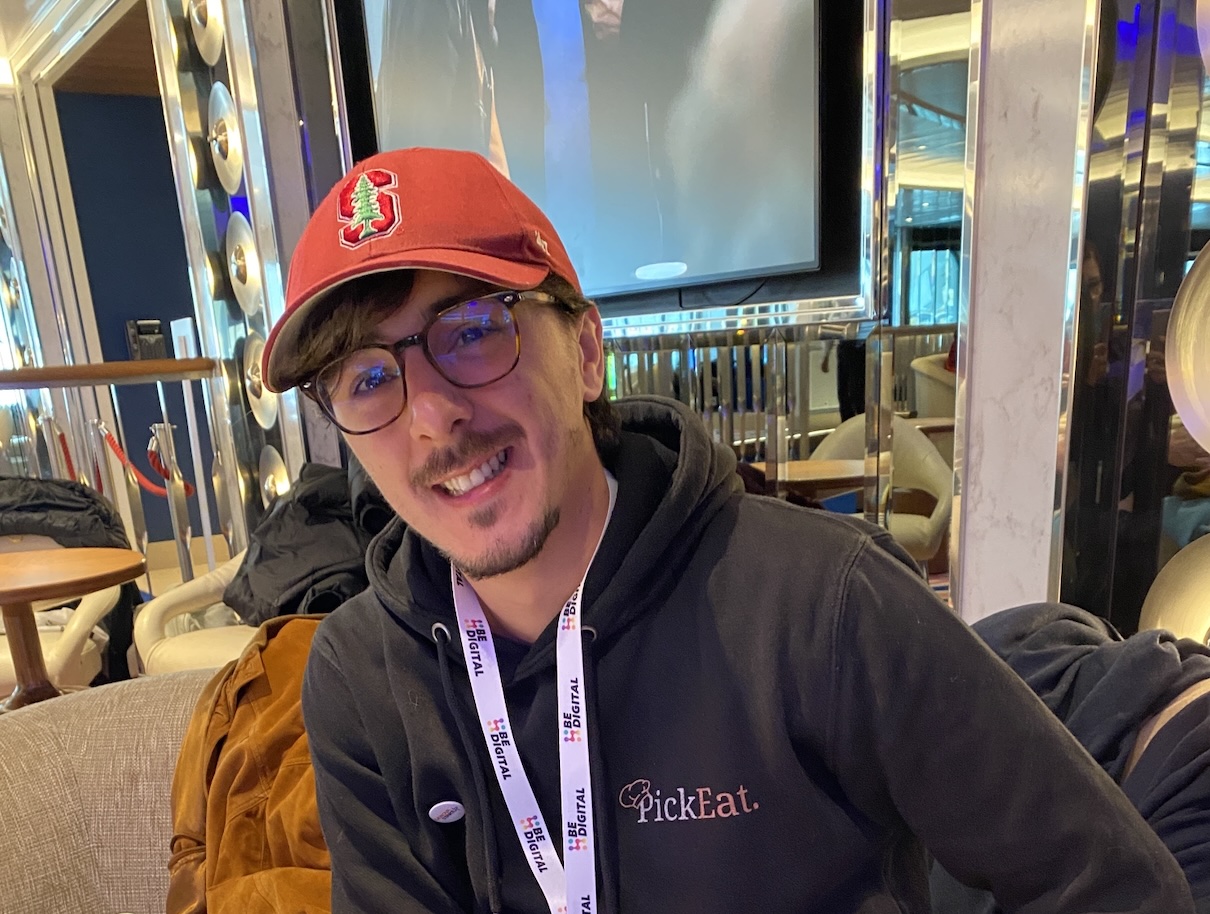
Perazzo (pictured), 28, CEO and co-founder of PickEat, describes it with surgical precision: “a long-standing operational inefficiency that can be transformed into a high-margin commercial asset”. This isn’t the romantic language of glossy magazine startups. It’s the language of someone who has studied the problem from the inside and built a tool to solve it.
The PickEat system is deliberately simple for users: you simply scan a QR code from your seat or open a link shared by the club to access a web app without having to download anything. You order, pay, and choose when and where to collect your order. That’s it.
Behind this simplicity lies a proprietary load-balancing algorithm that analyses kitchen capacity in real time and distributes order flows to avoid peaks. The result: staff are not overburdened, waiting times are reduced and the adoption rate has reached 24%, as measured among partners such as Varese Basket, a team competing in Italy’s top league. But above all, the average bill has tripled.
PickEat is not positioned as a ‘simple’ ordering app, but as a logistics operating system for the venue. This distinction is important, as it radically changes the value proposition for the customer, which is not the fan, but the club.
Every digital order is converted into profiled data that is fed into the club’s CRM system. The system captures 100% of transactions and analyses them to build demand prediction models: how many beers will we sell on Saturday night if it rains and the match is a Champions League tie? The stated aim is to predict individual spectators’ orders based on historical data, the day of the week, the time of day, the weather conditions and the importance of the match.
In addition to this, there is a new range of sponsorship options: banners in the ordering interface, targeted coupons, even naming rights for the fast-track lanes, and an integrated cashless solution: the vendor app, featuring tap-to-pay technology, allows staff to manage both digital and physical orders from the same device, without the need for a traditional POS terminal.
Giacomo Perazzo has a background in economics and management; he is currently pursuing a PhD at the University of Genoa, focusing on risk management, venture capital and artificial intelligence in decision-making processes. As part of this programme, he teaches on the International Entrepreneurship course, where eight students each year are awarded scholarships for trips to Silicon Valley, Los Angeles, Boston, Singapore and Shenzhen.
Over the coming months, Perazzo will travel to Boston at the invitation of Northeastern University to explore expansion into the North American market, where PickEat already has four active projects. He also has established ties with Qatar and is working with Hub17 to foster business links between Italy and Doha.
Perazzo describes the challenges of operating in Italy: “Many clubs struggle to set aside a budget for innovation and face a huge structural constraint: as they do not own the stadiums, they do not see a direct return on investments in infrastructure or food and beverage.”
The contrast with Switzerland and North America is stark. There, clubs own the facilities, recognise the value of technology that maximises matchday revenue, and accept a fair price, whereas in Italy negotiations drag on for a long time.
On the investor front, the picture is just as critical. “He notes with regret,” writes Perazzo, adopting the researcher’s third-person perspective, “that the Italian ecosystem suffers from a deep-seated aversion to risk in the early stages.” There are funds for seed-stage and later rounds, but pre-seed funding is virtually non-existent. The vicious circle is well known: to develop the product, capital is needed, but to obtain capital, metrics are needed that only a finished product can generate.
To make matters worse, there are gruelling due diligence procedures for grants of €25,000, offers of “investment in services” rather than actual capital, and public tenders that take 9–12 months to produce results. “In a modern market, a year’s wait means the project has either taken a new direction or has already failed,” he adds.
PickEat is raising a $1 million pre-seed round. The round has already secured 30% in hard commitments, rising to 70% when soft commitments are included. The sales pipeline includes over 50 active negotiations with Italian and Swiss clubs. Significantly, the lead investors are not Italian: they are Spanish, Portuguese and American.
“If we want to foster excellence in Italy and prevent genuine innovation from being forced to move abroad, we must cut red tape and, above all, return to funding real risk.”
ALL RIGHTS RESERVED ©