Dairect is the start-up that has developed proprietary technology designed to make official hotel websites readable and interpretable by leading AI assistants, including ChatGPT, Gemini, Perplexity, Claude and DeepSeek.
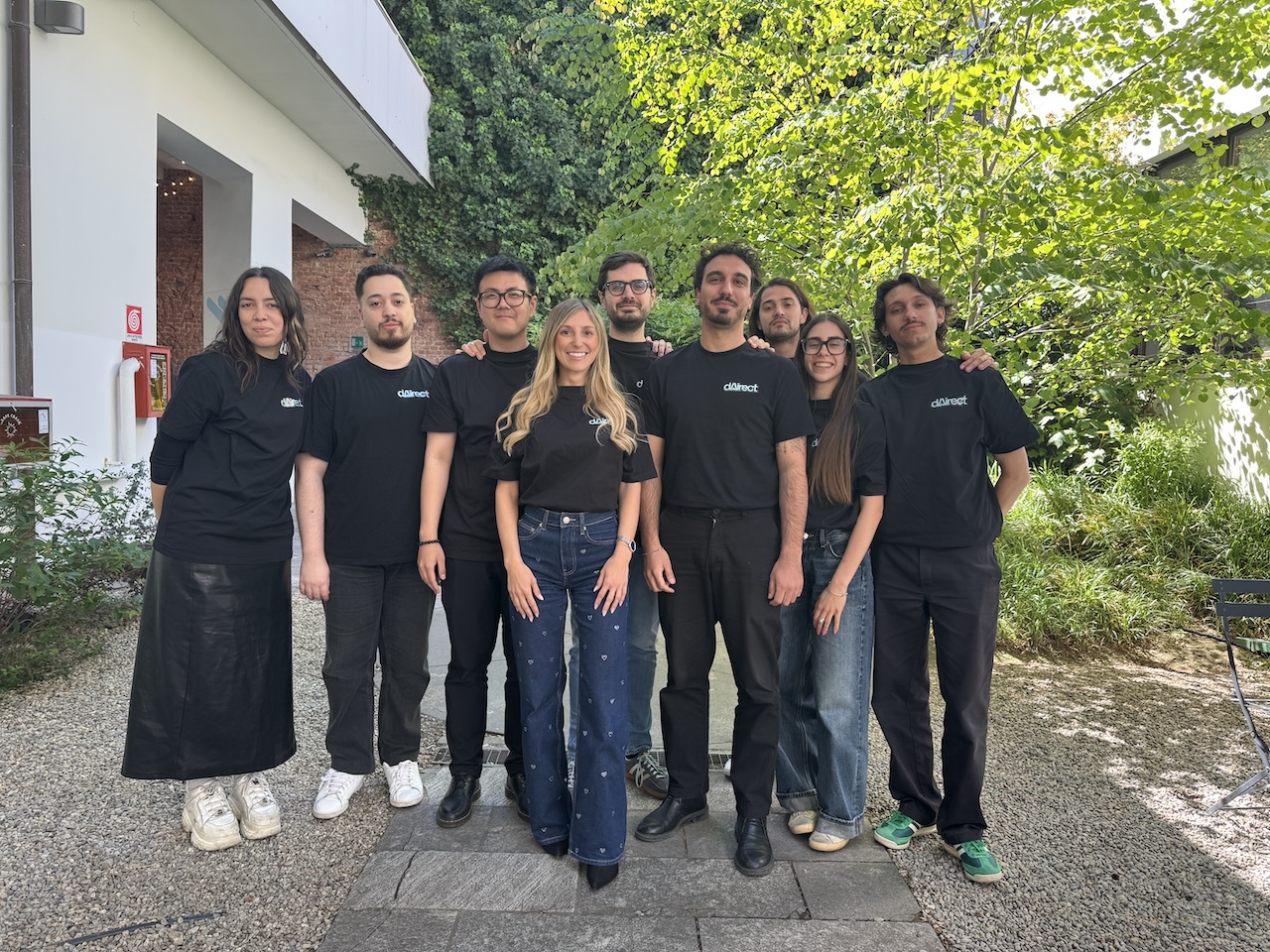
The start-up has raised €1 million in equity and €1.5 million in debt financing; its main investor is CDP Venture Capital through the fund linked to the fintech accelerator. It generates around €500,000 in annual recurring revenue, with the aim of reaching €1 million by 2026, and has a staff of around 10 people (pictured: the team) and has established partnerships with major Italian groups such as VOIhotels (Alpitour group), Mokinba and Italian Hotel Group. As part of its technological development, Dairect has also recently been selected by Nvidia for its Inception Programme, the global initiative that supports the best innovative start-ups shaping the future of AI.
Artificial intelligence is radically redefining the way travellers choose where to stay. For the first time in over twenty years of traditional search, a growing number of users are no longer starting their search on Google or OTAs (such as Booking or Expedia), but are turning directly to AI assistants like ChatGPT, Gemini or Claude for advice on where to stay.
According to Adyen’s Hospitality and Travel Report, by 2025 one in three travellers in Italy will have already used AI to plan their trips, representing a 77% increase in just one year. According to Bain & Company, this figure could exceed 60% by the end of 2026. But the most surprising finding is that it is not just Gen Z and millennials driving this change: the adoption of AI in travel is growing at an impressive rate even among older age groups, with a 111% increase in usage among baby boomers and an 85% increase among Generation X.
Despite this, most accommodation providers are effectively invisible on this new platform: only 16% appear in the responses generated by AI assistants, according to HotelWorld AI’s ‘World’s Best at AI 2025 Index’ report, which is based on 2.36 million data points collected by ChatGPT, Gemini and Perplexity on over 800,000 properties worldwide.
The result is a growing imbalance: online travel agencies (OTAs) such as Booking and Expedia continue to dominate AI-generated results, whilst official hotel websites risk being left out of the new ecosystem in which travel decisions are made.
“Hotels are facing a paradigm shift similar to the one experienced with the advent of the internet,” explains Antonio Picozzi, CEO and co-founder of Dairect, in a statement. “We are, in fact, entering the era of agent-driven web, in which it is no longer the user who browses and compares, but AI that selects and recommends alternatives on their behalf. In In this new landscape, if a property cannot be found or read by these systems, it effectively does not exist at the moment the customer makes their decision. It is not simply less visible: it is excluded from the decision-making process. The critical issue is that most hotel websites are not designed for this context: they are static, poorly maintained and not optimised from a technical and semantic perspective for artificial intelligence. Consequently, even a website that functions perfectly for a human user may be invisible or uninterpretable to an AI agent.”
The aim is to enable hotels to appear among the suggestions generated by artificial intelligence, thereby increasing the visibility of their official website on new channels for discovering potential guests. This translates into an increase in traffic and the share of direct bookings, with a consequent reduction in dependence on traditional intermediaries and OTAs. Furthermore, through the Dairect management system, properties can finally view their traffic levels and visibility within AI channels clearly and continuously. This is an aspect that is currently completely overlooked, rendering this demand channel effectively invisible to operators.
With Italy as its primary market, an already growing presence in Spain, and expansion plans underway in Portugal and Greece, Dairect is extending its model beyond the hospitality sector to encompass destinations, dining and experiences. The aim is to build a cross-cutting infrastructure for tourism in the age of AI: a layer capable of making operators, content and services more accessible, recommendable and actionable by new agent-based search systems.
ALL RIGHTS RESERVED ©