Table of contents
Working with start-ups means working on the future. For me, it has always meant asking how technology can improve society, create jobs, open up opportunities, generate new economies, strengthen local communities and give people greater freedom.
Then there comes a point where this question comes up against an awkward limit.
In recent years, within European funding schemes, public calls for proposals, research programmes, industrial partnerships and innovation projects, terms have appeared with increasing frequency that, until recently, seemed peripheral to the vocabulary of start-up ecosystems: security, autonomous systems, artificial intelligence, cyber security, robotics, drones, resilience and dual-use technologies.
In a word: defensetech.
Do drones save lives or take them?
The question takes on a different form. How much is the idea of ‘improving society’ worth when innovation also serves to defend, attack, monitor, anticipate and neutralise? Does an armed drone save lives or take them? Is a ground-based robot that carries ammunition in place of a soldier a human achievement or another step towards the dehumanisation of war?
The answer isn’t straightforward. And perhaps it shouldn’t be.
The war in Ukraine has accelerated everything: brutally, visibly, measurably. Startup Genome, in its analysis *How Conflict Rewires Startup Ecosystems*, explains this clearly: conflict does not merely damage innovation ecosystems; it rewires them. It shifts capital, talent, priorities, policies, supply chains and markets. In times of war, the speed of innovation is no longer merely a competitive advantage: it becomes a strategic capability.
We must not forget that Ukraine’s ability to hold out was also made possible by the contribution of private-sector technology. The case of Starlink, provided by Elon Musk’s SpaceX, has shown just how much of an impact a tech company can have on the resilience of a country at war, ensuring connectivity, coordination and operational continuity in extreme conditions.
The Ukrainian situation is currently the most obvious example of this transformation. Traditional procurement cycles, which take years, are unsustainable when the battlefield changes every week. Start-ups, on the other hand, are able to do something that large organisations struggle to replicate: prototype, test, refine, iterate and deploy.
Low-cost drones, autonomous systems, artificial intelligence, cyber security, logistics, sensors, satellite communications and digital infrastructure are no longer merely technological sectors. They are becoming key components of national resilience.
To truly understand what this transformation means, however, it is not enough to look at the figures. You have to look at the images. In the two-part video podcast *The Drone War | Stories Video* by Cecilia Sala from Ukraine, Sala delves into the new geography of the front line: the ‘kill zone’, the corridor of war where drones, sensors and unmanned systems have changed the way we fight. It is a necessary, albeit disturbing, insight. It is one thing to talk in abstract terms about military innovation; it is quite another to see the pilots, the targeting systems, the images uploaded by the units, and the fragments of life and death transformed into operational data.
The war of robots and drones is no longer the stuff of science fiction. It has already begun.
The figures: from 1.5 million drones to 7 million in two years
And this is where defence technology ceases to be a niche sector and becomes a new industrial infrastructure.
In 2024, the Ukrainian Ministry of Defence, together with the State Service for Special Communications, purchased over 1.5 million drones. For 2025, it has allocated over 110 billion hryvnia (approximately 2 billion euros, ed.), aiming for a national industrial capacity estimated at around 4.5 million FPVs. For 2026, Kyiv has set a target of producing over 7 million drones: a leap which, according to the most recent estimates, follows on from the approximately 4 million produced in 2025 and the 2.2 million in 2024. In three years, production has increased more than tenfold.
It’s not just about using technology. It’s about building a supply chain
And this raises an even bigger question: what is Ukraine teaching us?
We are talking about a country under enormous pressure, ravaged by a war that has destroyed lives, infrastructure, businesses and human capital. Yet, right in the midst of this crisis, Ukraine is building something that could outlive it. If the war were to end tomorrow morning, what industrial and technological legacy would remain? Perhaps one of Europe’s most advanced DefenceTech ecosystems.
In just a few years, the country has brought together research, procurement, field trials, industrial production, start-ups, venture capital, universities, large companies and institutions. A model born out of the emergency, but one that is likely to endure even after the war.
“Machines don’t bleed”: from heaven to earth
The same logic is shifting from the skies to the ground. Ground-based robots, or UGVs, transport ammunition, evacuate the wounded, carry out reconnaissance, deliver supplies and, in some cases, engage in combat. The point is not one of science fiction. It is a logistical one. Previously, to transport hundreds of kilos of ammunition to the front line, men had to be exposed to enemy drones. Now a machine can be sent instead. If it is destroyed, the army loses a vehicle, not a squad.
The message that emerges from the stories from the front is brutal: machines don’t bleed.
Allies are quick learners
The allies are also stepping up their efforts. In mid-June, the UK announced a £752 million package including 150,000 Ukrainian-made drones for Kyiv, as well as more than 350 missiles and air defence radar systems, funded by the £2.26 billion ERA loan secured against the proceeds from frozen Russian assets. London has also earmarked over 5 billion pounds for drones and autonomous systems in its Defence Investment Plan.
Brussels is moving in the same direction. The European Defence Fund has selected 57 projects for the 2025 cycle, representing an investment of 1.07 billion euros, which will also be allocated to AI, cyber defence, drones and counter-drone systems, involving 634 organisations from 26 EU countries and Norway. The DECODER project, which focuses on drones and counter-drones, involves 26 EU countries, Norway and Ukraine, with participants estimating an investment requirement of between €3.5 and €5 billion by 2033.
Private capital is following suit, and with increasing vigour. According to the Dealroom-NATO Innovation Fund report, European start-ups in the defence, security and resilience sectors raised $8.7 billion in 2025, 55 per cent more than the previous year. Quantum Systems, a German company specialising in drones and autonomous systems, closed a $1.2 billion funding round in early July, reaching a valuation of around $8 billion. Reuters and other observers describe these new companies as ‘neo-primes’: firms capable of challenging the major traditional contractors with faster, more modular and software-driven technologies.
Italy is also taking action: Fincantieri and the seabed
Italy is also involved in this development. Fincantieri has announced the acquisition of majority stakes in four Italian companies — Next Geosolutions, WSense, Graal Tech and Defcomm — operating in the fields of underwater technology, marine drones and underwater communications, with an initial investment of around 600 million euros. This sends a strong signal: the seabed, submarine cables, energy infrastructure and critical networks are becoming part of national security, within a clearly dual-use framework.
The key word, however, is no longer simply ‘weapon’. It is ‘platform’. Contemporary defence technology consists of software, data, sensors, supply chains, accelerated procurement, patient capital and continuous experimentation. It is closer to deep tech than to traditional defence. It is more industrial than purely digital. It is more geopolitical than financial.
The ethical question we cannot avoid
This is precisely why we cannot limit ourselves to mere enthusiasm. For those working in the field of innovation, the ethical question is unavoidable. It is not enough to say that a technology is dual-use. We must ask ourselves who uses it, under what rules, with what accountability, within what limits, and with what political vision.
Protecting people, infrastructure and democratic societies is a necessity. Turning war into a permanent market for innovation is a risk. It is a fine line. Crossing it without discussing it would be the worst possible way to approach innovation.
The key policy point is this: it is not enough to simply ask start-ups to contribute to defence or reconstruction. We need to establish procurement processes that are accessible to small organisations too, accountability frameworks compatible with rapid experimentation, dual-use investment instruments, clear certification pathways, and channels for collaboration between research, industry, the state and private capital.
For Italy, the challenge is twofold: on the one hand, to build on its already strong areas of expertise — aerospace, naval engineering, electronics, cyber security, robotics, sensor technology, energy and advanced materials — and, on the other, to ensure that start-ups do not become bogged down by bureaucracy, the fragmentation of funding and their distance from major public programmes. Defensetech can only become a strategic national sector if it is treated as an ecosystem, rather than as a mere collection of funding schemes.
Who will be able to govern it?
War does not automatically lead to innovation. War destroys. But it forces ecosystems to change rapidly. Those who have already built bridges between research, start-ups, industry, capital and public procurement are better able to respond. Those who have not built such bridges discover their own vulnerability only when the crisis is already upon them.
The real question, then, is not whether DefenceTech will grow. It is already growing. The question is who will be able to steer it. Under what rules. With what capital. With what expertise. And, above all, with what vision for the future.
Because working with start-ups still means shaping the future. But today, more and more often, it also means deciding what kind of future we are prepared to build.
Sources:
Startup Genome — How Conflict Rewires Startup Ecosystems
Cecilia Sala — La guerra dei droni, Stories Video, Parte 1 · Parte 2
Militarnyi — obiettivo 7 milioni di droni nel 2026
GOV.UK — pacchetto da 752 milioni di sterline e 150.000 droni per l’Ucraina
Commissione europea — Fondo europeo per la difesa, 57 progetti 2025
Reuters — proposta dei cinque progetti europei di difesa (DECODER)
NATO Innovation Fund / Dealroom — 8,7 miliardi di dollari raccolti nel 2025
Dealroom — Europe guide, 63,9 miliardi di dollari nel 2025
Reuters — Quantum Systems, round da 1,2 miliardi di dollari
Fincantieri — comunicato ufficiale sulle acquisizioni underwater
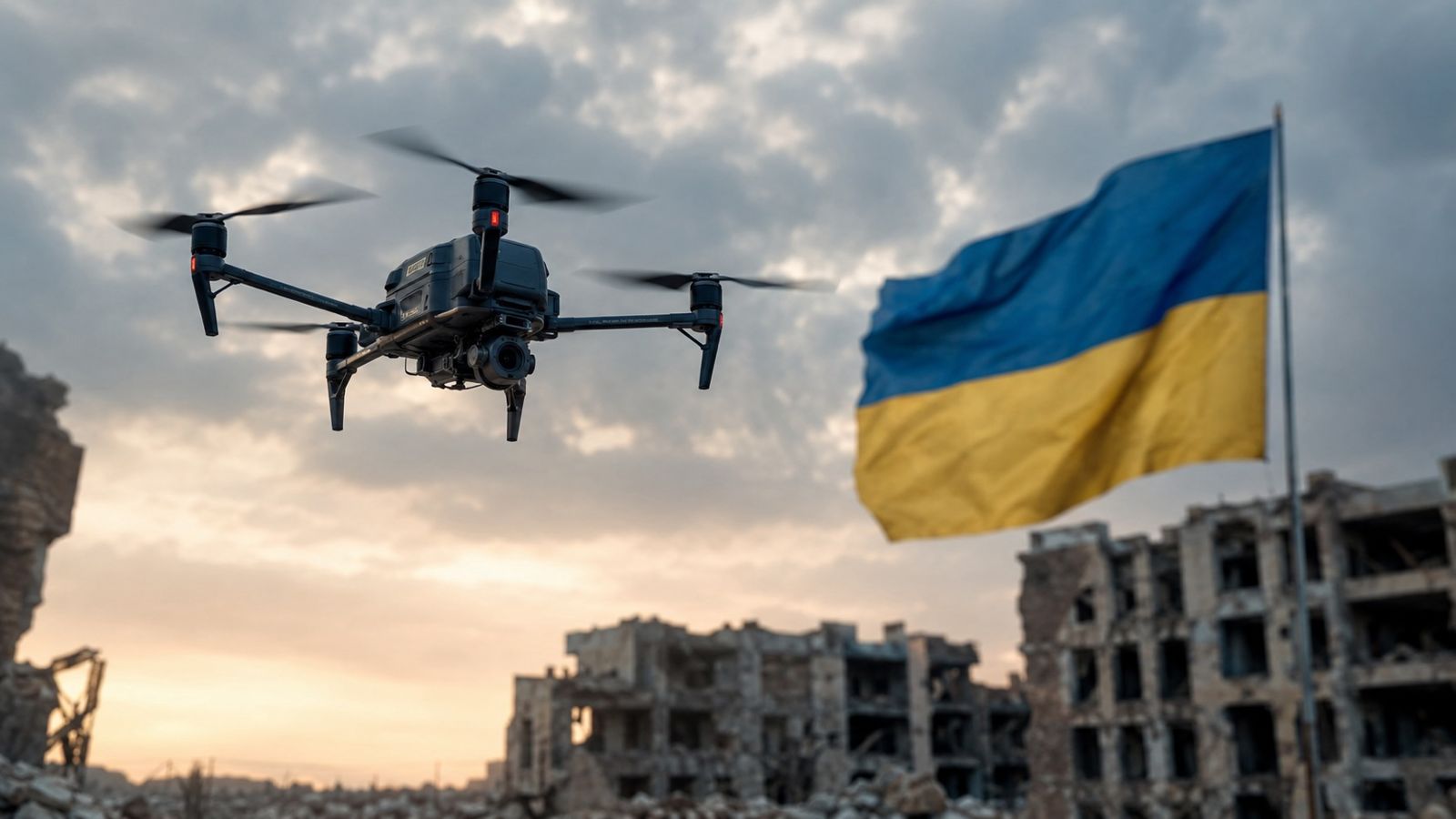
Antonio Prigiobbo is a designer and innovation journalist, a manager and a social investor. On Startupbusiness, he writes about innovation, ecosystems and design. (The image was created by the author using AI tools)
ALL RIGHTS RESERVED ©