Algorithmiq, a quantum software company, has chosen Milan as the location for its global headquarters, thereby confirming its confidence in Italy and Europe as a future centre of excellence for the industrialisation of quantum algorithms.
Algorithmiq focuses on building and scaling the algorithmic layer of quantum computing – the layer that can transform quantum computers into tools with practical applications. Algorithmiq’s decision to position itself at the heart of the Italian quantum ecosystem reflects a clear European commitment to the quantum software layer as the main area for future innovation in the sector.
Algorithmiq has raised €18 million in a funding round led by United Ventures and CDP Venture Capital, with Inventure VC continuing to participate. This round brings the total funding raised by Algorithmiq to €36 million and represents one of the most significant venture capital investments made in Italy in a quantum startup.
Milan will serve as the base from which Algorithmiq will expand its commercial activities as a software partner for the world’s leading quantum hardware manufacturers. From Italy, the company will draw on the vast pool of European scientific talent to strengthen its rapidly growing team, capitalising on the region’s increasing strategic focus on quantum technology.
The relocation of Algorithmiq’s global headquarters to Milan from Finland – where the company will continue to maintain a significant presence – reflects Italy’s thriving quantum technology ecosystem and the wider European effort to bridge the gap between deep-tech research and commercialisation.
The decision follows on from Italy’s National Quantum Strategy, launched in 2025, which aims to support the creation of a robust quantum infrastructure in Italy.
Access to national and pan-European capital dedicated to quantum computing, combined with the Italian government’s ambitious policy commitments, makes Milan a highly attractive strategic base for expansion into European and global markets.
From the ‘Panisperna Group’ led by Enrico Fermi to today’s research ecosystem – as the company notes – Italy has made a decisive contribution to laying the foundations of modern physics upon which the algorithms and applications that will drive the next phase of the quantum industry are based. As this sector matures, building ever more powerful machines remains essential, but it is no longer enough: without significant progress in algorithmic efficiency, quantum hardware risks proving impossible to commercialise, thereby nullifying its practical impact.
Rather than competing in the capital-intensive race for hardware, Algorithmiq focuses on building the algorithmic layer that transforms quantum computers into tools of industrial value.
Algorithmiq was recently named the sole winner of the $2 million prize in the Wellcome Leap Q4Bio Challenge, becoming the first company ever to demonstrate that end-to-end quantum-classical algorithms are capable of simulating complex therapies. This result charts a clear course towards commercially viable quantum computing and saw Algorithmiq emerge victorious over competitors of the calibre of Harvard University, Oxford University, Stanford University, the University of Nottingham and Infleqtion.
In 2025, Algorithmiq also became the first company in the world to achieve quantum advantage on a real-world scientific problem, using an in-house model on IBM quantum hardware. This milestone followed the launch of its first commercially available quantum product: a noise mitigation algorithm designed for both researchers and industry professionals, distributed via IBM’s Qiskit Functions catalogue.
The move to Milan and the latest round of funding follow a year of strong commercial performance during which Algorithmiq signed major agreements with Microsoft, IBM and Rigetti, confirming its position as a leader in quantum software for the world’s leading technology companies.
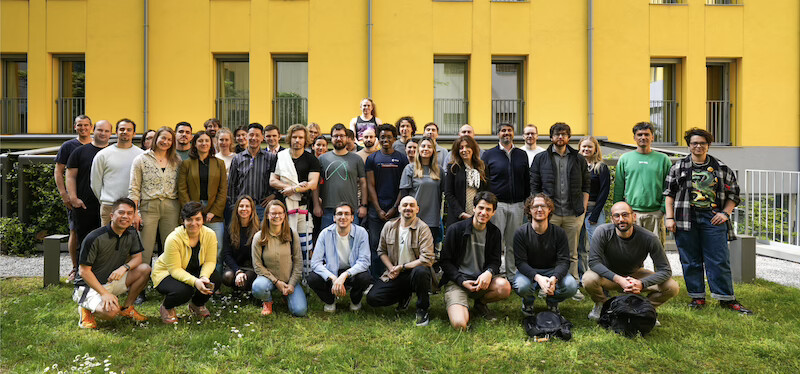
Sabrina Maniscalco, CEO and co-founder of Algorithmiq (pictured with the team), said in a statement: “2026 is the year when more practical quantum applications will become a reality, and we want to be at the heart of this change. This strategic move and the injection of capital give us the tools to expand and continue to serve and collaborate with the world’s leading quantum players. Our quantum software makes quantum computers practically useful, and we are proud to take this message global from our new headquarters in Milan. As quantum computing matures, the focus is shifting from who can build the most powerful machine to who can make them truly useful. This challenge lies at the intersection of science, software and industrial execution, and it is increasingly there that the real competitive advantage is played out.”
Jacopo Drudi, a partner at United Ventures, adds: “With quantum computing, Europe has the opportunity to set the pace rather than follow it. Italy has always been at the forefront of mathematics and physics, from Leonardo to Fermi to Marconi, and this legacy gives us a structural advantage in the coming technological revolution. Bringing an international team of excellence such as Algorithmiq to Milan is a victory not only for United Ventures, but for the country. We are building a continental tech giant, and for European quantum talent wishing to return home, Italy now offers a place where they can give their very best.”
Tommaso Calarco, author of the Quantum Manifesto that launched the European Commission’s Quantum Flagship – of which he is currently president – and of the Quantum Community Network (QCN), says: “It is particularly significant when a company’s trajectory sends a broader signal as to where innovation might emerge.” “This is what Europe needs: decisions that bring together scientific excellence, entrepreneurship and long-term industrial ambition. Italy is well placed to play a role in this context.”
ALL RIGHTS RESERVED ©