Table of contents
Sweden, Europe’s innovation hub: the start-up ecosystem that has taken the world by storm
Sweden is now recognised as one of the most vibrant startup ecosystems in the world. A country with just over ten million inhabitants has managed to produce an extraordinary number of technology companies of international significance, becoming a benchmark for governments, investors and entrepreneurs worldwide. From Spotify to Klarna, from King to iZettle, Sweden’s ability to nurture talent, attract capital and create value is no accident, but the result of a structured and forward-thinking system.
Investment figures: how much does Sweden invest in start-ups?
Sweden consistently ranks among the European countries with the highest ratio of investment in start-ups to per capita GDP. The Stockholm region is regarded by the European Commission as the most innovative in Europe, with the highest number of unicorns (41) per capita, second only to Silicon Valley.
The sectors in which we excel are deep tech, fintech, climate tech and life sciences.
The Swedish government provides structural support for innovation through dedicated public agencies. The most significant of these is Vinnova, the Swedish Innovation Agency, which has a budget of around 3.5 billion Swedish kronor (approximately 325 million euros, ed.) in 2025, supporting 3,452 innovative projects.
At the same time, Almi Invest, the financial arm of the state-owned Almi Group, operates as a venture capital fund with a strong presence in the early-stage segment, investing where risk is highest and the private market tends to be more cautious.
Private equity and venture capital: the Swedish capital market
The Swedish private equity and venture capital market is one of the most developed in Europe, both in terms of depth and the sophistication of its players. According to the Swedish Private Equity & Venture Capital Association (SVCA), Swedish PE and VC funds manage assets worth tens of billions of euros and maintain a significant pace of investment each year, both in the domestic and international markets.
Even during a period of rising interest rates and a slowdown in investment in the technology sector, Sweden has maintained levels of activity above the European average. Key market players include EQT, one of Europe’s largest private equity groups based in Stockholm, as well as Northzone, Creandum and Kinnevik, the latter being a listed investment holding company with a history stretching back over a century and a portfolio of stakes in some of the world’s best-known start-ups.
EQT deserves a special mention: founded in 1994 with the support of the Wallenberg family, it has played a key role in establishing a venture capital culture in Sweden, serving as a model and a talent incubator for the entire national ecosystem.
The ecosystem, structure and strengths
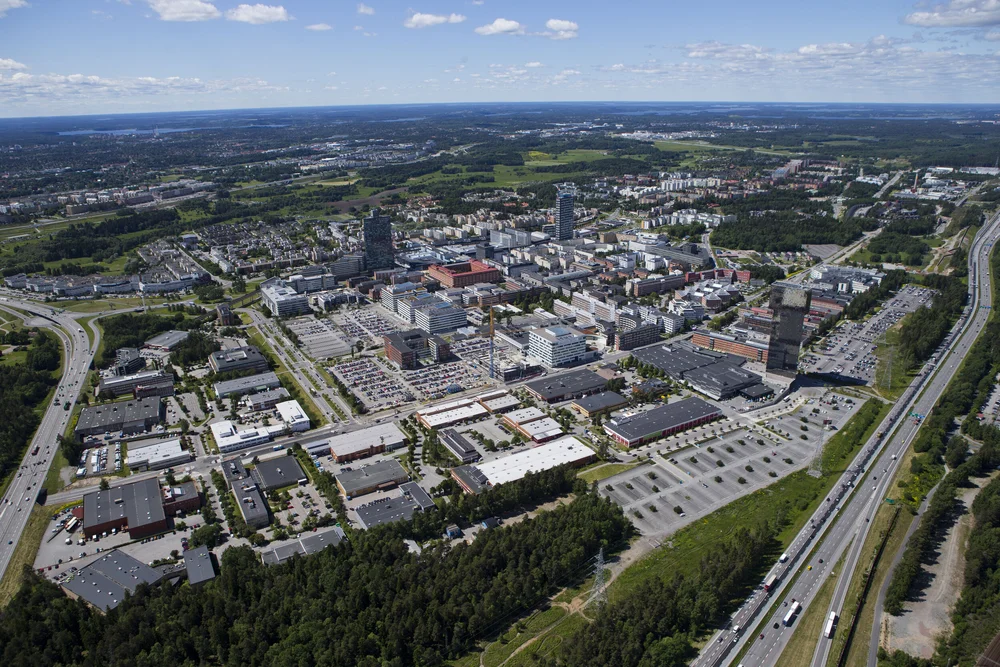
The Swedish start-up ecosystem has developed around a number of key pillars. The first is the quality of education: Swedish universities — in particular the KTH Royal Institute of Technology, Lund University and Chalmers University of Technology — produce thousands of highly qualified graduates in engineering, computer science and applied sciences every year. The integration between academia and industry is particularly strong, facilitating rapid and effective technology transfer. Sweden has been a pioneer in Europe in the creation of science parks. Kista Science City, focused on ICT, has transformed a (then unattractive) suburb north of Stockholm into a technology hub with over 60,000 employees in just a few years (the opening photo shows a view of the area).
The second pillar is a culture of innovation. Sweden boasts a deep-rooted entrepreneurial tradition, fuelled by a cultural tolerance for risk and a close-knit network of mentoring and support amongst entrepreneurs. So-called ‘serial entrepreneurs’ — people who have founded, scaled up and sold successful companies, only to reinvest their capital and experience in new ventures — are a common and respected figure within the ecosystem.
The third factor is pervasive digitalisation. Sweden is one of the most digitally advanced countries in the world, with an excellent broadband infrastructure, high uptake of digital payments, and a public sector that has embraced technological innovation since the early 2000s. This has created a domestic market conducive to the testing and validation of new business models, prior to subsequent international expansion.
The legal framework, legal certainty and institutional stability
One factor to consider when analysing Sweden’s success is the quality of its legal framework. Sweden consistently ranks among the top countries in international indices measuring the rule of law, institutional transparency and the fight against corruption. According to the World Justice Project Rule of Law Index, the country consistently ranks among the world’s top performers, with an efficient, independent and – above all – predictable judicial system.
For foreign investors, this represents a major competitive advantage: the certainty that contracts will be honoured or enforced without any surprises, that disputes will be resolved within a reasonable timeframe, and that the regulatory framework will remain stable over time significantly reduces perceived risk and encourages the inflow of international capital and access to finance for businesses.
On the tax front, Sweden has implemented significant reforms over the years to make its system more favourable to business activity. The corporate tax rate currently stands at 20.6%, a competitive level compared to the European average. There are also tax relief schemes for stock options granted to start-up employees — known as kvalificerade personaloptioner — designed to enable young companies to attract talent despite having limited financial resources, by deferring taxation until the options are actually exercised. Recent regulatory changes have further expanded the pool of start-ups and workers eligible for these benefits, signalling a clear political commitment to continue supporting the growth of the ecosystem.
Success stories
Typical of the Swedish ecosystem:
Spotify, founded in Stockholm in 2006 by Daniel Ek and Martin Lorentzon, has revolutionised the global music industry. Today, it has over 760 million active users worldwide, with a market capitalisation of nearly $100 billion. Its listing on the NYSE in 2018 via a direct listing represented an alternative and innovative model compared to a traditional IPO.
Klarna, founded in 2005, has become one of the world leaders in the digital payments sector and the ‘buy now, pay later’ model. It reached a valuation of $45.6 billion in 2021, holding the title of Europe’s most highly valued private fintech company for a period. After being affected by the tech sector crisis in 2022, it completed its listing process, officially going public on Wall Street in September 2025.
King, the software company behind Candy Crush Saga, was acquired by Activision Blizzard in 2016 for approximately $5.9 billion, in one of the biggest exits in the history of the European tech industry.
iZettle, a pioneer in mobile payments for small businesses, was acquired by PayPal in 2018 for $2.2 billion, demonstrating Sweden’s ability to develop scalable fintech solutions with global appeal.
Conclusions
Sweden represents a rare model of an ecosystem in which institutional quality, a culture of innovation, human capital and access to finance combine in a virtuous and self-reinforcing manner. For international investors and businesses seeking opportunities in a stable, transparent and growth-oriented market, the Swedish start-up ecosystem offers a privileged gateway to European innovation. The success of countless companies born in this environment is no accident: it is the result of a system that has consistently built, over time, the structural conditions to make innovative entrepreneurship a true national strategic asset. (photo taken from the VisitKista.com website)
Note to the reader: the author is a solicitor practising in Milan and Stockholm, and a partner at the law firm De Berti Jacchia
ALL RIGHTS RESERVED ©