
Table of contents
By Davide Viglialoro of Norwich Business School (University of East Anglia), Giuliano Sansone of University College Dublin, Elisa Ughetto and Paolo Landoni, both of the Polytechnic University of Turin.
Angel investing is usually described as a local and deeply personal activity. An entrepreneur or experienced professional meets a founder, assesses the opportunity, invests their own capital and then contributes advice, contacts and credibility.
This traditional image still captures what makes business angels valuable, but it no longer represents the entire market. Angel investing is becoming more collective, more organised and more digital. Investors are increasingly operating through groups, networks and platform-based structures, whilst online pitches, virtual due diligence and digital documentation have become an integral part of funding early-stage start-ups. This raises an important question: can angel investing expand across time and space without losing the human relationships and expertise that set it apart? Our study, published in the Journal of Technology Transfer, identifies an emerging answer: Business Angel Platforms, or BAPs.
Identifying a new organisational model
The main contribution of our research is to give this phenomenon a name and provide an organisational explanation for it. BAPs are not simply online versions of angel investor groups, nor are they more selective equity crowdfunding platforms.
They represent a distinct hybrid model. We define BAPs as “organisations that provide an integrated digital infrastructure for early-stage investment, connecting business angels to co-invest in start-ups and supporting the entire investment process through mechanisms structured and facilitated by the platform”. Doorway, the Italian platform at the heart of our case study, provides a concrete example of this model in practice. Compared to traditional angel investing, BAPs retain the selectivity, depth of relationships and ambition to provide ‘smart money’: capital accompanied by knowledge, advice and networks.
Through digital platforms, they embrace scalability, standardisation and the ability to coordinate participants who are not in the same place or available at the same time. The result is not simply ‘online angel investment’, but a governed infrastructure designed to combine reach, quality and trust.
What makes a business angel platform effective?
Our analysis identifies five key design elements. Firstly, BAPs organise collective angel investments via a digital platform, enabling start-ups to reach a wider and more coordinated community of selected investors. Secondly, they regulate access to the investor community through invitations, screening and onboarding, helping to create a credible and competent pool of investors for the businesses they support. Thirdly, they structure the entire investment process, from identifying opportunities and conducting due diligence to negotiation, presentation and execution, providing start-ups with a clearer and more organised pathway to raising capital. Fourthly, they support investors through training, peer learning, reporting and monitoring, helping them to remain informed and engaged, whilst fostering more continuous interaction with portfolio start-ups. Finally, they embed investment knowledge and experience into founders, teams, champions and repeatable processes, transforming individual expertise into a more replicable collective capability that benefits both investors and entrepreneurs. The value of a BAP therefore does not lie in any single digital feature, but in the way these elements work together as a system to support the coordination of investments, broaden start-ups’ access to funding and expertise, and preserve the relational support associated with angel investments.
The investment cycle is the product
The platform transforms a potentially fragmented process into a transparent and repeatable investment framework. It coordinates the identification of investment opportunities, selection, due diligence, negotiation and presentation to investors, before supporting the execution and post-investment monitoring. A champion, usually an experienced business angel, acts as a bridge between the co-investors and the start-up. The champion sits at the intersection of deal execution and venture capital continuity: their role helps to formalise the investment and then maintain the relationship even after the deal has been closed. The process, therefore, brings together three functions that are often separate: a high-quality pipeline, deal execution and venture capital continuity.
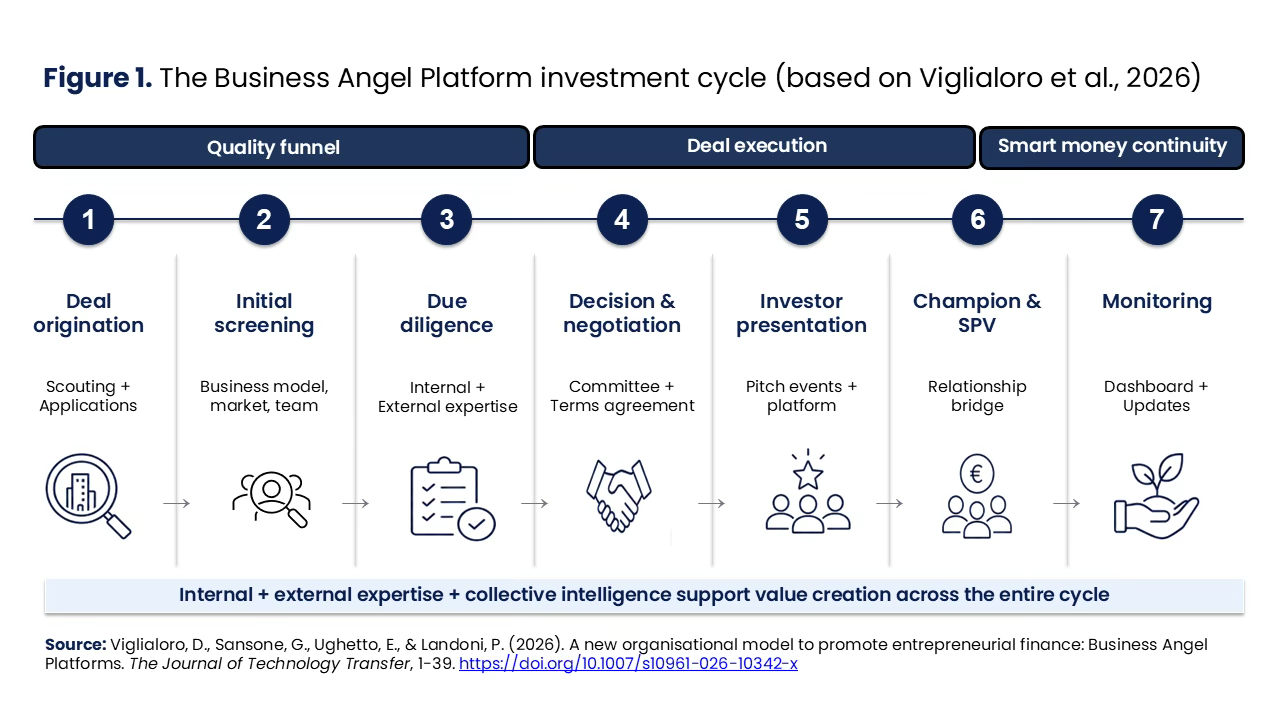
They are neither a group of angel investors nor an equity crowdfunding platform. Angel investor groups combine rigorous member selection with strong peer relationships, but often remain geographically concentrated and reliant on meetings and the voluntary involvement of members. Equity crowdfunding platforms achieve broad digital reach and standardised execution, but generally offer less stringent investor selection and less post-investment engagement. BAPs combine elements of both models without being categorised as either: selective access to investors, digital coordination and an ongoing level of relationship-building supported by the champion. Their distinctive promise is that of intelligent, scalable capital.
| Dimension | Angel groups | Business Angel Platforms | Equity crowdfunding |
| Core logic | Relationship and collective judgement | Relationship plus governed digital process | Digital marketplace and broad reach |
| Investor access | Selective, often through trust and referrals | Curated, screened and formally onboarded | Broad access subject to legal requirements |
| Post-investment | Champion and peer involvement | Champion, training, dashboard and monitoring | Usually limited investor engagement |
| Main source of trust | Repeated interaction | Governance, process and selected community | Regulation and disclosure |
Why is it important for the various stakeholders?
Our study identifies two roles that explain why BAPs are important within the entrepreneurial finance ecosystem. Firstly, they act as “facilitators and developers of angel investing”, reducing barriers relating to time, geography, knowledge and access to trusted co-investors. Secondly, they act as “intelligent orchestrators of platform-based cash flows”, structuring the way in which capital, expertise, monitoring and strategic support flow during and after the investment process.
1) For investors: less friction without compromising on quality
Access to traditional angel investing can be difficult. It requires time, access to credible opportunities, knowledge of early-stage valuation, and trusted co-investors. As facilitators and developers of angel investing, BAPs can reduce these barriers through a curated flow of opportunities, formal onboarding, training and peer learning. This is particularly valuable for investors with limited time, those gaining experience, and those looking beyond their immediate local network.
2) For start-ups: capital and organised expertise
For entrepreneurs, the appeal lies not only in access to funding. As a smart orchestrator of cash flows, enabled by a platform, a BAP can provide a structured pathway to selected investors and coordinate the flow of advice, monitoring and strategic support following the funding round. The champion offers founders a clear point of contact, whilst the wider investor community can contribute industry knowledge, networks and expertise.
3) For accelerators, incubators and venture capital funds: co-investment infrastructure
For accelerators, incubators and venture capital funds, BAPs can provide a select pool of investors, a structured pathway for co-investment and a structured process for taking investment-ready businesses from selection through to execution. This creates opportunities to build shared pipelines, combine different forms of capital and extend support beyond a single programme or local network.
4) For policy-makers: reducing regional tensions
For policymakers, BAPs can be seen as part of the investment infrastructure of an entrepreneurial ecosystem. Their potential significance is particularly strong in regions where there are promising start-ups, but where local angel capital and specialist expertise are limited. By digitally coordinating selected investors, BAPs can help private capital and expertise reach businesses outside the usual metropolitan centres. This does not eliminate the need for local ecosystems, but it can connect them to wider pools of funding and expertise.
Technology creates scale; governance ensures the prudent use of funds
The most important lesson from our study is not simply that angel investing has moved online. Digital tools alone do not build trust, guarantee quality or maintain investor engagement. BAPs become distinctive when three elements are designed together: technology expands reach, governance safeguards quality, and relational roles maintain engagement even after the deal is done. This combination offers a possible path to making angel investing more scalable and international without losing the human touch that lies at its heart. More broadly, the model offers new insights into how angel investing is transforming from a predominantly individual and local practice into a more collective, digitally coordinated and potentially cross-border form of investment. (photo by Damon Carr on Unsplash)
Bibliographic reference: Viglialoro, D., Sansone, G., Ughetto, E., & Landoni, P. (2026). A new organisational model to promote business financing: business angel platforms. The Journal of Technology Transfer, 1–39. https://doi.org/10.1007/s10961-026-10342-x
ALL RIGHTS RESERVED ©