The Sorrento Peninsula and the Amalfi Coast are among Italy’s most internationally recognised destinations. Yet their global appeal also gives rise to a well-known paradox: the abundance of experiences, services and providers can coexist with a fragmented hospitality offering, a lack of price transparency, and a visitor experience that is not always as personalised as it promises to be.
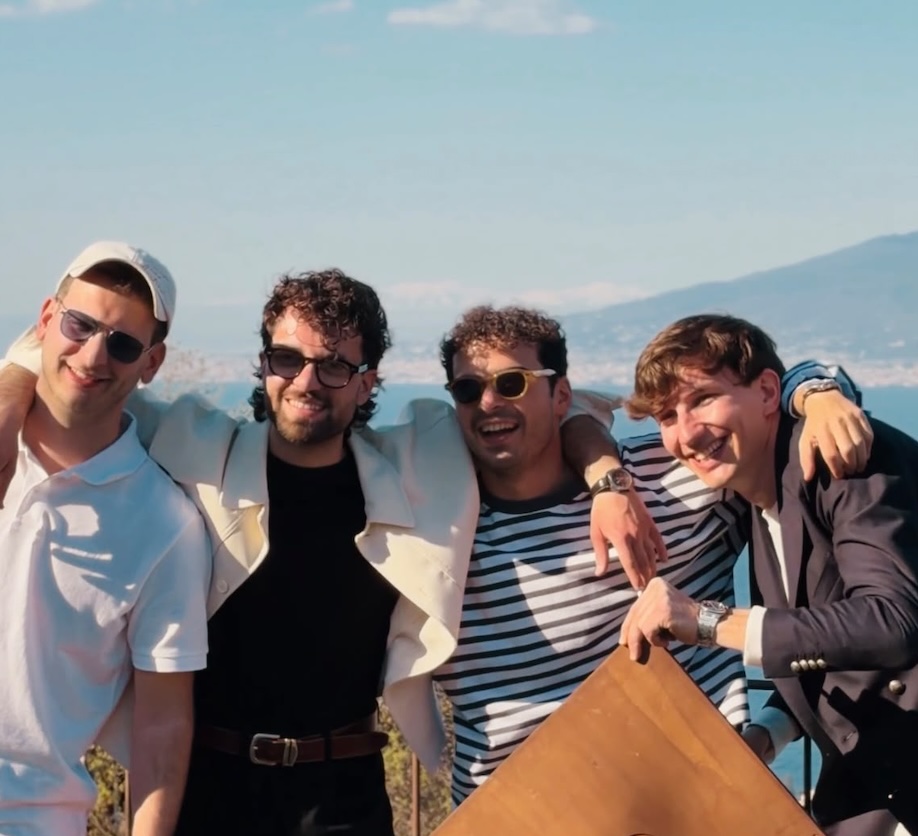
Vero Concierge was established in 2025 specifically to address this gap. The company, founded by Carlo Cannavale, Marvin Balsamo, Francesco Urbani and Pasquale Daddio (pictured), operates in the luxury lifestyle management sector, supporting international guests and local hospitality partners across the Sorrento Peninsula and the Amalfi Coast.
The project stems from the founders’ shared connection to Vico Equense, but was structured from the outset as a business with distinct and complementary roles. Cannavale is responsible for organisation, compliance and business processes; Balsamo manages operations and supplier relations; Urbani leads branding, marketing and communications; Daddio oversees business development and financial sustainability.
“The problem isn’t a lack of luxury services,” says Daddio. “What’s often missing is a genuine human connection. Many travellers are tired of off-the-shelf experiences that can be bought with just a few clicks. They’re looking for someone who really knows the area, whom they can trust and with whom they can chat as they would with a local friend.”
For the founders, this means prioritising the relationship over the transaction. Their clients are not simply looking for a yacht, a villa or a restaurant booking, but a point of contact who can understand their preferences, resolve any issues and tailor their stay to their expectations.
The company’s services range from private yacht charters to villa hire, from private chefs to luxury transfers, right through to cultural tours, wellness experiences and event organisation. However, Vero Concierge does not present itself as a catalogue of premium services.
“The difference lies in our independence and the genuine level of personalisation we can offer,” says Urbani. “We don’t work with fixed packages, and we don’t direct a guest towards a particular restaurant, villa or skipper simply because we have an exclusive agreement. We start with the individual, their needs and expectations, and then seek out the best possible solution.”
The approach is designed to transform a series of individual services into a coordinated experience. “The real product isn’t a single yacht charter or a villa booking,” adds Balsamo. “It’s the ability to link every element of the stay into a single, seamless flow, from the moment the guest arrives at the airport or station right through to the end of their trip.”
Alongside its direct relationship with end customers, Vero Concierge is developing a B2B channel aimed at property managers, villa owners and operators in the non-hotel accommodation sector. The aim is to become an operational extension of the hospitality brand, handling requests that would otherwise risk overburdening in-house teams or going unanswered.
The company’s main international market is currently the US, followed by guests from the United Arab Emirates, Canada and Europe. For partners in the hospitality sector, Vero Concierge offers a revenue-sharing model designed to make concierge services more manageable and, at the same time, more commercially viable.
“Many hospitality operators receive complex requests from guests, but do not have the time or the internal structure to handle them properly,” continues Daddio. “We can take care of this aspect of the experience, whilst helping the establishment to offer a stronger and more comprehensive service.”
This is where Vero Concierge builds its ‘start-up angle’ – the element that sets its offering and positioning apart and makes it stand out. The company does not position itself as a software platform and does not aim to replace human interaction with automation. Instead, it uses technology and internal processes to support the service behind the scenes.
The team has developed what it describes as a proprietary management system to track requests, coordinate partners, assign tasks and reduce operational errors. The customer experience is also framed by the ESCA.E method: exclusivity, serenity, culture, aromas, pleasure, elegance and simplicity.
“The point isn’t to standardise the end experience,” Urbani continues, “but to standardise the process that makes it possible. When workflows, quality controls and response times are organised properly, the team is free to focus on what cannot be automated: listening to the guest and creating something that feels truly personal.”
The network of local partners is another key asset. Vero Concierge works with producers, chefs, craftspeople, guides, skippers and other service providers, whose knowledge and connections give the service a deeply local flavour.
“We don’t see them as mere suppliers,” emphasises Balsamo. “They are an integral part of the experience. It is the people who know this area, its stories and its rhythms that enable us to offer something that cannot be replicated by a generic online platform.”
The company is also developing a second line of business focused on private events and proprietary formats. The first launch took place in April 2026 at a private villa, followed by ‘Grains’, an event organised on 1 June at Crapolla Abbey in Vico Equense. “Grains wasn’t simply a launch event,” explains Urbani. “It was a statement of intent. We want to create experiences that open up access to places, traditions and stories that are often overlooked, for both international visitors and local people.”
Built around the Uva di Sabato, a local grape variety, and set in a historic vineyard, Grains was fully booked, with all 100 places taken. The company plans to organise five in-house events by the end of 2026, using them both to strengthen the brand and to develop a further commercial vertical.
Over the next twelve months, the focus will remain on consolidating the local model: strengthening the supplier network, expanding B2B partnerships with property managers and luxury villas, developing new events and exploring the direct management of hospitality assets.
“Processes, technology and quality controls can be replicated,” Daddio continued, “but the local spirit of the service cannot simply be copied and pasted. Every destination would require relationships built on trust, cultural sensitivity and a deep understanding of the local area.”
ALL RIGHTS RESERVED ©